
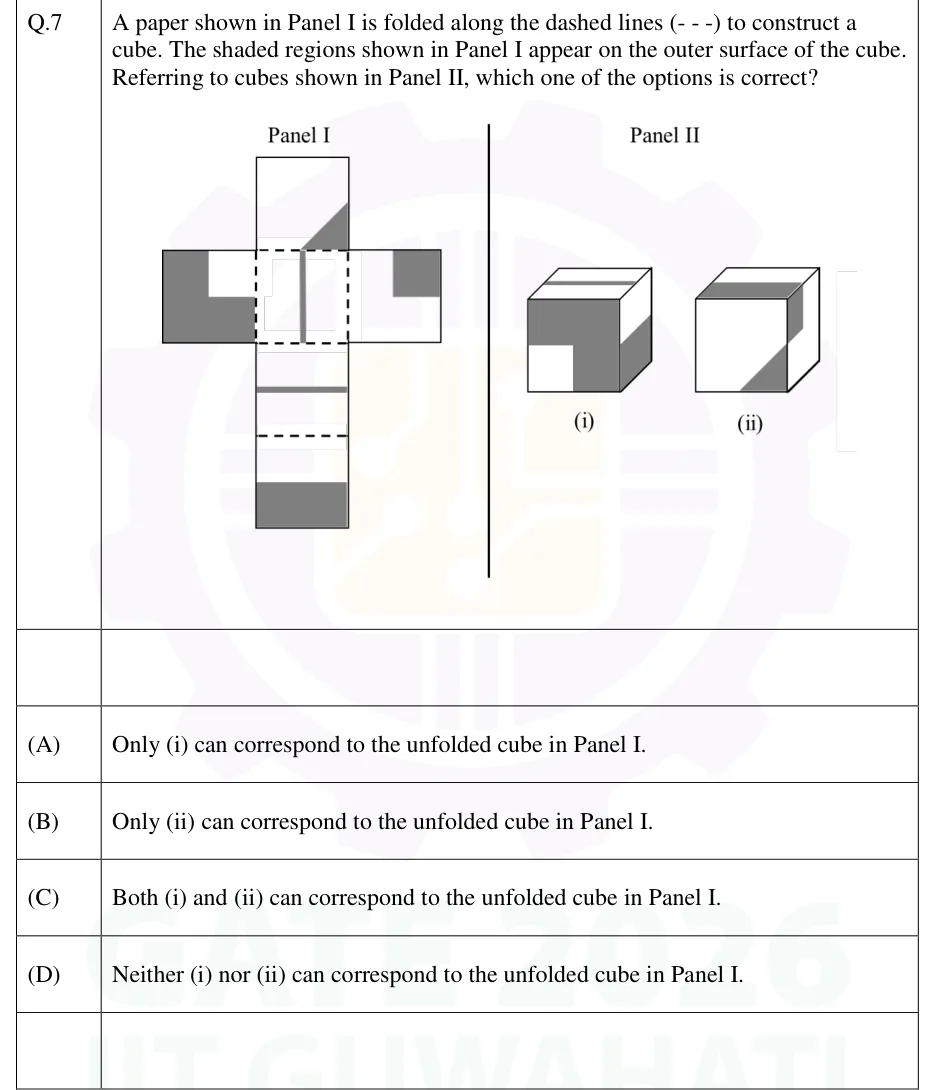
A paper shown in Panel I is folded along the dashed lines (- - -) to construct a cube. The shaded regions shown in Panel I appear on the outer surface of the cube. Referring to cubes shown in Panel II, which one of the options is correct?
 Tap to open full size
Figure description
A vertical line separates Panel I (left) from Panel II (right). Panel I is a cross-shaped net of six equal squares: a centre square with one square above it, one to its left, one to its right, and a column of two squares below it. All four edges of the centre square are dashed, and so is the edge between the two lower squares. Every other outline is solid. Shading (grey on white): - Top square: a grey right isosceles triangle in its bottom-right corner. Its legs are half the side, lying along the bottom edge (shared with the centre square) and along the right edge. - Left square: grey everywhere except a white quarter-square in its top-right corner, the corner that touches the centre square's top-left corner. The grey region is L-shaped (three quarters of the square). - Centre square: a thin grey vertical stripe down the middle, running the full height. - Right square: a grey quarter-square in its top-right corner (the outer top corner). - Square directly below the centre: a thin grey horizontal stripe across the middle, running the full width. - Bottom square: its lower half is grey. Panel II shows two cubes in oblique view. Each shows its front, top and right faces. (i) Front face: grey with a white quarter-square in its bottom-left corner. Right face: lower half grey, and the boundary is horizontal at mid-height (parallel to the face's top edge). Top face: white with a thin grey stripe at mid-depth, parallel to the front edge. (ii) Front face: white with a grey right isosceles triangle in its bottom-right corner (legs half the side, along the bottom and right edges). Top face: the front half, next to the front edge, is grey. Right face: a grey quarter-square in its top-front corner.
- (A)
Only (i) can correspond to the unfolded cube in Panel I.
- (B)
Only (ii) can correspond to the unfolded cube in Panel I.
- (C)
Both (i) and (ii) can correspond to the unfolded cube in Panel I.
- (D)
Neither (i) nor (ii) can correspond to the unfolded cube in Panel I.