
IAE Academy

GATE 2025 CS1 GA Q.9: solution and answer

GATE 2025 · CS1GA Q.9 · 2 marks · MCQ

A square paper, shown in figure (I), is folded along the dotted lines as shown in the figures (II) and (III). Then a few cuts are made as shown in figure (IV). Which one of the following patterns will be obtained when the paper is unfolded?

Note: The figures shown are representative.
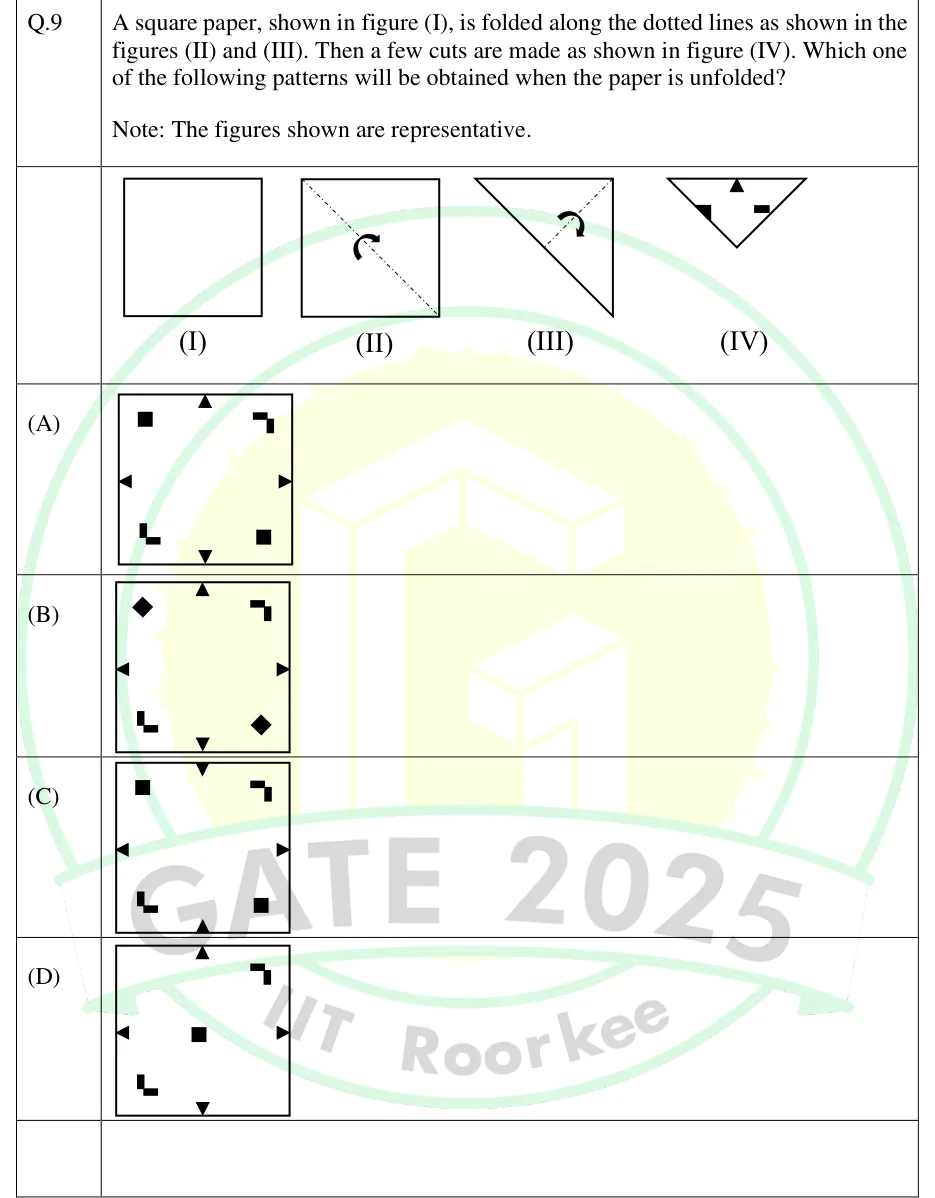
GATE 2025 CS1 GA question 9: Four small figures in a row.Tap to open full size
Figure from the GATE 2025 CS1 paper. It is part of the question.
Figure description

Four small figures in a row. (I) a plain empty square. (II) a square with a dashed diagonal from the top-left corner to the bottom-right corner and a curved arrow at the centre showing a fold along it. (III) the resulting right isosceles triangle with vertices at top-left, top-right and bottom-right (right angle at top-right); a dashed line runs from the top-right corner to the midpoint of the long diagonal edge, with a curved arrow showing a second fold along it. (IV) the folded triangle with its long edge horizontal at the top and its right-angle vertex pointing down; three black cut-outs: a small upward-pointing triangle at the middle of the top (long) edge, a small square-like notch on the left slanting edge near its middle, and a small horizontal bar on the right slanting edge near its middle. Each option is a square with small black triangles at the midpoints of its sides, plus other cut-outs near the corners. (A) triangles at all four side midpoints pointing outward (up at top, left at left, right at right, down at bottom); squares at top-left and bottom-right corners; L-shaped cuts at top-right and bottom-left corners. (B) the same four outward triangles and the same L-shaped cuts at top-right and bottom-left, but diamonds (tilted squares) at top-left and bottom-right. (C) squares at top-left and bottom-right, L-shapes at top-right and bottom-left; triangles at top (pointing down), left (pointing left) and bottom (pointing up) midpoints, none at the right. (D) triangles at top, right and bottom midpoints but none at the left; a square at the centre; an L-shape at top-right and one at bottom-left; no corner squares.

  1. (A)

    Figure: square with four outward-pointing triangles at the side midpoints, squares at top-left and bottom-right corners, L-shaped cuts at top-right and bottom-left corners

  2. (B)

    Figure: square with four outward-pointing triangles at the side midpoints, diamonds at top-left and bottom-right corners, L-shaped cuts at top-right and bottom-left corners

  3. (C)

    Figure: square with squares at top-left and bottom-right corners, L-shaped cuts at top-right and bottom-left corners, triangles at the top (pointing down), left (pointing left) and bottom (pointing up) midpoints, and none at the right

  4. (D)

    Figure: square with triangles at top, right and bottom midpoints (none at left), a square at the centre, L-shaped cuts at top-right and bottom-left corners

Answer and solution

ANSWER

The unfolded paper is pattern (A).

Official answer: ASource: Official answer key, GATE 2025 CS1 (IIT Roorkee)

  1. Track the folds. Call the square's corners TL, TR, BR, BL and its centre O. The first fold is along the diagonal TL-BR, which gives the triangle TL-TR-BR of figure (III). The second fold is along the line from TR to O, the midpoint of the long edge. Folding the part near BR back over the part near TL gives the triangle of figure (IV): long edge TL-TR (the top side of the square), right-angle vertex O pointing down. The paper now has 4 layers, and both creases lie along the diagonals of the square.

  2. Locate the cuts in figure (IV). The left slanting edge, from TL to O, is the first crease, which is half of the diagonal TL-BR. The right slanting edge, from TR to O, is the second crease, which is half of the diagonal TR-BL. The triangle cut is on the long edge, the bar cut is on the right (TR-O) crease, and the square-like notch is on the left (TL-O) crease.

  3. Triangle at the middle of the long edge. This cut is at the midpoint of the top side, pointing outward from the paper. The four layers of this edge are the four sides of the square, because the two diagonals are the mirror lines that carry one side onto the next. Unfolding therefore puts the same cut at the midpoint of every side, each pointing outward: up at the top, left at the left, right at the right, down at the bottom. This rules out C, whose top and bottom triangles point inward and which has no right triangle. It also rules out D, which has no left triangle and has a centre cut that nothing in figure (IV) produces.

  4. Bar on the right crease (diagonal TR-BL). The bar lies horizontally with one end on the crease. Unfolding along the crease adds its mirror image across the diagonal TR-BL, which is a vertical bar meeting the first at the crease. Together they form an L-shaped cut with its corner on the diagonal, at about the middle of the half-diagonal from O to TR. The other fold repeats this across the diagonal TL-BR, so the same L appears at BL. L-shaped cuts therefore appear at the top-right and bottom-left corners, as in all four options.

  5. Square-like notch on the left crease (diagonal TL-BR). The notch is half of an upright square. Its flat slanted side lies on the crease, so unfolding across the diagonal TL-BR completes the square, with its sides parallel to the sides of the paper. The other fold repeats it on the opposite end of that diagonal. Upright squares therefore appear at the top-left and bottom-right corners. This rules out B, whose cuts there are tilted diamonds.

  6. Conclusion. Only A has outward triangles at all four midpoints, upright squares at top-left and bottom-right, and L-shaped cuts at top-right and bottom-left. The answer is (A).

KEY IDEA

Each fold line is a mirror line, so every cut is reflected across the creases when the paper is unfolded. Both creases here are the square's diagonals, so each cut is repeated in a symmetric pattern around the square. A cut on the open edge appears on every side. A cut on a crease joins with its mirror image to make a full shape.

WATCH OUT FOR

Mixing up which slanting edge of the folded triangle is which crease, or treating a half-cut on a crease as a full cut. A bar with one end on a crease joins its mirror image to make an L, not a square. Also, a cut on an outer edge must be repeated on all four sides, pointing the same way (outward) each time.

From the GATE 2025 CS1 paper. Every question of this paper · Download the full paper · All 48 Spatial questions, with notes

More Spatial questions