
IAE Academy

GATE 2026 EE GA Q.5: solution and answer

GATE 2026 · EEGA Q.5 · 1 mark · MCQ

Which one of the following figures P, Q, R, or S, correctly shows the 45° clockwise-rotated version of figure (I)?
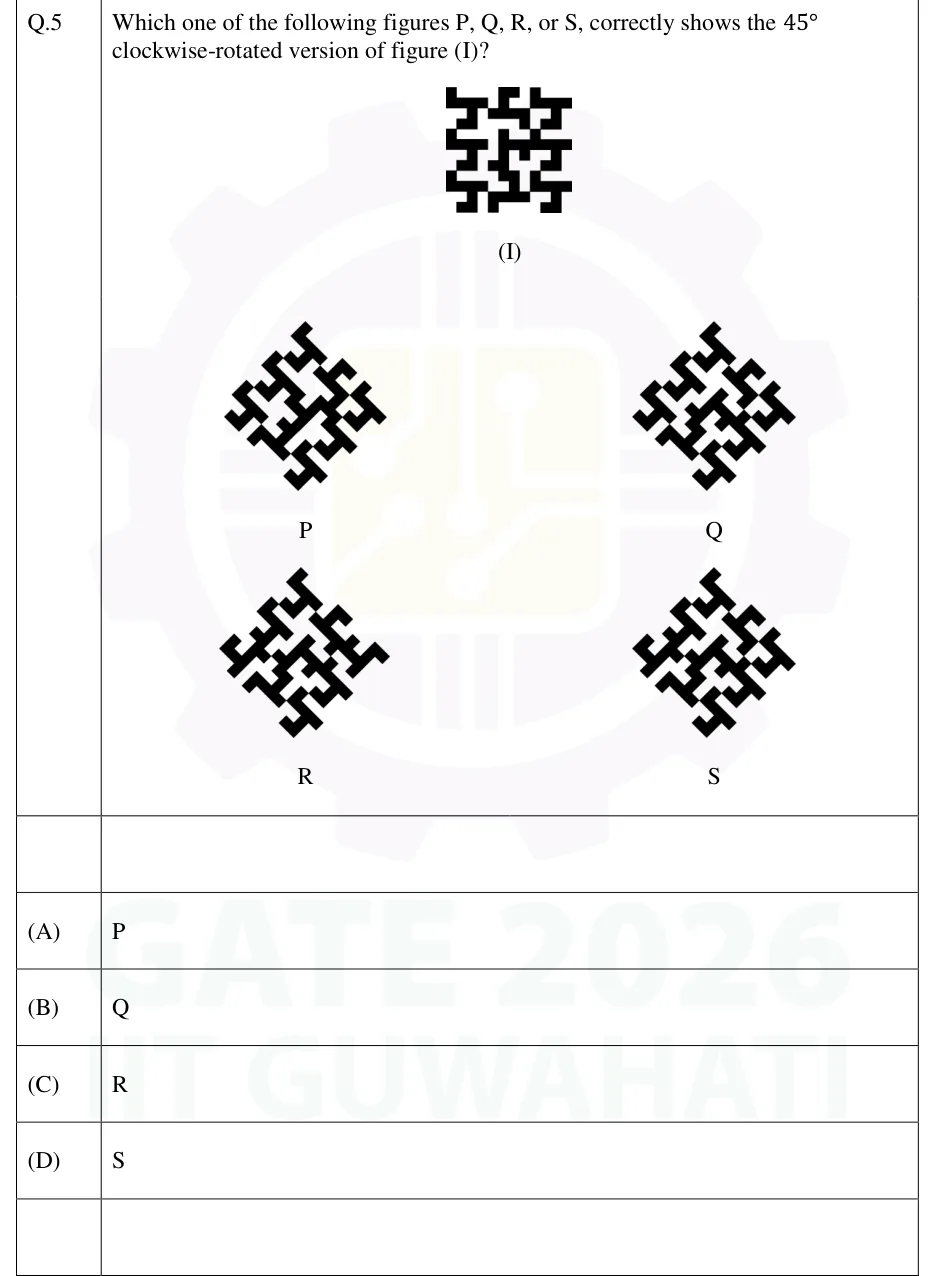
GATE 2026 EE GA question 5: Figure (I), at the top centre, is an upright square pattern of solid black unit squares on a 12 x 12 grid.Tap to open full size
Figure from the GATE 2026 EE paper. It is part of the question.
Figure description

Figure (I), at the top centre, is an upright square pattern of solid black unit squares on a 12 x 12 grid. Rows from top to bottom, columns from left to right, '#' = black and '.' = white: row 1 #....##.#...; row 2 ####.#..####; row 3..#.####..#.; row 4.##....#.##.; row 5 #....#..#...; row 6 ####.#######; row 7..#..#.#..#.; row 8.##.##...##.; row 9 #....##.#...; row 10 ####..#.####; row 11..#.####..#.; row 12.##.#....##.. It reads as a 3 x 3 array of 4 x 4 hook motifs. The basic hook is a bar of four squares with one square raised above its left end, and a stem that drops from its third square and turns left. All four corner hooks are identical and face the same way. The top-middle hook is turned through 180 degrees, the bottom-middle hook is mirrored top-to-bottom, and the central hook is turned 90 degrees anticlockwise. The central hook joins the right-middle and bottom-middle hooks into one 24-square piece. Below (I) are four diamond-shaped figures in a 2 x 2 arrangement: P top-left, Q top-right, R bottom-left, S bottom-right. Each is the same kind of pattern tilted 45 degrees so that a corner points straight up. Compared with (I) rotated 45 degrees clockwise: Q matches square for square. In P the central 4 x 4 block (rows 5-8, columns 5-8) is turned 180 degrees, reading..##/#.#./###./..#. instead of.#../.###/.#.#/##... In R the top-right and bottom-left corner hooks (now at the right and left vertices) are each turned an extra 90 degrees clockwise, each reading..##/#.#./###./..#.. In S only the bottom-left corner hook (now at the left vertex) is turned an extra 90 degrees clockwise. Options: (A) P, (B) Q, (C) R, (D) S.

  1. (A)

    P

  2. (B)

    Q

  3. (C)

    R

  4. (D)

    S

Answer and solution

ANSWER

Q is the 45° clockwise rotation of figure (I). The answer is option (B).

Official answer: BSource: Official answer key, GATE 2026 EE (IIT Guwahati)

  1. Read (I) as a grid made of nine blocks. Each block holds the same hook motif: a bar of four squares, one square raised above its left end, and a stem that drops from the third square and turns left. The four corner blocks and the left-middle and right-middle blocks all hold identical copies facing the same way. The top-middle copy is turned through , the bottom-middle copy is flipped top-to-bottom, and the centre copy is turned anticlockwise. The centre hook touches the right-middle and bottom-middle hooks, so those three form one 24-square piece. The top-middle and left-middle hooks stand apart.

  2. The rule for a rigid rotation is that every part turns through the same angle and keeps its place relative to the others. Nothing is reflected and no single motif turns on its own. Pieces that touch in (I) must still touch, and pieces that are separate must stay separate.

  3. Under a clockwise turn the square becomes a diamond. The top-left corner goes to the top vertex, top-right to the right vertex, bottom-right to the bottom vertex and bottom-left to the left vertex.

  4. The four corner hooks of (I) are identical and face the same way. So the four vertex hooks of the correct diamond must also be identical copies facing the same way relative to the diamond. Check the vertices first.

  5. R: the hooks at the right and left vertices (from the top-right and bottom-left corners of (I)) are each turned an extra clockwise compared with the hooks at the top and bottom vertices. That is not a rigid rotation, so reject R.

  6. S: only the left-vertex hook (from the bottom-left corner of (I)) is turned an extra clockwise. The other three vertices match, so S is a near miss. Reject S.

  7. P: all four vertex hooks are correct, but the central motif is turned through from where it should be. Turned that way it touches all four middle hooks and makes one 40-square piece. In (I) the centre joins only the right-middle and bottom-middle hooks. Reject P.

  8. Q: turning Q back through anticlockwise gives (I) square for square. Every motif, the centre included, is where a clockwise turn of (I) puts it. Answer: Q, option (B).

KEY IDEA

A rotation is rigid: every motif turns through the same angle and keeps its place and its contacts with its neighbours. Each option differs from the true rotation in just one or two motifs. Check the four vertex hooks first, since they come from four identical corner hooks and must all look alike. Then check the centre, and the one option with no odd motif is the answer.

WATCH OUT FOR

Stopping once the outline and the four vertices look right. P passes that check and differs from Q only in its central motif, which is turned 180°, so a quick comparison picks P. The centre has to be checked too, for example by seeing which hooks it touches.

From the GATE 2026 EE paper. Every question of this paper · Download the full paper · All 23 Spatial questions, with notes

More Spatial questions