
IAE Academy

GATE 2026 EE GA Q.2: solution and answer

GATE 2026 · EEGA Q.2 · 1 mark · MCQ

The figure below is supposed to show three non-overlapping shapes – one oval and two triangles. Which one of the following figures P, Q, R, or S fits the missing portion indicated by ‘?’ and completes the oval and the two triangles?
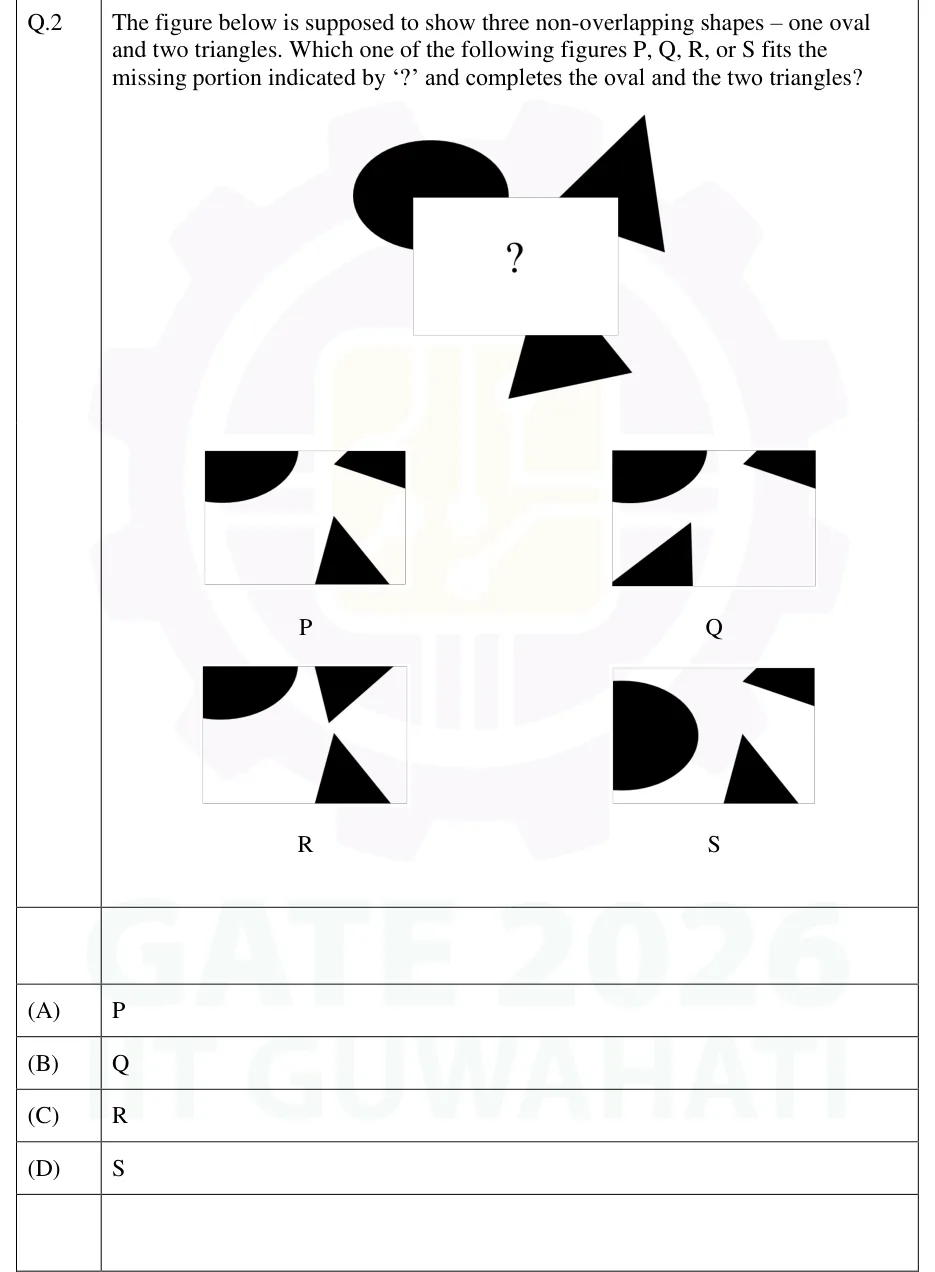
GATE 2026 EE GA question 2: Main figure: a white rectangular box marked '?' in the centre, about 1.5 times as wide as it is tall, hides parts of…Tap to open full size
Figure from the GATE 2026 EE paper. It is part of the question.
Figure description

Main figure: a white rectangular box marked '?' in the centre, about 1.5 times as wide as it is tall, hides parts of three solid black shapes. (1) Oval, upper left: a horizontal black ellipse. Its left part shows to the left of the box and its top pokes above the box's top edge. Its outline meets the box's top edge about 46% of the way across from the left, and the box's left edge about 37% of the way down, so the box hides the oval's lower-right part. (2) Triangle, upper right: a tall black triangle whose apex is above the box, a little higher than the top of the oval. Its long left side runs down-left and enters the box's top edge about 71% of the way across. Its right side runs almost straight down to a vertex to the right of the box, level with the bottom of the oval. From that vertex its lower side runs up-left and enters the box's right edge about 28% of the way down. So the triangle's third vertex is hidden inside the box near its top-right corner. (3) Triangle, lower middle: a black triangle below the box. Its bottom-left vertex points down-left and its right vertex points right. Its other two sides rise into the box's bottom edge, crossing it about 55% and 92% of the way across, so its upper vertex is hidden inside the box. Options P, Q, R and S are four rectangles the same shape as the box, each holding black pieces. P: a quarter-oval in the top-left corner (along the top edge to about 46% across, down the left edge to about 38%); a four-sided piece in the top-right corner (along the top edge from about 71% across to the corner, down the right edge to about 28%, with a pointed vertex at about 65% across and 10% down); a triangle standing on the bottom edge (base from about 55% to 91% across, apex at about 64% across and halfway down). Q: the same top-left quarter-oval and top-right piece as P, but its triangle sits at the bottom-left: its base runs along the bottom edge from the left corner to about 39% across, its right side is nearly vertical, and its apex is at about 38% across and 54% down. R: the same top-left quarter-oval and bottom triangle as P, but the top-right piece is an inverted triangle hanging from the top edge (from about 55% to 92% across) with its point at about 62% across and 41% down; it does not touch the right edge. S: a large half-oval (D shape) on the left edge, running from about 11% to about 90% down and bulging to about 42% across, so it does not touch the top edge; a top-right piece like P's; and a bottom triangle like P's.

  1. (A)

    P

  2. (B)

    Q

  3. (C)

    R

  4. (D)

    S

Answer and solution

ANSWER

(A) P. It is the only option whose three pieces meet every point where the oval and the two triangles cross the edge of the box, and whose straight edges continue the triangles' visible sides to the hidden vertices.

Official answer: ASource: Official answer key, GATE 2026 EE (IIT Guwahati)

  1. Continuity rule. A piece fits only if its black regions meet the box's border exactly where the visible shapes cross into the box. Its straight edges must also carry on the visible sides as straight lines until they meet inside the box.

  2. Oval (top-left of the box). The oval crosses the top edge at about 46% of the width and the left edge at about 37% of the height. So the box must hold a quarter-oval in its top-left corner that covers the top edge from 0 to 46% and the left edge from 0 to 37%. S fails. Its top edge is white on the left, where the oval crosses. Its D-shaped piece also runs down the left edge from about 11% to about 90%, where there is only white outside the box.

  3. Upper triangle (top-right of the box). The visible left side enters the top edge at about 71% of the width, and the visible lower side enters the right edge at about 28% of the height. Carried on into the box, these two straight lines meet at about 64% across and 10% down. That point is the hidden vertex. So the missing piece is a thin four-sided sliver: along the top edge from 71% to the corner, down the right edge to 28%, and ending in a point that aims left. R fails. Its top-right piece hangs from the top edge between about 55% and 92% and never reaches the right edge. That leaves the part of the triangle outside the box on the right with nothing to join, and it puts black on the top edge between 55% and 71%, where the region above is white.

  4. Lower triangle (bottom of the box). Its two sides enter the bottom edge at about 55% and 92% of the width, so the missing triangle's base must span that stretch. Carried upward, the two sides meet at about 64% across and halfway up the box, which is the hidden apex. Q fails. Its bottom triangle stands between 0% and about 39% of the bottom edge, where the visible triangle has no edges to join.

  5. Check P. Quarter-oval: about 46% along the top edge and 38% down the left edge, which matches 46% and 37%. Top-right sliver: from about 71% along the top edge, down to about 28% on the right edge, with its point at about 65% across and 10% down. That matches the crossings and the hidden vertex at 64%, 10%. Bottom triangle: base from about 55% to 91%, apex at about 64% across and halfway down, which matches. The three pieces do not touch, so the oval and the two triangles stay separate, as the question requires.

  6. Only P completes the oval and both triangles. The answer is (A) P.

KEY IDEA

Treat the '?' box's border as a set of checkpoints. First mark every point where a visible shape crosses into the box. Then carry each visible straight side on into the box until it meets its partner: that meeting point is the hidden vertex. The correct option must have black on the border exactly at those crossings and must put its vertices at those points. Test one shape at a time, and drop an option as soon as one checkpoint fails.

WATCH OUT FOR

Judging the options by overall look instead of by where they touch the border. R's top-right piece looks like a triangle tip, but it never reaches the box's right edge, so the triangle stays broken. S's large D shape looks like 'more oval', but the oval only crosses the left edge down to 37% and crosses the top edge, which S leaves white. Q copies the correct lower triangle but puts it on the wrong side.

From the GATE 2026 EE paper. Every question of this paper · Download the full paper · All 23 Spatial questions, with notes

More Spatial questions