
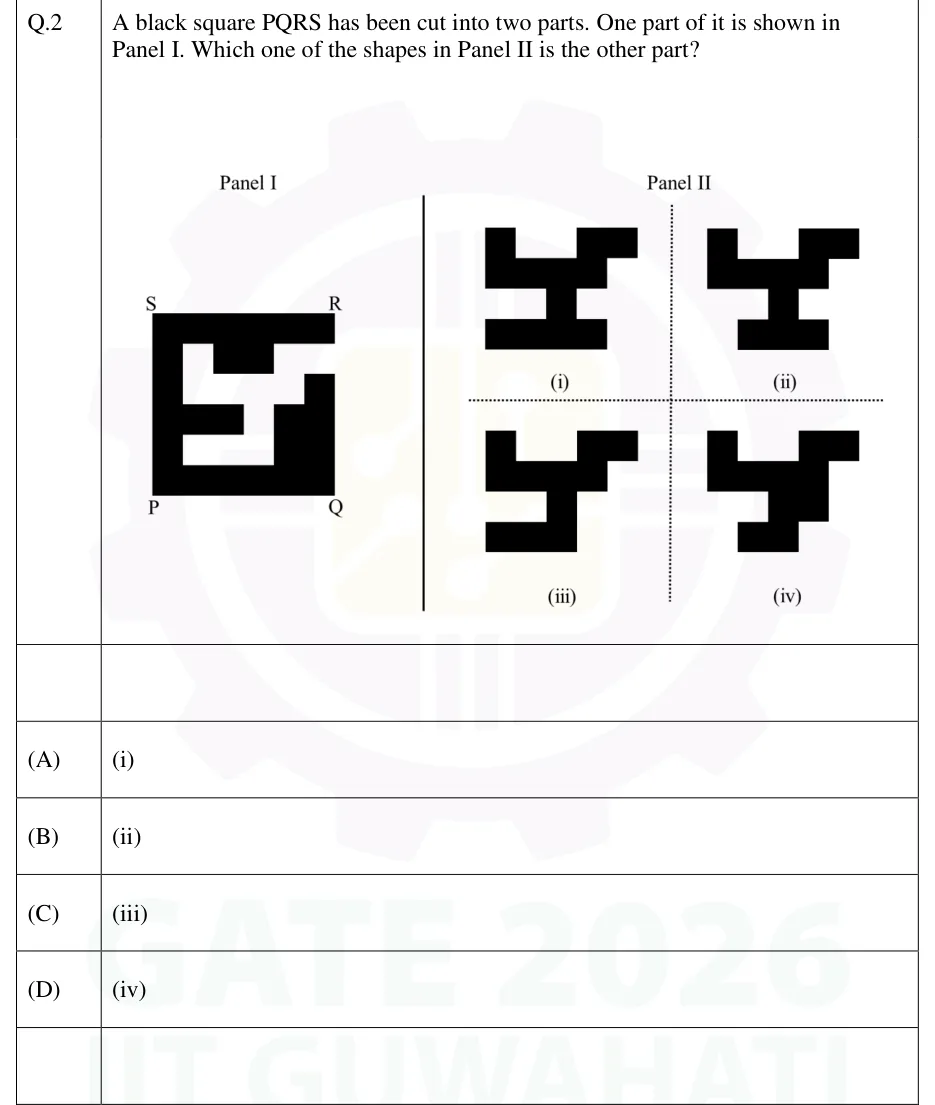
A black square PQRS has been cut into two parts. One part of it is shown in Panel I. Which one of the shapes in Panel II is the other part?
 Tap to open full size
Figure description
Panel I: the black part, drawn inside the outline of square PQRS (S top-left, R top-right, P bottom-left, Q bottom-right) on a 6 by 6 grid. Rows and columns are counted from the top-left corner. Black cells: all of row 1; all of row 6; all of column 1; columns 3-4 of row 2, a block hanging from the top row; columns 2-3 of row 4, a tab from the left column; column 6 from row 3 down; and column 5 from row 4 down, so the right-hand black part steps outward. The white cells are the cut-out channel: row 2, columns 2, 5 and 6; row 3, columns 2-5; row 4, column 4; row 5, columns 2-4. That is 11 cells, and the channel touches the outline at row 2, column 6. Panel II: four black polyominoes. (i) and (ii) are mirror images of each other. Each has a top part with a short arm and a longer bar, a one-cell stem, and a bottom bar that runs out on both sides of the stem. (iii) and (iv) are Y-like, with a wide top, a one-cell stem and a short foot that runs to the lower left. In (iii) the top-right bar sticks out over a step, so the right edge is one cell tall. In (iv) the right-hand part goes two rows deep at the right edge.
- (A)
(i)
- (B)
(ii)
- (C)
(iii)
- (D)
(iv)