
IAE Academy

GATE 2026 CS1 GA Q.2: solution and answer

GATE 2026 · CS1GA Q.2 · 1 mark · MCQ

The figure shows two 4-tile patterns.

Either one or both of the patterns can be used any number of times and in any orientation to construct a new pattern. Which one of the options below cannot be constructed by using only these two 4-tile patterns assuming there are no overlaps among them?
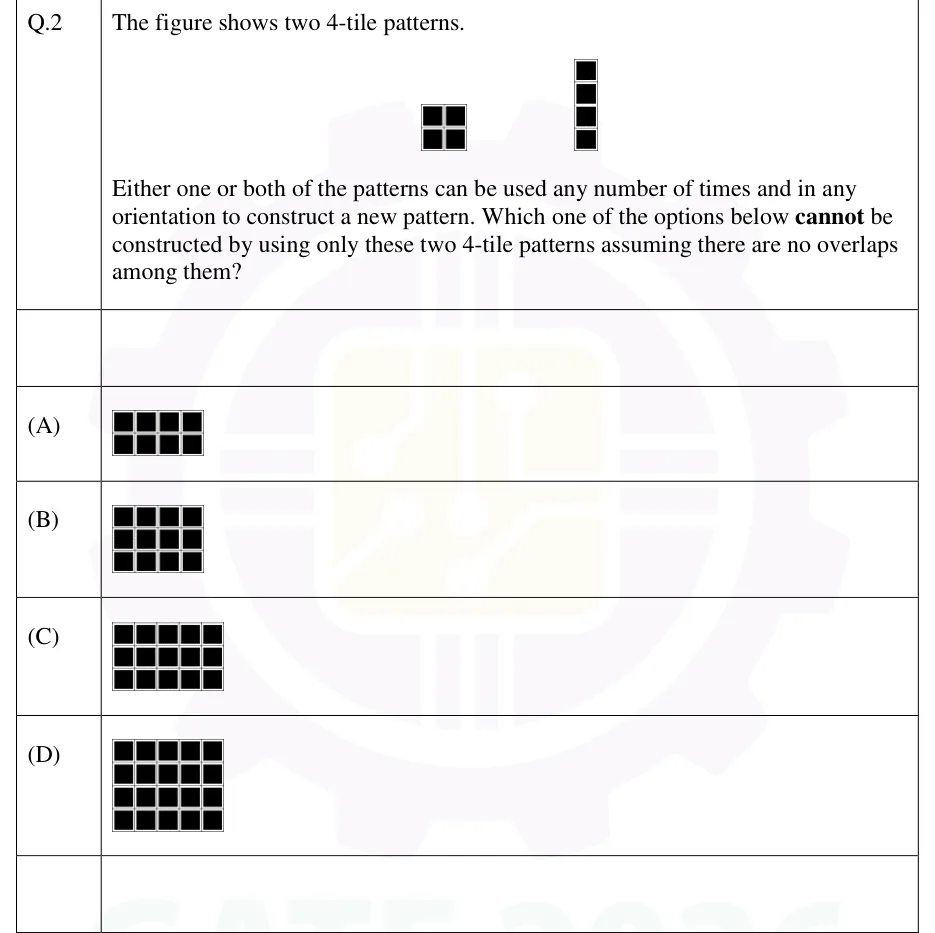
GATE 2026 CS1 GA question 2: Two black-tile patterns side by side, each tile a unit square.Tap to open full size
Figure from the GATE 2026 CS1 paper. It is part of the question.
Figure description

Two black-tile patterns side by side, each tile a unit square. Left: a 2 x 2 block of 4 black tiles. Right: a vertical strip of 4 black tiles (1 wide, 4 tall). Each option is a solid rectangle of black tiles: (A) 2 rows x 4 columns (8 tiles); (B) 3 rows x 4 columns (12 tiles); (C) 3 rows x 5 columns (15 tiles); (D) 4 rows x 5 columns (20 tiles).

  1. (A)

    Figure: solid rectangle of black tiles, 2 rows by 4 columns (8 tiles)

  2. (B)

    Figure: solid rectangle of black tiles, 3 rows by 4 columns (12 tiles)

  3. (C)

    Figure: solid rectangle of black tiles, 3 rows by 5 columns (15 tiles)

  4. (D)

    Figure: solid rectangle of black tiles, 4 rows by 5 columns (20 tiles)

Answer and solution

ANSWER

Option (C), the rectangle, cannot be constructed.

Official answer: CSource: Official answer key, GATE 2026 CS1 (IIT Guwahati)

  1. Both building patterns, the square and the strip, contain exactly 4 tiles. With no overlaps, any pattern built from them has a number of tiles that is a multiple of 4.

  2. Count the tiles in each option: (A) , (B) , (C) , (D) .

  3. is not a multiple of , so option (C) cannot be built from these patterns.

  4. Check the others by construction. (A) Two squares side by side fill the rectangle.

  5. (B) Three strips, each turned to lie horizontally, stacked one above another fill the rectangle.

  6. (D) Five vertical strips placed side by side fill the rectangle.

  7. Hence only (C) is impossible.

KEY IDEA

Every building piece has 4 tiles, so any pattern made from them has a tile count that is a multiple of 4. Count the tiles in each option first, then confirm the others by tiling.

WATCH OUT FOR

Trying to tile all four options by hand without counting first, or forgetting that the pieces may be rotated. The strip can lie horizontally, which is what makes the 3-row rectangle in (B) possible.

From the GATE 2026 CS1 paper. Every question of this paper · Download the full paper · All 48 Spatial questions, with notes

More Spatial questions