
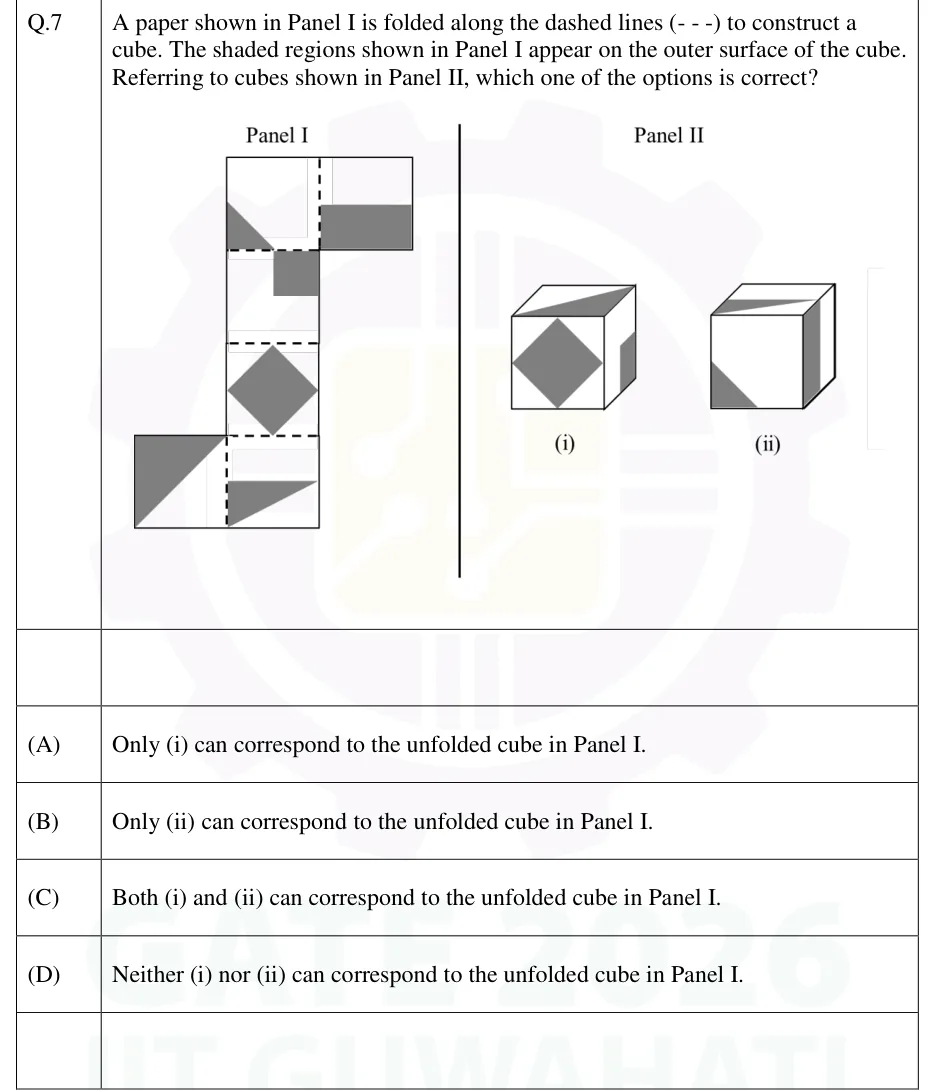
A paper shown in Panel I is folded along the dashed lines (- - -) to construct a cube. The shaded regions shown in Panel I appear on the outer surface of the cube. Referring to cubes shown in Panel II, which one of the options is correct?
 Tap to open full size
Figure description
Panel I (left): a cube net made of a vertical column of four squares (call them S1 top, S2, S3, S4 bottom) with dashed fold lines between them. S1 has a small shaded right triangle in its bottom-left corner (legs about half the side). A square S5 is attached to the right of S1 with a shaded rectangular band covering the lower half of S5 (full width). S2 has a small shaded square (quarter of the face) at its top-right corner. S3 has a large shaded diamond (square rotated 45 degrees) centred in the face. S4 has a shaded triangle at its bottom-left, with vertices at the bottom-left corner and at the midpoints of the left and right edges. A square S6 is attached to the left of S4 with the upper-left half shaded (a right triangle with hypotenuse from its top-right corner to its bottom-left corner). Panel II (right): two cubes. Cube (i) shows a front face with a large shaded diamond, a top face with a shaded triangle, and a right face with a small shaded strip near its far, lower part. Cube (ii) shows a front face with a shaded right triangle in its lower-left corner, a top face with a thin shaded triangle, and a right face with a vertical shaded strip along its far edge.
- (A)
Only (i) can correspond to the unfolded cube in Panel I.
- (B)
Only (ii) can correspond to the unfolded cube in Panel I.
- (C)
Both (i) and (ii) can correspond to the unfolded cube in Panel I.
- (D)
Neither (i) nor (ii) can correspond to the unfolded cube in Panel I.