
IAE Academy

GATE 2026 IN Q.55: solution and answer

GATE 2026 · INQ.55 · 2 marks · MSQ

Which of the following functions represent(s) the output of the CMOS logic-gate shown in the circuit below?
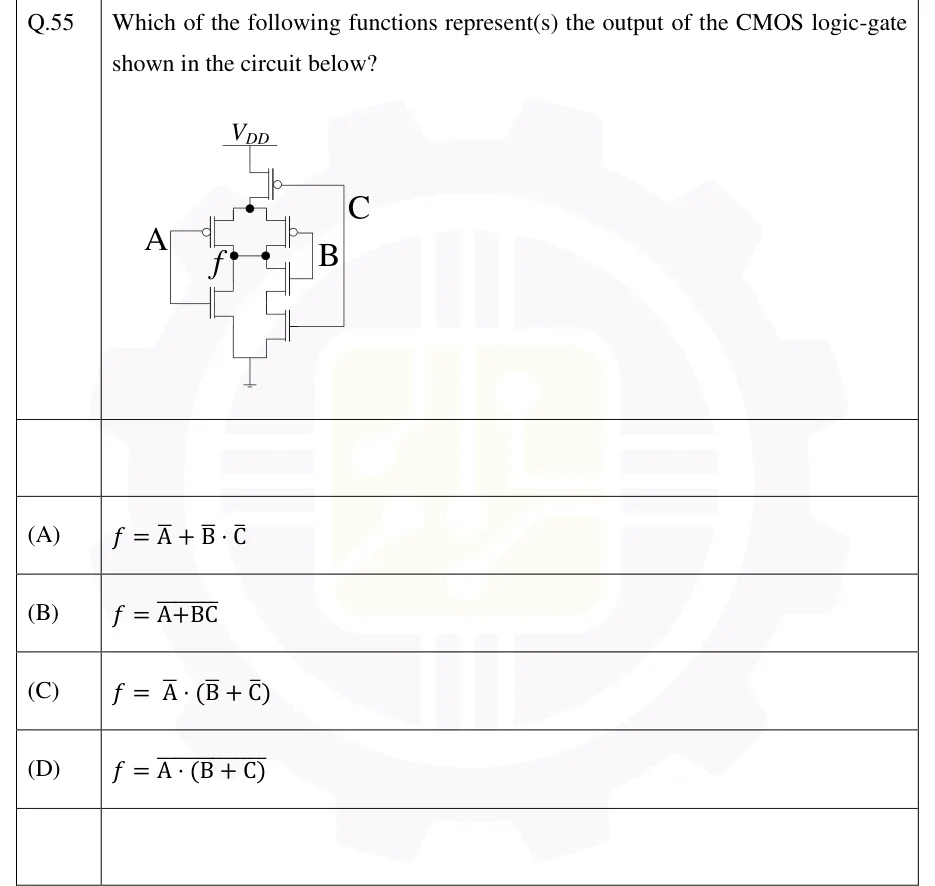
GATE 2026 IN question 55: A CMOS gate between V_DD (top) and ground (bottom), with output node f at the middle.Tap to open full size
Figure from the GATE 2026 IN paper. It is part of the question.
Figure description

A CMOS gate between V_DD (top) and ground (bottom), with output node f at the middle. Pull-up network: a PMOS with gate C has its source on V_DD and its drain on an internal node X. Two PMOS transistors run in parallel from X to f: the left one has gate A and the right one has gate B. Pull-down network: two branches in parallel between f and ground. The left branch is a single NMOS with gate A (drain at f, source at ground). The right branch is an NMOS with gate B (drain at f) in series with an NMOS with gate C (source at ground). Input A drives the left PMOS and the left NMOS. Input B drives the right PMOS and the upper right NMOS. Input C drives the top PMOS and the lower right NMOS. The two PMOS drains and the NMOS drains join at the node labelled f.

  1. (A)

  2. (B)

  3. (C)

  4. (D)

Answer and solution

ANSWER

Options (B) and (C) are correct: . The official key is MTA, and the printed pull-up network is not the dual of the pull-down network. Even so, on every input where the drawn gate gives a defined output, that output equals this function.

Official answer: marks to all candidatesSource: Official answer key, GATE 2026 IN (IIT Guwahati)

  1. Read the pull-down network (the NMOS devices between and ground). There are two parallel branches: NMOS A on its own, and NMOS B in series with NMOS C. An NMOS conducts when its gate is 1. Series means AND and parallel means OR, so the pull-down network conducts, pulling to 0, when .

  2. In a static CMOS gate the output is 0 exactly when the pull-down network conducts, so . That is option (B). (A bar means complement throughout.)

  3. By De Morgan's theorem, . That is option (C), so (B) and (C) are the same function.

  4. Options (A) and (D) are also the same function as each other: . That is the output of a different gate, one whose pull-down network has A in series with (B in parallel with C).

  5. Separate the two pairs with . NMOS B and NMOS C both conduct. PMOS C is off, which cuts off the whole pull-up path, so . Options (B) and (C) give , which is correct. Options (A) and (D) give , which is wrong.

  6. Check the pull-up network as printed. The exact dual of the pull-down network would be PMOS A in series with (PMOS B in parallel with PMOS C). The figure draws something else: PMOS C in series with (PMOS A in parallel with PMOS B). A PMOS conducts when its gate is 0, so the drawn pull-up conducts when . Now take each input in turn. At 000 and 010 only the pull-up conducts, so . At 011, 101, 110 and 111 only the pull-down conducts, so . In all six cases . At 100 both networks conduct, which is a direct path from to ground, so the output is undefined. At 001 neither network conducts and the output floats. The circuit as drawn is therefore not a valid static CMOS gate for every input.

  7. Conclusion. On every input where the output is a defined logic level, it equals . Options (A) and (D) contradict a defined output (at 011). No option equals the drawn pull-up's own function : it differs from at 001 and from at 011. So the circuit's defined behaviour supports options (B) and (C).

KEY IDEA

For a static CMOS gate, read the NMOS pull-down network (series = AND, parallel = OR) and complement the result: here . Then use De Morgan to spot options that are the same function written another way. Finally, check that the pull-up network is the dual. When it is not, as here, test each option only on inputs where the circuit actually gives a defined 0 or 1.

WATCH OUT FOR

Swapping series and parallel in the pull-down network gives , so options (A) and (D) get ticked. Reading the function from the drawn pull-up (C in series with A parallel to B) gives , which matches no option. A third slip in this MSQ is ticking only (B) and missing that (C) is the same function after De Morgan's theorem.

From the GATE 2026 IN paper. Every question of this paper · Download the full paper · All 7 Logic families questions, with notes

More Logic families questions