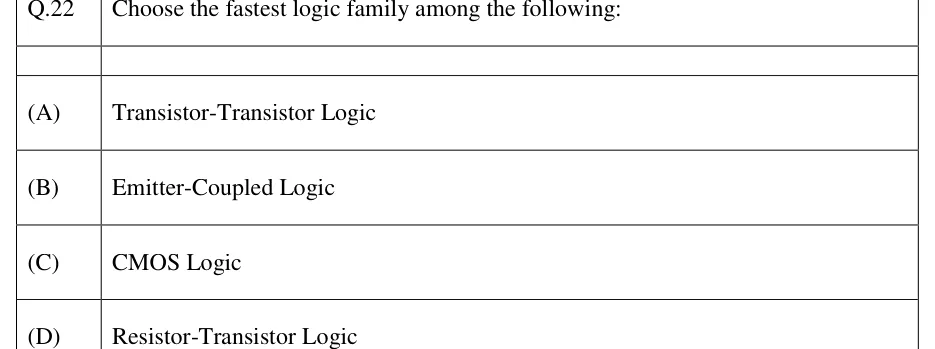
Choose the fastest logic family among the following:
- (A)
Transistor-Transistor Logic
- (B)
Emitter-Coupled Logic
- (C)
CMOS Logic
- (D)
Resistor-Transistor Logic

Choose the fastest logic family among the following:
Transistor-Transistor Logic
Emitter-Coupled Logic
CMOS Logic
Resistor-Transistor Logic
ANSWER
The answer is (B), Emitter-Coupled Logic. It is the fastest of the four families, with a typical propagation delay of about 1 ns to 2 ns, and under 1 ns in the 100K series.
Official answer: BSource: Official answer key, GATE 2023 IN (IIT Kanpur)
What sets gate speed. A gate's propagation delay is the time between an input change and the resulting output change. Two effects dominate it: (i) in bipolar logic whose transistors saturate, the storage time needed to remove excess base charge before a transistor can turn off; (ii) the time needed to charge or discharge the load capacitance through the output resistance, which grows with the voltage swing the output has to cover.
RTL (D). Resistor-Transistor Logic uses a saturating BJT switch with a passive resistor pull-up. It pays the full storage time at turn-off, and on the rising edge the resistor charges slowly. Typical is around , which makes it one of the slowest families.
TTL (A). TTL transistors still saturate, so storage time remains. The active totem-pole output drives the edges harder than RTL's resistor does, so standard TTL has . Its swing is still about . Schottky versions clamp the base-collector junction to keep the transistors out of deep saturation, which shortens the delay but does not remove the large swing.
CMOS (C). CMOS has no storage delay, but its output swings rail to rail (about on a supply), and its MOSFETs charge through a fairly high on-resistance, so delay rises with load. Standard CMOS is typically or slower (the 4000 series is slower still at ). High-speed HC parts reach about to , which puts them level with standard TTL, not ahead of ECL.
ECL (B). Emitter-Coupled Logic is built on a differential current-switch pair fed by a constant current source. The current is steered from one transistor to the other, so each transistor is either cut off or in the active region. Neither ever saturates, so there is no storage time. The logic swing is small (, , about in total), and the emitter-follower outputs have low output resistance, so charges quickly through a small voltage change. Typical is about to for the 10K series and under for the 100K series.
Conclusion. Of the four families, only ECL both avoids saturation and uses a sub-volt swing with low-resistance outputs. That gives it the smallest propagation delay: about to , against about for standard TTL and roughly for RTL and standard CMOS. The cost is high static power, because the current source conducts all the time. The fastest logic family is Emitter-Coupled Logic, so the answer is option (B).
KEY IDEA
ECL is the fastest family because its current-switch transistors never saturate, so there is no storage delay. It also uses a small swing (about 0.85 V) and low-resistance emitter-follower outputs, so the load capacitance charges quickly. The price is the highest static power dissipation of the common families.
WATCH OUT FOR
Picking CMOS because it is the dominant modern technology. CMOS's strength is very low static power, not speed: standard CMOS gates are slower than TTL, and high-speed CMOS only matches standard TTL. A second mistake is confusing 'fastest' with 'best speed-power product'. ECL wins on raw delay but not on power.
From the GATE 2023 IN paper. Every question of this paper · Download the full paper · All 7 Logic families questions, with notes