
IAE Academy

GATE 2025 EC Q.36: solution and answer

GATE 2025 · ECQ.36 · 2 marks · MCQ

Let be the transfer function of a second-order system. A controller is connected to the system in the configuration shown below.

Consider the following statements.

(i) There exists no controller of the form , where is a positive real number, such that the closed loop system is stable.

(ii) There exists at least one controller of the form , where and are positive real numbers, such that the closed loop system is stable.

Which one of the following options is correct?
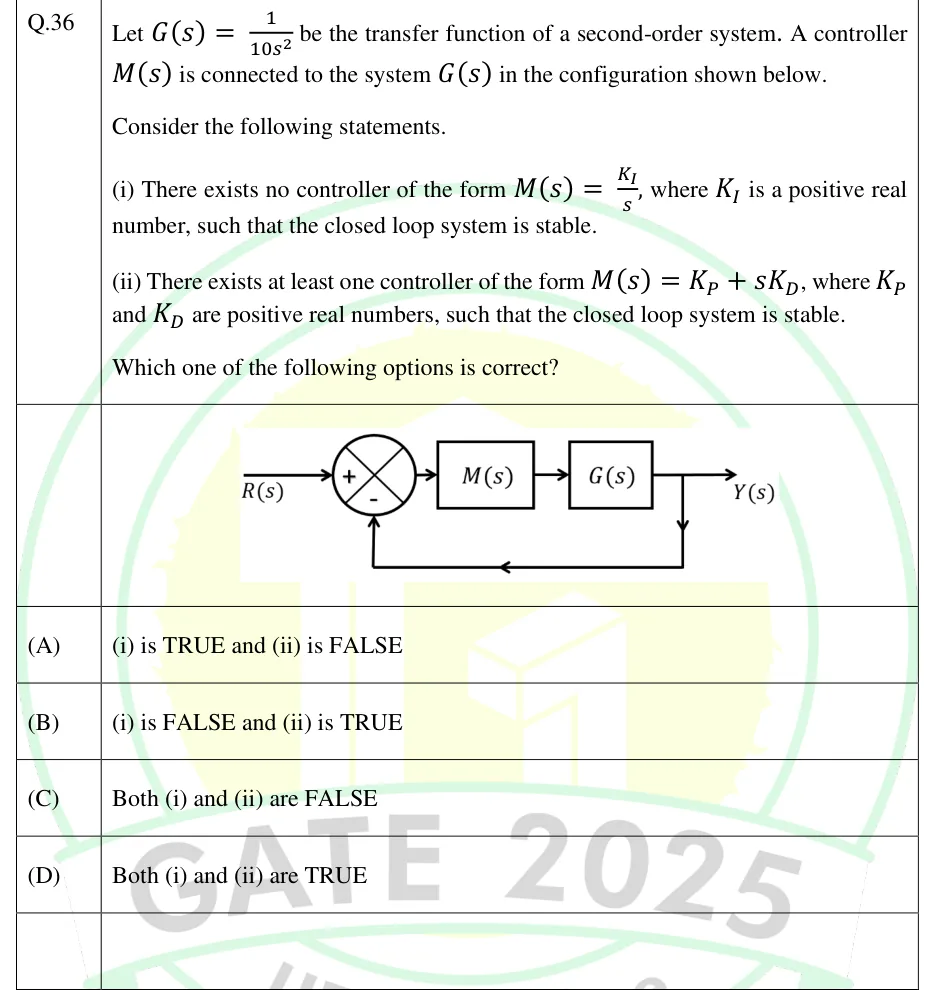
GATE 2025 EC question 36: Unity negative feedback loop.Tap to open full size
Figure from the GATE 2025 EC paper. It is part of the question.
Figure description

Unity negative feedback loop. The input R(s) enters a summing junction with sign + on the input and sign - on the feedback path. The junction output drives the block M(s), which feeds the block G(s) in cascade. The output of G(s) is Y(s). A take-off point on Y(s) feeds back directly, with no block (unity gain), to the - input of the summing junction.

  1. (A)

    (i) is TRUE and (ii) is FALSE

  2. (B)

    (i) is FALSE and (ii) is TRUE

  3. (C)

    Both (i) and (ii) are FALSE

  4. (D)

    Both (i) and (ii) are TRUE

Answer and solution

ANSWER

Both (i) and (ii) are TRUE, which is option (D). With the integral controller the characteristic equation is . It is missing its and terms and has two right-half-plane roots, so no can stabilise the loop. With the PD controller it is , which is stable for every .

Official answer: DSource: Official answer key, GATE 2025 EC (IIT Roorkee)

  1. The loop has unity negative feedback with and in cascade, so the closed-loop characteristic equation is , where is a double integrator.

  2. Statement (i), integral controller. With :

    There is no pole-zero cancellation, so this cubic is the full characteristic polynomial.

  3. The necessary condition for stability fails: every coefficient of a stable polynomial must be present and share one sign, but here the and coefficients are zero. So the loop cannot be stable for any .

  4. The roots confirm it. From , the three roots have magnitude and angles and . The two roots at have positive real part, so they lie in the right half-plane.

  5. The Routh array gives the same result. Row : . Row : . Its first element is zero, so replace it with a small . Then row is , which is large and negative, and row is . The first column changes sign twice, so there are two right-half-plane roots.

  6. So no controller with stabilises the loop, and (i) is TRUE. In physical terms, the integrator turns the double integrator into a triple integrator, which only adds phase lag.

  7. Statement (ii), PD controller. With :

    There is no cancellation, because the zero at is not at the origin.

  8. For a second-order polynomial, all coefficients present and positive is both necessary and sufficient for stability. With this always holds. In standard form, and . For example, gives , that is , with roots , both in the left half-plane.

  9. In fact every PD controller with positive gains stabilises the loop, so 'at least one exists' is TRUE. The derivative term supplies the damping term that the double integrator lacks. Both statements are TRUE, so the answer is option (D).

KEY IDEA

A double integrator has no term in its characteristic polynomial, so it has no damping. Stabilising it needs a controller that adds that term. A PD controller adds and gives , which is stable for all positive gains. An integral controller raises the order to and still leaves the and coefficients at zero. That fails the necessary coefficient condition, whatever the gain.

WATCH OUT FOR

One mistake is misreading the wording of the statements. Statement (i) is a claim that no stabilising controller exists. The integral loop is unstable, so (i) is TRUE, not FALSE. A second mistake is stopping the Routh test for at the zero in the first column of row and calling the system marginally stable. Completing the array with shows two sign changes, so two roots are in the right half-plane and the loop is unstable. A third is thinking that (ii) needs a particular tuning of and . For a second-order polynomial, positive coefficients alone guarantee stability.

From the GATE 2025 EC paper. Every question of this paper · Download the full paper · All 10 Compensators & PID questions, with notes

More Compensators & PID questions