
IAE Academy

GATE 2026 EC Q.40: solution and answer

GATE 2026 · ECQ.40 · 2 marks · MCQ

For the control system shown in the Figure, the transfer function of a plant, is connected in cascade with a compensator , where and are positive real valued constants.

Which of the following pairs represent the correct values for the closed loop system to have poles at ?
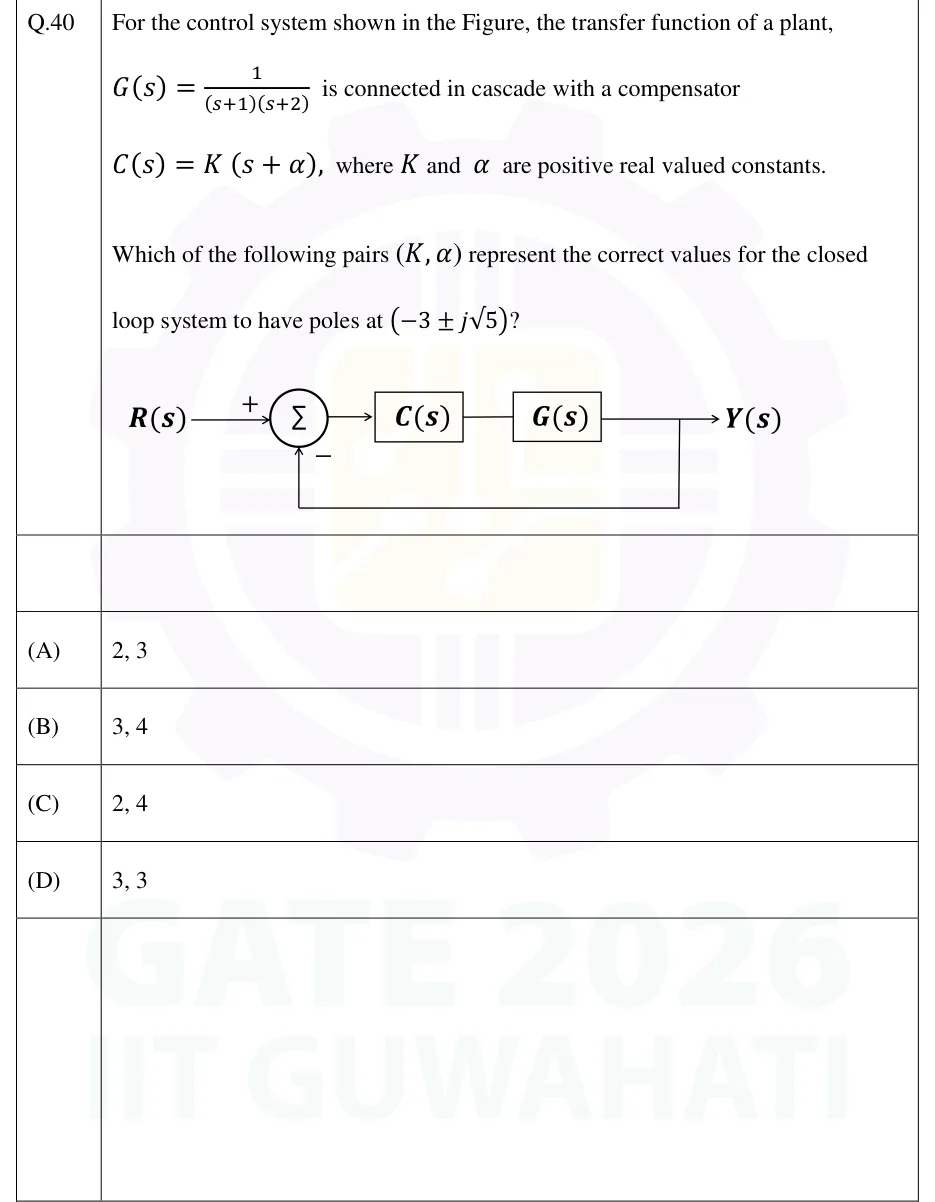
GATE 2026 EC question 40: Unity negative feedback block diagram.Tap to open full size
Figure from the GATE 2026 EC paper. It is part of the question.
Figure description

Unity negative feedback block diagram. Input R(s) enters a summing junction (Σ) at the '+' input. The summing junction output feeds block C(s), which is in cascade with block G(s); the output of G(s) is Y(s). Y(s) is fed back directly (unity gain, no block) to the summing junction at its '−' input (bottom).

  1. (A)

    2, 3

  2. (B)

    3, 4

  3. (C)

    2, 4

  4. (D)

    3, 3

Answer and solution

ANSWER

, which is option (B).

Official answer: BSource: Official answer key, GATE 2026 EC (IIT Guwahati)

  1. With unity negative feedback and in cascade with , the open-loop transfer function is

  2. The closed-loop poles are the roots of :

  3. The characteristic polynomial the poles call for is

  4. Match the coefficients: .

  5. Match the constant terms: .

  6. Check: gives , as required. Both and are positive, so , which is option (B).

KEY IDEA

For a second-order closed loop, the complex poles fix the characteristic polynomial exactly as . The compensator gives two free parameters, one for each coefficient. Here alone sets the coefficient (), and once is known, sets the constant term ().

WATCH OUT FOR

Taking the constant term of the desired polynomial as or as , when it is . The other mistake is forgetting that multiplies in the constant term, which gives . Every distractor is close. Option (D), , gets right but gives , whose poles are . Options (A) and (C) have , which gives an coefficient of 5 and a real part of .

From the GATE 2026 EC paper. Every question of this paper · Download the full paper · All 10 Compensators & PID questions, with notes

More Compensators & PID questions