
IAE Academy

GATE 2026 IN Q.34: solution and answer

GATE 2026 · INQ.34 · 1 mark · NAT

In the circuit below the maximum value of is ________ V. (rounded off to the nearest integer)
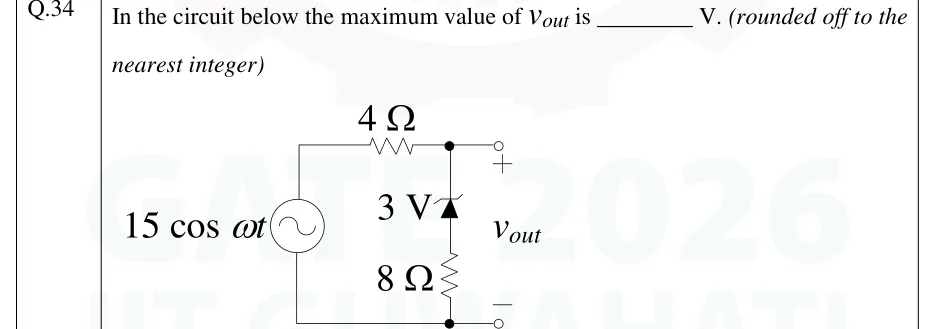
GATE 2026 IN question 34: An AC source 15 cos ω t (sinusoidal source symbol) on the left;Tap to open full size
Figure from the GATE 2026 IN paper. It is part of the question.
Figure description

An AC source 15 cos ω t (sinusoidal source symbol) on the left; its top terminal goes through a series 4 Ω resistor to the top output node (marked + of v_out). From the top output node to the bottom rail there is one branch: a 3 V Zener diode in series with an 8 Ω resistor. The Zener's cathode (bar with bent ends) is at the top, connected to the output node, and its triangle points upward, so the anode connects downward to the 8 Ω resistor, whose lower end goes to the bottom rail. The bottom rail returns to the source's lower terminal and is the - terminal of v_out. So v_out is measured across the Zener plus the 8 Ω resistor together. No load is connected at the output terminals.

Answer and solution

ANSWER

The maximum value of is . It occurs at the source peak of , when the Zener is in breakdown and flows through the loop: .

Official answer: 11Source: Official answer key, GATE 2026 IN (IIT Guwahati)

  1. Model: take the Zener as ideal. It is an open circuit when reverse biased below . In reverse breakdown it holds exactly , and forward biased it is a short (zero forward drop). Its cathode is at the output node and its anode goes to the resistor, so it is reverse biased whenever . Let . The source swings through both signs, so both half cycles occur whichever terminal is taken as positive.

  2. Positive half cycle, : the Zener has not broken down, so the Zener and branch carries no current. No current flows in the resistor, so it drops nothing and . The resistor also drops nothing, so the whole of appears across the Zener, and breakdown starts when reaches .

  3. Positive half cycle, : the Zener is in breakdown and acts as a battery in series with the two resistors. KVL around the loop gives the current flowing down through the branch: This is positive for , which confirms the Zener really is in reverse breakdown.

  4. The output is taken across the Zener and the resistor together:

  5. This rises with , so it is largest at the source peak :

  6. Negative half cycle: the Zener is forward biased and acts as a short, so the two resistors form a voltage divider: . Its lowest value is , at . This half cycle never gives a positive output, and a small forward drop would not change that. So

KEY IDEA

The Zener is in series with the resistor and does not sit directly across the output, so it does not clamp at . Once it breaks down it behaves like a battery. The output is then that plus the drop across the resistor, which keeps rising with the source: .

WATCH OUT FOR

One mistake is to treat the Zener as a clamp across the output and answer , which ignores the drop in series with it. Another is to apply the voltage divider to the whole peak, , which leaves the Zener's out of the loop. That value is actually the size of the negative-half-cycle extreme, not the positive maximum.

From the GATE 2026 IN paper. Every question of this paper · Download the full paper · All 25 Diode circuits questions, with notes

More Diode circuits questions