
IAE Academy

GATE 2024 EE Q.60: solution and answer

GATE 2024 · EEQ.60 · 2 marks · NAT

In the given circuit, the diodes are ideal. The current through the diode in milliamperes is ________ (rounded off to two decimal places).
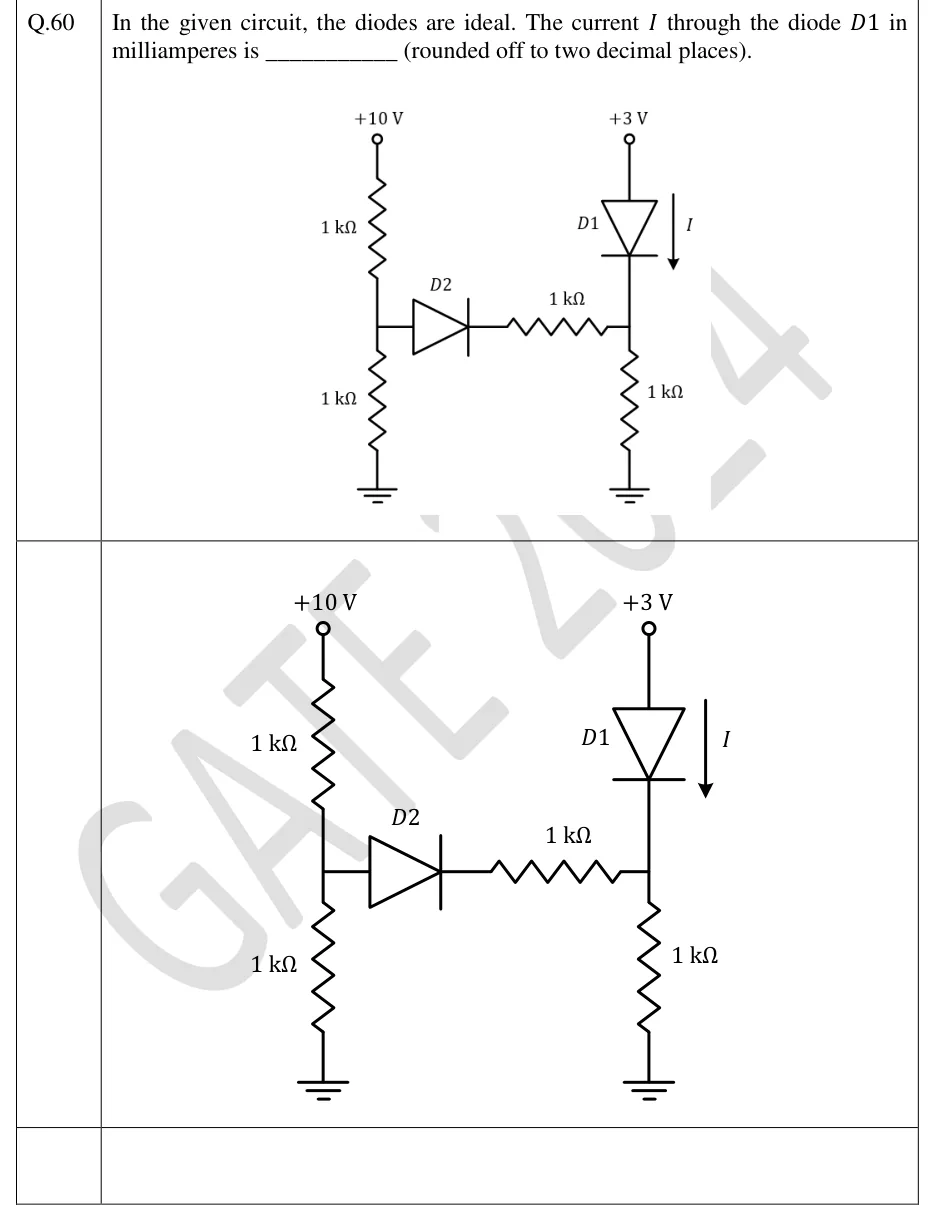
GATE 2024 EE question 60: Left branch: a +10 V terminal feeds a 1 kΩ resistor down to node A, and a second 1 kΩ resistor runs from node A to ground.Tap to open full size
Figure from the GATE 2024 EE paper. It is part of the question.
Figure description

Left branch: a +10 V terminal feeds a 1 kΩ resistor down to node A, and a second 1 kΩ resistor runs from node A to ground. Diode D2 points to the right, with its anode at node A and its cathode going through a series 1 kΩ resistor to node B. Right branch: a +3 V terminal connects to the anode of diode D1, which points downward, so its cathode is at node B. The current I is marked by an arrow pointing downward through D1, from the +3 V terminal towards node B. Node B goes to ground through a 1 kΩ resistor.

Answer and solution

ANSWER

The current through D1 is I = 5/3 mA ≈ 1.67 mA.

Official answer: 1.64 to 1.70Source: Official answer key, GATE 2024 EE (IISc Bengaluru)

  1. Neither node is labelled in the figure, so name them here. Node A is the junction of the two left-hand 1 kΩ resistors, which is also the anode of . Node B is the cathode of , where the series 1 kΩ from and the lower right 1 kΩ to ground also meet. Assume both ideal diodes are ON, so each acts as a short circuit, and check this at the end. Work in mA and kΩ.

  2. ON ties node B to its anode supply: .

  3. ON puts its cathode at , so the current through and its series 1 kΩ resistor, from A towards B, is .

  4. KCL at node A. The current arriving from the +10 V supply equals the current into the lower 1 kΩ plus the current into :

  5. Current through : . It is positive (anode to cathode), so really is ON.

  6. Current from node B to ground through the lower right 1 kΩ: .

  7. KCL at node B. and together must supply those 3 mA: . is positive and flows downward from anode to cathode, as the arrow shows, so really is ON. Both assumptions hold, and for ideal diodes this consistent state is the solution.

  8. Rounded to two decimal places, .

KEY IDEA

Assume a state for each ideal diode (ON means short circuit, OFF means open circuit), solve the linear circuit, then confirm the state: every ON diode must carry forward current and every OFF diode must be reverse-biased. Here ON pins node B at 3 V. That turns node A into a single-node KCL problem, and follows from KCL at B.

WATCH OUT FOR

Taking as the full 3 mA that flows from node B to ground, which forgets that already supplies 4/3 mA of it. Another mistake is working out the left branch as an unloaded divider ( V, so mA and mA), which ignores that draws current from node A.

From the GATE 2024 EE paper. Every question of this paper · Download the full paper · All 25 Diode circuits questions, with notes

More Diode circuits questions