GATE 2024 BT Q.22
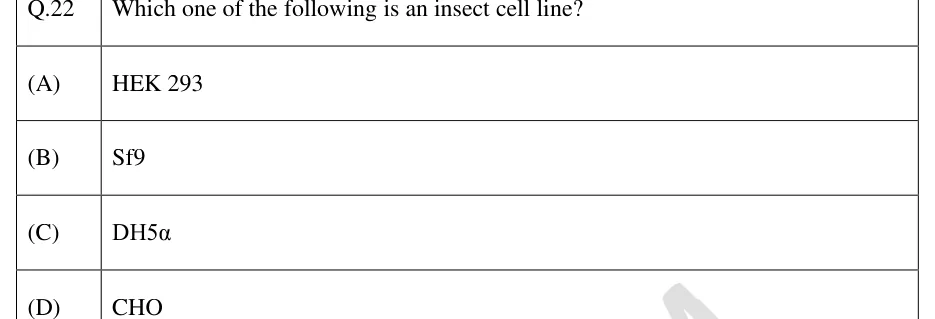
Which one of the following is an insect cell line?
- (A)
HEK 293
- (B)
Sf9
- (C)
DH5α
- (D)
CHO

GATE BT
Recombinant DNA work uses three sets of tools. Type II restriction enzymes cut DNA at defined, usually palindromic, sites (written 5'→3' with ^ marking the cut) and leave 5'-overhang, 3'-overhang or blunt ends. Modifying enzymes then trim, fill, phosphorylate, dephosphorylate, tail and join those ends. Cloning vectors carry inserts in a host: plasmids and phagemids (up to about 10 kb), λ vectors (up to about 23 kb), cosmids and fosmids (about 35–45 kb), BACs and PACs (about 100–300 kb), YACs (hundreds of kb to about 1–2 Mb), the Ti plasmid for plants and viral vectors for animal cells. Expression vectors add a promoter, ribosome-binding or Kozak signals, a terminator and tags so that the host makes the protein. The numbers that matter are fragment counts (linear n+1, circular n), expected site spacing (4^n bp for a palindromic n-bp site in random 50% GC DNA) and packaging limits. The conditions that matter are the ones each screen or selection depends on.
10 previous-year questions · 10 solved · 6 practice questions
Restriction enzymes, modifying enzymes, cloning vectors and expression vectors together make up the toolbox of recombinant DNA technology. Restriction enzymes cut DNA at defined sequences to generate compatible ends. Modifying enzymes adjust and join those ends. Vectors carry and replicate the fragment inside a host, and expression vectors add the signals needed to make protein from the cloned gene. The topic mixes arithmetic (fragment counting, restriction mapping, expected site frequency) with facts that hold only under stated conditions (which host, which cofactor, which screen). Learn each fact together with its condition.
A bacterial restriction-modification (R-M) system has two activities that recognise the same sequence. A restriction endonuclease cleaves unmethylated (foreign, e.g. phage) DNA. A methyltransferase methylates the host's own DNA at that sequence, which protects it from cleavage. This is how the cell tells its own DNA from foreign DNA.
Naming convention. Take the first letter of the genus and the first two letters of the species (italicised), add a strain designation, then a Roman numeral for the order of discovery in that strain. For example, EcoRI = Escherichia coli strain RY13, enzyme I.
Type | Recognition site | Cleavage position | Cofactors | Use in cloning |
|---|---|---|---|---|
Type I | Bipartite, asymmetric (non-palindromic) | Variable sites far from the recognition site (often ~1 kb or more away), after DNA translocation | ATP, SAM (S-adenosylmethionine), Mg2+; one multi-subunit complex also methylates | Not used: the cut position is not fixed |
Type II | Usually palindromic, 4–8 bp | Fixed position within or immediately next to the site | Mg2+ only; methylation is done by a separate methyltransferase | The standard enzymes for cloning and mapping: reproducible fragments |
Type IIS (subtype of II) | Asymmetric, non-palindromic (e.g. FokI: 5'-GGATG-3') | Fixed distance outside the site (FokI: 9 nt on this strand, 13 nt on the complementary strand) | Mg2+ | Used where the cut must lie outside the recognition site (e.g. assembly methods) |
Type III | Asymmetric 5–6 bp site; two copies in inverted (head-to-head) orientation are needed for efficient cleavage | About 25–27 bp downstream of one site | ATP and Mg2+ required; SAM stimulates | Not used routinely |
Type IV | Modified (methylated) DNA, e.g. McrBC | Not at a fixed position | Vary (McrBC needs GTP and Mg2+) | Not used for cutting. They restrict methylated foreign DNA, so methylated (e.g. eukaryotic) DNA is cloned in mcr/mrr-deficient E. coli strains |
Only Type II enzymes (including Type IIS for special purposes) are used routinely in cloning, because they cut at a fixed, predictable position and so give reproducible fragment ends.
Type II end types (sites written 5'→3', ^ = cut on this strand)
5' overhang (cohesive/sticky): EcoRI G^AATTC leaves the single-stranded overhang 5'-AATT.
3' overhang (cohesive/sticky): PstI CTGCA^G leaves the overhang TGCA-3'.
Blunt: SmaI CCC^GGG cuts straight across and leaves no overhang.
Two ends are compatible when their overhangs are complementary. This holds for ends cut by the same enzyme, and also for ends cut by different enzymes with different sites but the same overhang. For example, BamHI (G^GATCC) and BglII (A^GATCT) both leave 5'-GATC.
Blunt ends can be joined to any other blunt end, but ligation is much less efficient than sticky-end ligation because no base pairing holds the ends together while the ligase acts. T4 DNA ligase is used.
Term | Definition | Example |
|---|---|---|
Isoschizomers | Different enzymes that recognise the same sequence (used strictly, they also cut at the same position) | HpaII and MspI both cut C^CGG. HpaII is blocked when the internal C is methylated (CmCGG) but MspI is not, so the pair is used to probe CpG methylation. |
Neoschizomers | Isoschizomers that recognise the same sequence but cut at a different position, so they leave different ends | SmaI CCC^GGG (blunt) and XmaI C^CCGGG (5'-CCGG overhang) |
Compatible cohesive ends from different sites | Different recognition sequences, identical overhang | BamHI G^GATCC and BglII A^GATCT (both leave 5'-GATC). The ligated hybrid site (GGATCT / AGATCC) is usually cut by neither enzyme. |
EXAM TIP
Isoschizomers share a recognition sequence. Whether they also share the cut position, and therefore the end type, has to be checked for each pair. SmaI and XmaI recognise the same CCCGGG but give different ends.
Host methylation. E. coli Dam methylase methylates the adenine (N6) in 5'-GATC-3', and Dcm methylates the internal cytosine (C5) in 5'-CCWGG-3' (W = A or T). Overlapping methylation can block some enzymes. Of three enzymes that act at GATC, MboI cuts only unmethylated DNA, Sau3AI cuts whether or not the A is Dam-methylated, and DpnI cuts only when it is methylated.
EXAM TIP
Star activity. Under non-standard conditions (high glycerol, low ionic strength, high pH, Mn2+ in place of Mg2+, or large excess of enzyme), some Type II enzymes also cut sequences that differ from the true site. EcoRI activity of this kind is written EcoRI*. It gives extra, unexpected fragments.
Rules for counting fragments (complete digestion)
A linear DNA molecule with n sites for one enzyme gives n + 1 fragments.
A circular DNA molecule (e.g. a plasmid) with n sites (n ≥ 1) gives exactly n fragments. A single cut only linearises it.
Fragment sizes always add up to the total length of the molecule. In a double digest (two enzymes together), each single-digest fragment equals the sum of one or more adjacent double-digest fragments. Maps are built by testing which site placements satisfy every digest.
A partial digest (incomplete cutting) also gives fragments whose sizes are sums of adjacent complete-digest fragments. This is used to find the order of fragments.
EXPECTED NUMBER OF SITES FOR A PALINDROMIC N-BP SITE IN RANDOM DNA
L is the length in bp, and all four bases have probability 1/4, independently. The expected average spacing between sites is 4^n bp: 256 bp for a 4-cutter, 4096 bp for a 6-cutter, 65,536 bp for an 8-cutter such as NotI (GC^GGCCGC). A palindromic site reads the same on both strands, so each position is counted once. A non-palindromic site can occur on either strand of dsDNA, which doubles the expected count. Real genomes differ from these values because base composition is biased and sequence is not random.
SITE PROBABILITY WHEN GC CONTENT IS NOT 50%
g is the GC fraction, so each of G and C has probability g/2 and each of A and T has probability (1−g)/2. n_GC and n_AT count the G/C and A/T bases in the site. The expected average spacing is 1/P_site bp (palindromic site).
WORKED EXAMPLE
A 10 kb linear DNA is digested. EcoRI alone gives 4 kb + 6 kb. BamHI alone gives 3 kb + 7 kb. EcoRI + BamHI gives 3 kb + 1 kb + 6 kb. Place the two sites.
Each enzyme gives 2 fragments from a linear molecule, so each has 1 site (n + 1 = 2). The double digest has 1 + 1 = 2 sites, so 3 fragments, which matches.
Measure from one end. EcoRI is at 4 kb or 6 kb, and BamHI is at 3 kb or 7 kb.
Try BamHI at 3 and EcoRI at 4. The fragments are 0–3, 3–4 and 4–10, i.e. 3, 1 and 6 kb. This matches.
Try BamHI at 7 and EcoRI at 4. The fragments are 4, 3 and 3 kb. This does not match.
BamHI at 7 with EcoRI at 6 gives 6, 1 and 3 kb. This is the same map read from the other end.
Answer: The BamHI site is 3 kb and the EcoRI site 4 kb from the same end, so the two sites are 1 kb apart. The orientation (which end is 'left') cannot be fixed from these data.
Enzyme | Reaction | Use in cloning |
|---|---|---|
DNA ligase (T4 or E. coli) | Forms a phosphodiester bond between an adjacent 3'-OH and 5'-phosphate in duplex DNA | Both seal nicks and join cohesive ends. T4 DNA ligase (ATP-dependent) also joins blunt ends. E. coli DNA ligase (NAD+-dependent) is very inefficient on blunt ends. |
Alkaline phosphatase (CIP, BAP, SAP) | Removes 5'-phosphate groups from DNA ends | Dephosphorylates the linearised vector so that it cannot re-ligate to itself. The insert must keep its 5'-phosphates. |
T4 polynucleotide kinase (PNK) | Transfers the γ-phosphate of ATP to a 5'-OH end | Phosphorylates synthetic oligonucleotides, linkers and adaptors (made without a 5'-phosphate) before ligation. Also 5'-end labelling with [γ-32P]ATP. |
Terminal deoxynucleotidyl transferase (TdT) | Adds deoxynucleotides to a 3'-OH end without a template | Homopolymer tailing: complementary tails (e.g. oligo-dG on the vector, oligo-dC on the insert) anneal, joining molecules that share no restriction ends. Also 3'-end labelling. |
Klenow fragment (of E. coli DNA polymerase I) | 5'→3' polymerase and 3'→5' exonuclease; lacks the 5'→3' exonuclease | Fills in 5' overhangs to make blunt ends; end labelling by fill-in |
T4 DNA polymerase | 5'→3' polymerase with a strong 3'→5' exonuclease | Removes 3' overhangs (and can fill 5' overhangs) to make blunt ends |
S1 nuclease / mung bean nuclease | Degrade single-stranded DNA | Trim single-stranded overhangs to leave blunt ends |
Linkers and adaptors. A linker is a short, synthetic, double-stranded blunt oligonucleotide that contains a restriction site. It is ligated onto blunt ends and then cut, which gives the fragment the matching sticky end. An adaptor is a synthetic oligonucleotide with one sticky end already formed, so it adds a sticky end without cutting. Adaptors avoid the problem of cutting an internal site in the insert.
EXAM TIP
Alkaline phosphatase stops the vector from ligating to itself, but it does not stop vector-insert ligation, because the insert's own 5'-phosphates supply the phosphate at each junction. Each of the two junctions keeps one unsealed nick, where the dephosphorylated vector 5' end meets the insert 3'-OH. The two nicks are on opposite strands, and the host repairs them after transformation.
Vector | Basis | Typical insert capacity | Key features |
|---|---|---|---|
Plasmid | Circular extrachromosomal dsDNA that replicates from its own origin in bacteria | Usually up to about 10 kb; larger inserts clone less efficiently and less stably | Origin, selectable marker (antibiotic resistance) and multiple cloning site (MCS). Many carry lacZα for blue-white screening. pUC-type origins give high copy number. |
Bacteriophage λ vector | Phage λ (wild-type genome 48.5 kb); the non-essential central region is used for cloning | Insertion vectors: up to about 10 kb. Replacement vectors: about 9–23 kb. | Only DNA of about 78–105% of wild-type length (≈38–51 kb between cos sites) is packaged, so replacement vectors have a minimum as well as a maximum insert size. In vitro packaging and infection are far more efficient than plasmid transformation. Recombinants form plaques. |
Cosmid | Plasmid (origin + marker) carrying the λ cos site; no phage genes | About 35–45 kb | Packaged in vitro into λ heads (needs ≈38–51 kb between cos sites), injected into E. coli, then replicates as a plasmid. Recombinants are selected as antibiotic-resistant colonies, not plaques. Because the cosmid itself is small (about 5 kb), only large inserts give a packageable molecule. |
Fosmid | Cosmid-like vector built on the F-plasmid replicon | About 35–45 kb (λ packaging) | Single copy per cell, so large inserts are more stable than in multicopy cosmids |
Phagemid | Plasmid carrying a filamentous-phage (f1 or M13) origin | Similar to plasmids | Replicates normally as a double-stranded plasmid. With a helper phage, single-stranded DNA is packaged and secreted, giving ssDNA for sequencing and mutagenesis. |
M13 vector | Filamentous ssDNA phage; its double-stranded replicative form (RF) is used for cloning | Best with small inserts (a few kb); larger inserts tend to be unstable | Infects E. coli carrying the F pilus. Released without lysis (turbid plaques from slowed host growth). Source of single-stranded template DNA. |
Ti plasmid-based vector | Tumour-inducing plasmid of Agrobacterium tumefaciens; its T-DNA is transferred into the plant nuclear genome | No packaging limit; the insert is carried between the T-DNA borders | Only DNA between the left and right borders (25 bp imperfect direct repeats) is transferred. The vir genes are induced by plant phenolics such as acetosyringone and act in trans. Disarmed vectors lack the onc genes (auxin and cytokinin synthesis). Binary vectors carry the T-DNA on a small plasmid and the vir genes on a separate helper Ti plasmid. Used for stable plant transformation. |
Bacterial artificial chromosome (BAC) | F-plasmid replicon (oriS, repE, parA, parB) | About 100–300 kb | One copy per cell, so large inserts rarely rearrange. Circular, propagated in E. coli (introduced by electroporation). |
P1-derived artificial chromosome (PAC) | Phage P1 replicon, propagated as a plasmid in E. coli | About 100–300 kb | Low copy number; stable like BACs |
Yeast artificial chromosome (YAC) | Linear vector: centromere (CEN), two telomeres (TEL), autonomously replicating sequence (ARS), yeast selectable markers (e.g. TRP1, URA3) | Hundreds of kb up to about 1–2 Mb | Replicates and segregates like a yeast chromosome; the largest capacity of the standard vectors. Prone to chimeric clones and insert rearrangement. In pYAC4-type vectors the cloning site lies in the SUP4 tRNA gene, so in an ade2-ochre host recombinants are red and non-recombinants white. |
Plasmid features to know
pBR322 (4361 bp) carries amp^R (bla) and tet^R. An insert at BamHI (inside tet^R) gives Amp^R Tet^S recombinants, which are found by replica plating onto tetracycline. An insert at PstI (inside bla) gives Amp^S Tet^R recombinants. This is insertional inactivation.
pUC vectors have a high-copy origin, amp^R, and an MCS inside lacZα for blue-white screening.
A shuttle vector carries an origin and a selectable marker for each of two hosts (e.g. E. coli and yeast), so it can be built in E. coli and then used in the second host.
Yeast vector | Replication element | Copy number / stability |
|---|---|---|
YIp (integrating) | None; integrates into a yeast chromosome by homologous recombination | Usually one copy; very stable; low transformation frequency |
YEp (episomal) | 2μ plasmid origin | High copy; fairly stable |
YRp (replicating) | ARS | High copy, but lost easily at cell division |
YCp (centromeric) | ARS + CEN | 1–2 copies; stable, segregates like a chromosome |
YAC | ARS + CEN + two TEL (linear) | Behaves as a linear chromosome; very large inserts |
Viral vector (animal/insect cells) | Genome | Fate in the host cell | Notes |
|---|---|---|---|
Retroviral (γ-retrovirus) | ssRNA, reverse-transcribed to DNA | Integrates into the host genome | Transduces dividing cells only |
Lentiviral (e.g. HIV-based) | ssRNA, reverse-transcribed to DNA | Integrates | Also transduces non-dividing cells |
Adenoviral | dsDNA | Stays episomal (non-integrating); expression is transient | Infects dividing and non-dividing cells |
Adeno-associated virus (AAV) | ssDNA, about 4.7 kb | Recombinant vectors stay mostly episomal | Small packaging capacity (about 4.7 kb total) |
Baculovirus (e.g. AcMNPV) | dsDNA | Insect-cell expression system | Strong polyhedrin promoter drives high-level expression in insect cells (e.g. Sf9) |
SV40 | dsDNA | Early mammalian cloning vector | Its origin and early promoter are widely used in mammalian plasmid vectors |
EXAM TIP
Insert capacity, smallest to largest: plasmid ≈ phagemid ≈ λ insertion vector (up to about 10 kb) < λ replacement vector (about 9–23 kb) < cosmid ≈ fosmid (about 35–45 kb) < BAC ≈ PAC (about 100–300 kb) < YAC (hundreds of kb to about 1–2 Mb). λ vectors, cosmids and fosmids are all limited by the λ head packaging window (≈38–51 kb).
An expression vector is a cloning vector with the extra signals needed to transcribe and translate the cloned gene. For prokaryotic expression these are a strong, usually inducible promoter upstream of the MCS; a ribosome-binding site (Shine–Dalgarno sequence) a few nucleotides (typically about 5–10) upstream of the start codon; a transcription terminator; and often a sequence for a purification or detection tag. For eukaryotic expression they are a eukaryotic promoter (e.g. CMV or SV40 early), a Kozak consensus around the start AUG, and a polyadenylation signal. Bacteria cannot splice introns, so a eukaryotic gene is expressed in E. coli from its cDNA.
Expression vector elements and choices
Inducible promoters keep expression off while cells grow, which avoids toxicity and growth burden. Examples: lac, tac and trc (induced by IPTG, which inactivates the LacI repressor; tac is a trp–lac hybrid). The T7 promoter, used in hosts such as BL21(DE3), which carry the T7 RNA polymerase gene under the IPTG-inducible lacUV5 promoter; T7 RNA polymerase transcribes only from T7 promoters. araBAD (induced by arabinose). λ P_L with the temperature-sensitive cI857 repressor (induced by shifting to 42 °C).
Fusion tags (e.g. His-tag, GST, MBP) are fused in frame with the gene for affinity purification, and some improve solubility. A protease site is often placed between the tag and the protein so the tag can be removed.
Selectable markers (e.g. antibiotic resistance) keep only plasmid-bearing cells growing under selection. The origin sets the copy number in the chosen host.
Host | Strengths | Limitations |
|---|---|---|
E. coli | Fast, cheap, high yield; many inducible systems | No eukaryotic glycosylation; no intron splicing (use cDNA); eukaryotic proteins often form insoluble inclusion bodies |
Yeast (S. cerevisiae, Pichia pastoris) | Eukaryotic folding and secretion; fast growth. Pichia has the strong methanol-inducible AOX1 promoter. | Glycosylation differs from human; S. cerevisiae tends to hypermannosylate |
Insect cells (baculovirus) | High-level expression from the polyhedrin promoter; most eukaryotic modifications | Glycosylation simpler than in mammalian cells |
Mammalian cells (e.g. CHO, HEK293) | Most human-like folding and glycosylation | Slow and expensive |
Blue-white screening (α-complementation) shows whether an insert is present. It does not show whether a gene is expressed. The vector carries lacZα with the MCS inside it. The host carries lacZΔM15, which makes the complementing ω-fragment. IPTG induces the lac promoter by inactivating the LacI repressor. An intact α-fragment complements the ω-fragment to give active β-galactosidase, which hydrolyses X-gal to a blue product, so non-recombinant (self-ligated) vector gives blue colonies. An insert in the MCS disrupts lacZα and gives white colonies (recombinant). Exceptions: a small in-frame insert may still give blue or light-blue colonies, and a vector with a small deletion at the site can give white colonies with no insert. White colonies are therefore confirmed by colony PCR or restriction digestion.
EXAM TIP
Selection kills or stops the growth of cells that lack the feature (e.g. an antibiotic kills plasmid-free cells). Screening lets every cell grow and tells them apart visually or by testing (blue-white, red-white in YACs, replica plating for Tet^S in pBR322).
PREVIOUS-YEAR QUESTIONS
Try each question first, then open the answer. We placed each question under a topic ourselves; the exam paper does not label topics.
See these papers in full: GATE BT 2024 · GATE BT 2023 · GATE BT 2022 · GATE BT 2020
Which one of the following is an insect cell line?
HEK 293
Sf9
DH5α
CHO
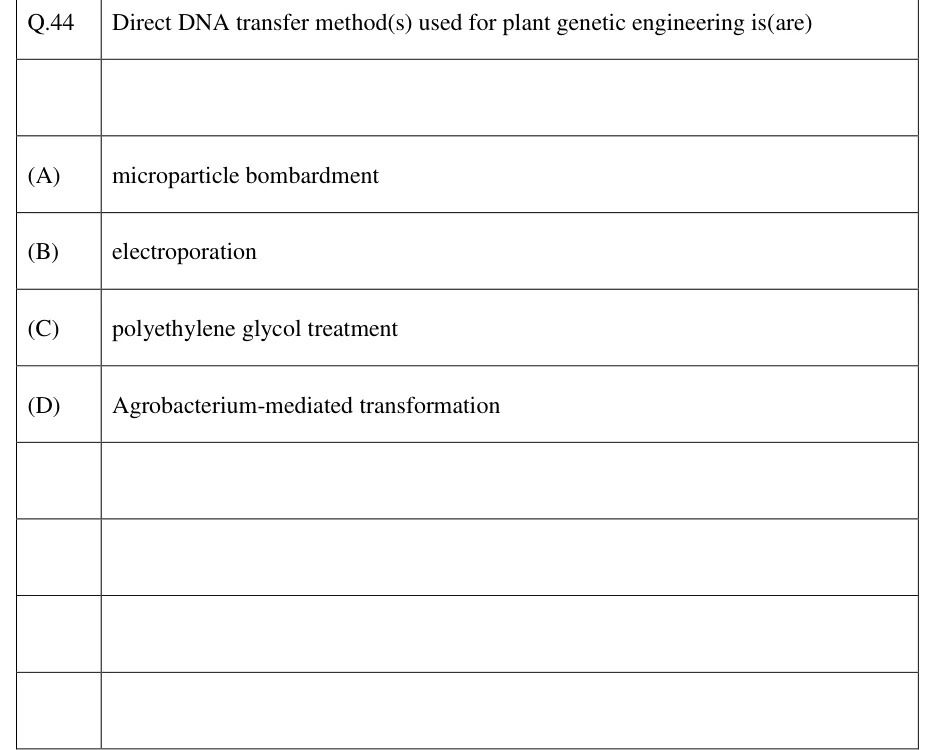
Direct DNA transfer method(s) used for plant genetic engineering is(are)
microparticle bombardment
electroporation
polyethylene glycol treatment
Agrobacterium-mediated transformation
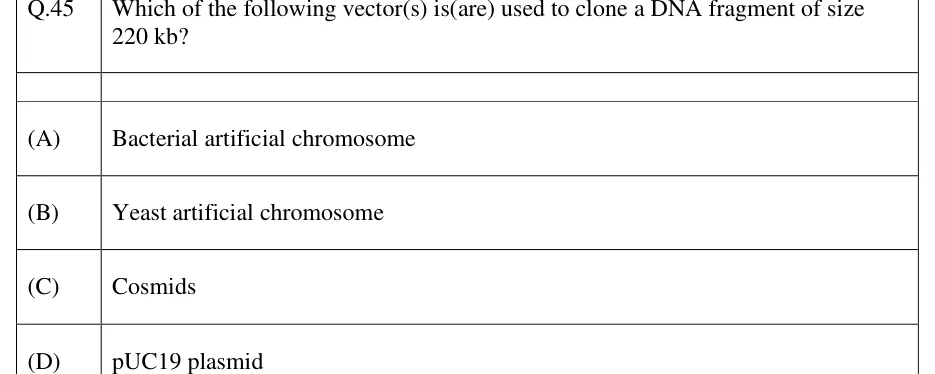
Which of the following vector(s) is(are) used to clone a DNA fragment of size 220 kb?
Bacterial artificial chromosome
Yeast artificial chromosome
Cosmids
pUC19 plasmid
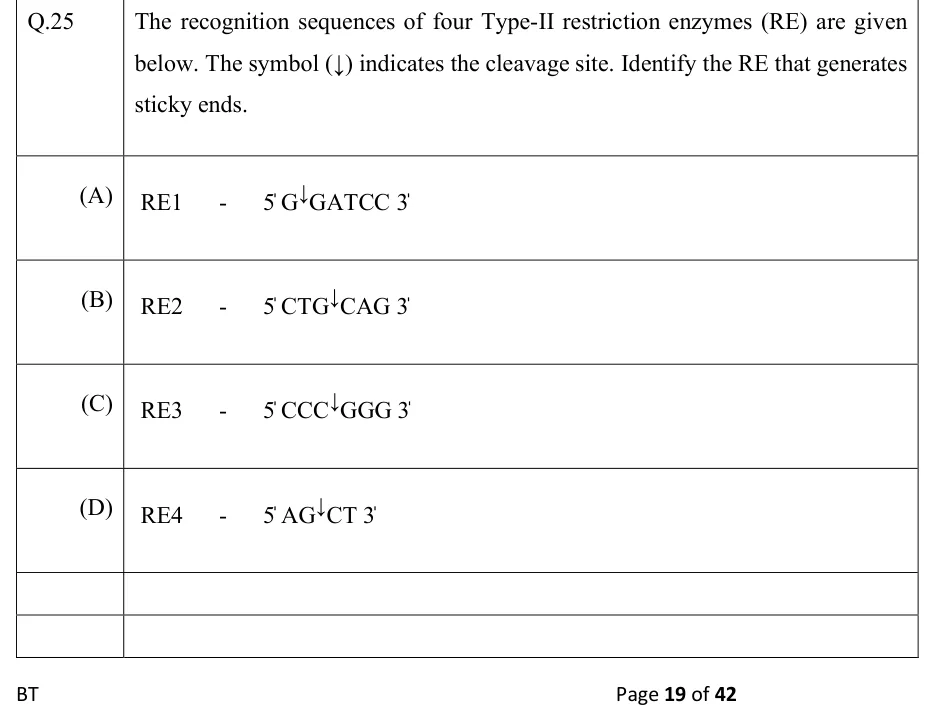
The recognition sequences of four Type-II restriction enzymes (RE) are given below. The symbol (↓) indicates the cleavage site. Identify the RE that generates sticky ends.
RE1 - 5' G↓GATCC 3'
RE2 - 5' CTG↓CAG 3'
RE3 - 5' CCC↓GGG 3'
RE4 - 5' AG↓CT 3'
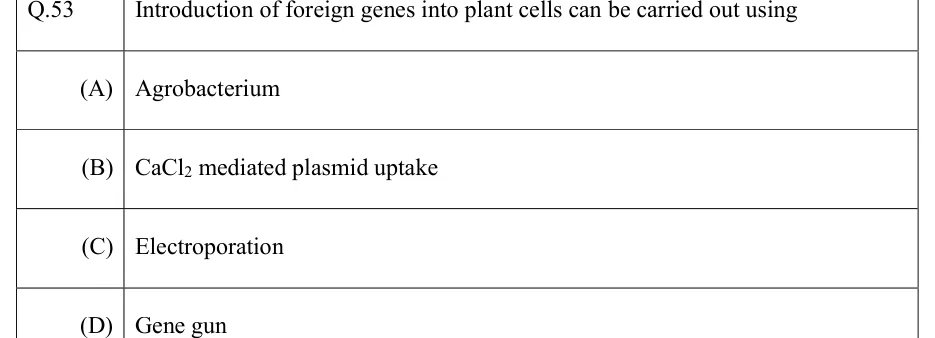
Introduction of foreign genes into plant cells can be carried out using
Agrobacterium
CaCl2 mediated plasmid uptake
Electroporation
Gene gun
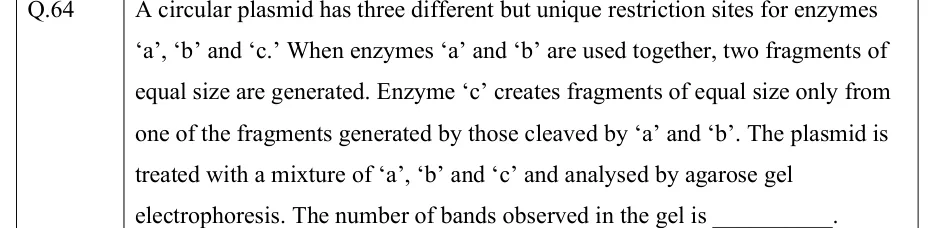
A circular plasmid has three different but unique restriction sites for enzymes 'a', 'b' and 'c.' When enzymes 'a' and 'b' are used together, two fragments of equal size are generated. Enzyme 'c' creates fragments of equal size only from one of the fragments generated by those cleaved by 'a' and 'b'. The plasmid is treated with a mixture of 'a', 'b' and 'c' and analysed by agarose gel electrophoresis. The number of bands observed in the gel is ___________.
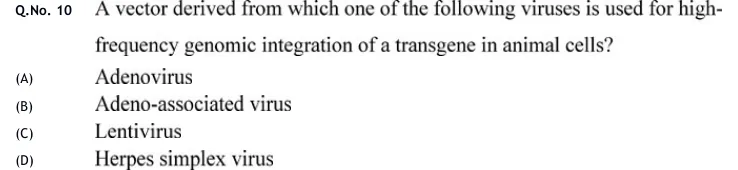
A vector derived from which one of the following viruses is used for high-frequency genomic integration of a transgene in animal cells?
Adenovirus
Adeno-associated virus
Lentivirus
Herpes simplex virus
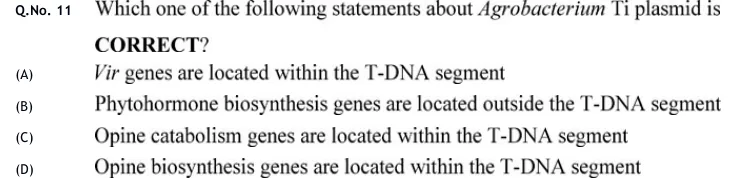
Which one of the following statements about Agrobacterium Ti plasmid is CORRECT?
Vir genes are located within the T-DNA segment
Phytohormone biosynthesis genes are located outside the T-DNA segment
Opine catabolism genes are located within the T-DNA segment
Opine biosynthesis genes are located within the T-DNA segment
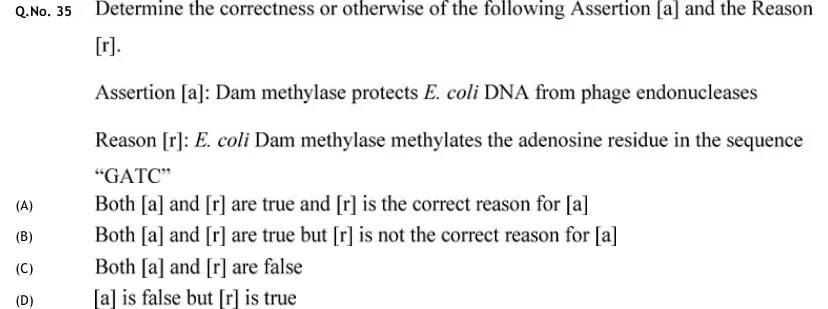
Determine the correctness or otherwise of the following Assertion [a] and the Reason [r].
Assertion [a]: Dam methylase protects E. coli DNA from phage endonucleases
Reason [r]: E. coli Dam methylase methylates the adenosine residue in the sequence "GATC"
Both [a] and [r] are true and [r] is the correct reason for [a]
Both [a] and [r] are true but [r] is not the correct reason for [a]
Both [a] and [r] are false
[a] is false but [r] is true
The sequence of a 1 Mb long DNA is random. This DNA has all four bases occurring in equal proportion. The number of nucleotides, on average, between two successive EcoRI recognition site GAATTC is ____________.
PRACTICE
A 6.0 kb circular plasmid has exactly three sites for an enzyme. Complete digestion gives fragments of 3.0, 2.0 and 1.0 kb. In a partial digest, a molecule may be cut at one, two or all three of its sites. Ignoring uncut circular plasmid, how many distinct linear fragment sizes (in kb) can appear on the gel?
Answer:
Cut at one site: the circle is only opened, giving a 6.0 kb linear molecule.
Cut at two sites: this releases one complete-digest fragment plus the other two fragments still joined. On a circle with 3 sites, any two fragments are adjacent. The products are 3.0 + (2.0+1.0 = 3.0), 2.0 + (3.0+1.0 = 4.0), and 1.0 + (3.0+2.0 = 5.0) kb.
Cut at all three sites: 3.0, 2.0 and 1.0 kb.
Distinct sizes: 6.0, 5.0, 4.0, 3.0, 2.0 and 1.0 kb. The 3.0 kb complete fragment and the 3.0 kb (2.0+1.0) partial product have the same size and run at the same position.
Number of distinct sizes = 6.
A restriction enzyme recognises a 6 bp palindromic sequence. Assume a random DNA sequence in which A, T, G and C occur with equal and independent probability at every position. What is the expected average distance, in bp, between two consecutive recognition sites?
Answer:
The probability that a given 6 bp sequence starts at a given position is (1/4)^6 = 1/4096.
The site is palindromic, so it reads the same on both strands and each position is counted once.
The expected spacing is the reciprocal of this probability: 4^6 = 4096 bp.
A plasmid vector carries an ampicillin-resistance gene () and a lacZ sequence containing its multiple cloning site, with a unique EcoRI site. EcoRI-cut foreign DNA is ligated into EcoRI-cut vector and transformed into an E. coli host carrying lacZΔM15 (which supplies the complementing ω-fragment). Cells are plated on ampicillin + X-gal + IPTG. A white colony on this plate most likely contains:
Recircularised vector with no insert
Vector with the insert disrupting lacZ, with the ampicillin-resistance gene intact
Vector with the insert disrupting the ampicillin-resistance gene
No plasmid at all
Answer: (B)
The colony grew on ampicillin, so it has a plasmid with an intact gene. This rules out C (no resistance) and D (plasmid-free cells die).
Recircularised vector keeps lacZα intact. α-complementation with the host's ω-fragment gives active β-galactosidase, which turns X-gal blue. This rules out A.
A white colony means lacZα has been disrupted, i.e. an insert is in the EcoRI site within lacZα. The answer is B.
'Most likely' because a small deletion at the cloning site can occasionally give a white colony with no insert, so white colonies are confirmed by colony PCR or restriction digestion.
Which enzyme is used to prevent self-ligation (recircularisation) of a linearised vector before ligating it to an insert?
Terminal deoxynucleotidyl transferase
Alkaline phosphatase
Polynucleotide kinase
DNA polymerase I (Klenow)
Answer: (B)
DNA ligase joins a 3'-OH to an adjacent 5'-phosphate.
Alkaline phosphatase removes the 5'-phosphates from the vector ends.
With no 5'-phosphate at either end, the vector's own two ends cannot be joined, so it cannot recircularise alone.
The untreated insert still has its 5'-phosphates, so vector-insert ligation proceeds. Each junction keeps one nick (at the dephosphorylated vector 5' end), which the host repairs after transformation. TdT adds tails, PNK adds phosphates (the opposite effect), and Klenow fills in ends.
Which of the following statements about cloning vectors are correct?
A cosmid carries the phage λ cos site and can be packaged in vitro into λ phage heads, accepting inserts of about 35–45 kb
A YAC contains a centromere, two telomeres and an autonomously replicating sequence, and can carry inserts from several hundred kb to over 1 Mb
A BAC replicates from the F-plasmid origin (oriS) at one copy per cell, which favours stability of large inserts
Blue-white screening reports directly on whether the cloned gene is being expressed as protein
Answer: (A), (B), (C)
A is correct. λ heads package about 38–51 kb of DNA between cos sites. A cosmid itself is only about 5 kb, so inserts of about 35–45 kb give a packageable molecule.
B is correct. CEN, two TEL and ARS let the YAC replicate and segregate as a linear yeast chromosome, which allows inserts of hundreds of kb to about 1–2 Mb.
C is correct. BACs use the F-plasmid replication and partition genes (oriS, repE, parA, parB) and are kept at one copy per cell, which reduces rearrangement of large inserts.
D is incorrect. Blue-white screening reports only whether an insert has disrupted lacZα, i.e. whether an insert is present. It says nothing about whether the cloned gene is transcribed or translated.
BamHI recognises 5'-G^GATCC-3'. In a genome of 60% GC content in which each base position is independent (G and C equally frequent, A and T equally frequent), what is the expected average spacing, in bp, between BamHI sites? Give the answer to the nearest whole number.
Answer: (accepted range )
P(G) = P(C) = 0.60/2 = 0.30, and P(A) = P(T) = 0.40/2 = 0.20.
GGATCC contains 4 G/C bases and 2 A/T bases.
.
The site is palindromic, so it is counted once per position. The average spacing is bp.
OFFICIAL GATE 2027 SYLLABUS WORDING
Copied from the GATE 2027 syllabus; see all 2027 syllabi.
GATE BT
Restriction and modification enzymes; Vectors - plasmids, bacteriophage and other viral vectors, cosmids, Ti plasmid, bacterial and yeast artificial chromosomes; Expression vectors
Preparing in Kolkata? IAE Academy's course for GATE BT.