IAE Academy

GATE 2022 BT Q.25: solution and answer

GATE 2022 · BTQ.25 · 1 mark · MCQ

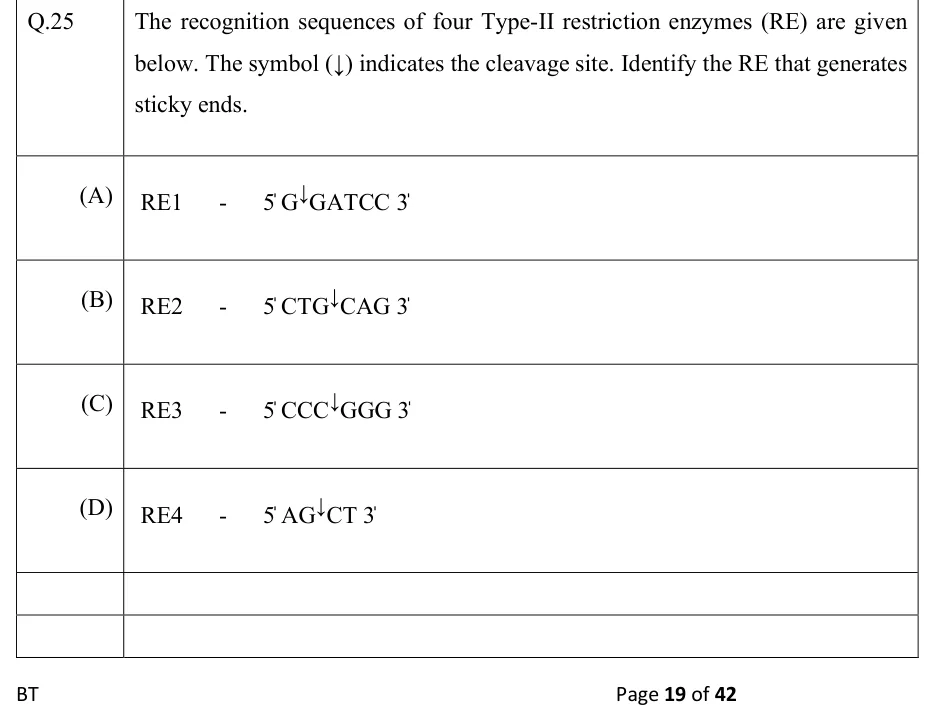
The recognition sequences of four Type-II restriction enzymes (RE) are given below. The symbol (↓) indicates the cleavage site. Identify the RE that generates sticky ends.

  1. (A)

    RE1 - 5' G↓GATCC 3'

  2. (B)

    RE2 - 5' CTG↓CAG 3'

  3. (C)

    RE3 - 5' CCC↓GGG 3'

  4. (D)

    RE4 - 5' AG↓CT 3'

See the question in the paper

Answer and solution

ANSWER

The correct answer is (A) RE1 (5′ G↓GATCC 3′), since it is the only enzyme among the four that cuts off-centre from the site's axis of symmetry, producing a staggered (sticky) end; RE2, RE3 and RE4 all cut exactly at the centre of their palindromic sites, producing blunt ends.

Official answer: ASource: Official answer key, GATE 2022 BT (IIT Kharagpur)

  1. Each of the four recognition sequences is a palindrome (its reverse complement equals itself), so whether the cut is symmetric or offset relative to the site's own centre determines blunt vs sticky ends.

  2. RE1: 5' G↓GATCC 3' — a 6 bp site. The cut falls after base 1 (1 base from one end, 5 from the other) — offset from the centre (which would be after base 3). Because the site is palindromic, the enzyme cuts the complementary strand at the mirror position too, leaving a 4-nucleotide single-stranded 5'-GATC overhang on each fragment → sticky (cohesive) ends. (This is the actual BamHI cutting pattern.)

  3. RE2: 5' CTG↓CAG 3' — a 6 bp palindromic site (reverse complement of CTGCAG is CTGCAG). The cut falls after base 3, exactly the centre of the 6-bp site → both strands are cut at the same relative position → blunt ends.

  4. RE3: 5' CCC↓GGG 3' — a 6 bp palindromic site (the classic SmaI site). Cut after base 3 = the exact centre → blunt ends, no overhang.

  5. RE4: 5' AG↓CT 3' — a 4 bp palindromic site (the classic AluI site). Cut after base 2 = the exact centre of a 4-bp site → blunt ends.

  6. Only RE1 cuts off-centre relative to its site's axis of symmetry, generating a protruding single-stranded (sticky/cohesive) end; RE2, RE3 and RE4 all cut exactly at the centre of symmetry, generating flush (blunt) ends.

  7. Hence the enzyme that generates sticky ends is RE1 → option (A).

KEY IDEA

For a palindromic (double-stranded-symmetric) restriction site, an enzyme produces sticky (cohesive) ends when its cleavage point on each strand is offset from the site's centre of symmetry (leaving a single-stranded overhang), and blunt ends when the cleavage point sits exactly at that centre (both strands cut in register).

WATCH OUT FOR

Assuming any recognition site with a "↓" symbol off-centre in the way it is typeset must be sticky, without actually locating the site's own centre of symmetry for each different site length (6 bp vs 4 bp) — e.g. mistakenly treating CTG↓CAG (cut after base 3 of 6, i.e. exactly centred) as asymmetric because the arrow "looks" placed differently from G↓GATCC.

From the GATE 2022 BT paper. Every question of this paper · Download the full paper · All 10 Enzymes & vectors questions, with notes

More Enzymes & vectors questions