
IAE Academy

GATE 2026 EE Q.27: solution and answer

GATE 2026 · EEQ.27 · 1 mark · MCQ

The figure shows a straight-line approximation for the forward characteristics of a power diode. A continuous on-state current of 15 A is flowing through the diode. What is the power loss in the diode?
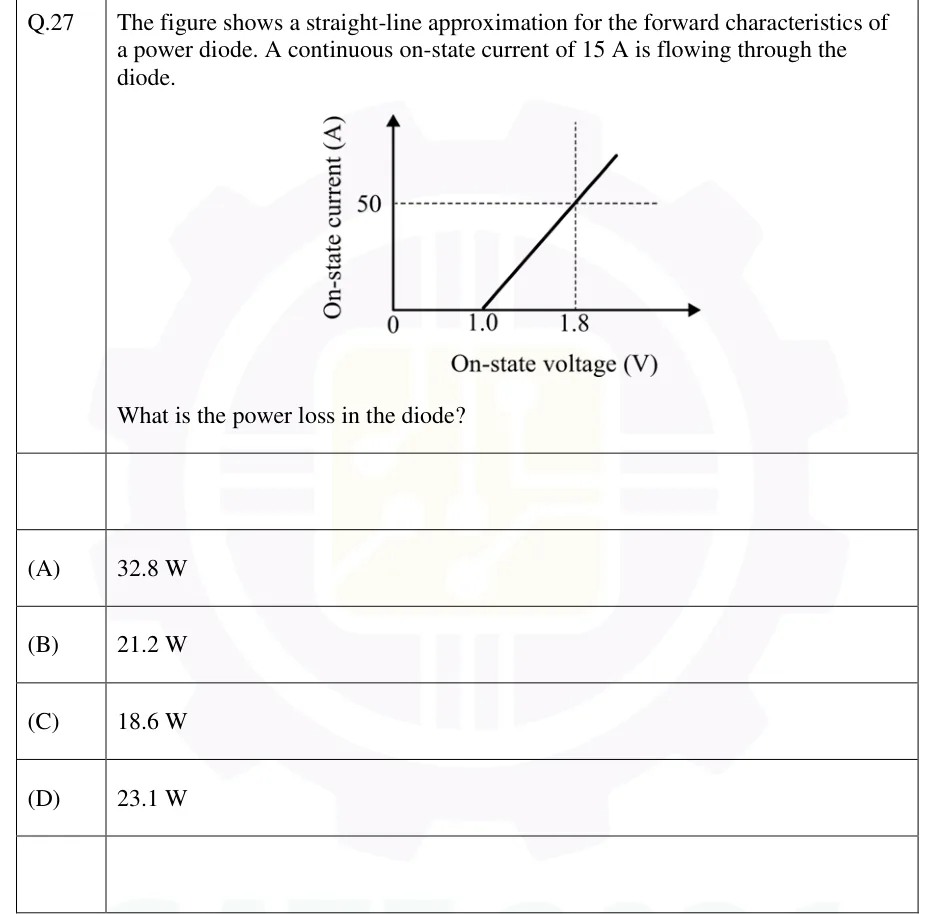
GATE 2026 EE question 27: Plot with horizontal axis 'On-state voltage (V)' and vertical axis 'On-state current (A)', origin 0.Tap to open full size
Figure from the GATE 2026 EE paper. It is part of the question.
Figure description

Plot with horizontal axis 'On-state voltage (V)' and vertical axis 'On-state current (A)', origin 0. A straight line starts on the voltage axis at 1.0 V (zero current) and rises to the right. A dashed horizontal line from the 50 A mark on the current axis and a dashed vertical line from 1.8 V on the voltage axis meet the straight line at the point (1.8 V, 50 A). The line continues slightly beyond that point.

  1. (A)

    32.8 W

  2. (B)

    21.2 W

  3. (C)

    18.6 W

  4. (D)

    23.1 W

Answer and solution

ANSWER

The power loss in the diode is 18.6 W, option (C).

Official answer: CSource: Official answer key, GATE 2026 EE (IIT Guwahati)

  1. The straight-line model of a power diode is a threshold voltage in series with a resistance: .

  2. From the graph the line leaves the voltage axis at (where the current is zero).

  3. The line passes through (the dashed lines meet on it), so .

  4. At the on-state voltage is .

  5. The current is continuous (dc), so the instantaneous and average loss are the same: .

  6. Check with the split form: . This matches option (C).

KEY IDEA

Replace the diode by a threshold voltage in series with a slope resistance read from the straight-line characteristic. For continuous current , the loss is .

WATCH OUT FOR

Using the 1.8 V point as the on-state voltage at 15 A (giving 27 W), or taking with no threshold voltage. The line does not pass through the origin. The slope is measured from the 1.0 V intercept, not from zero.

From the GATE 2026 EE paper. Every question of this paper · Download the full paper · All 9 Switches questions, with notes

More Switches questions