
IAE Academy

GATE 2026 IN Q.39: solution and answer

GATE 2026 · INQ.39 · 2 marks · MCQ

A two-port network has z-parameters , and .

The value of such that maximum power is transferred to is ________ .
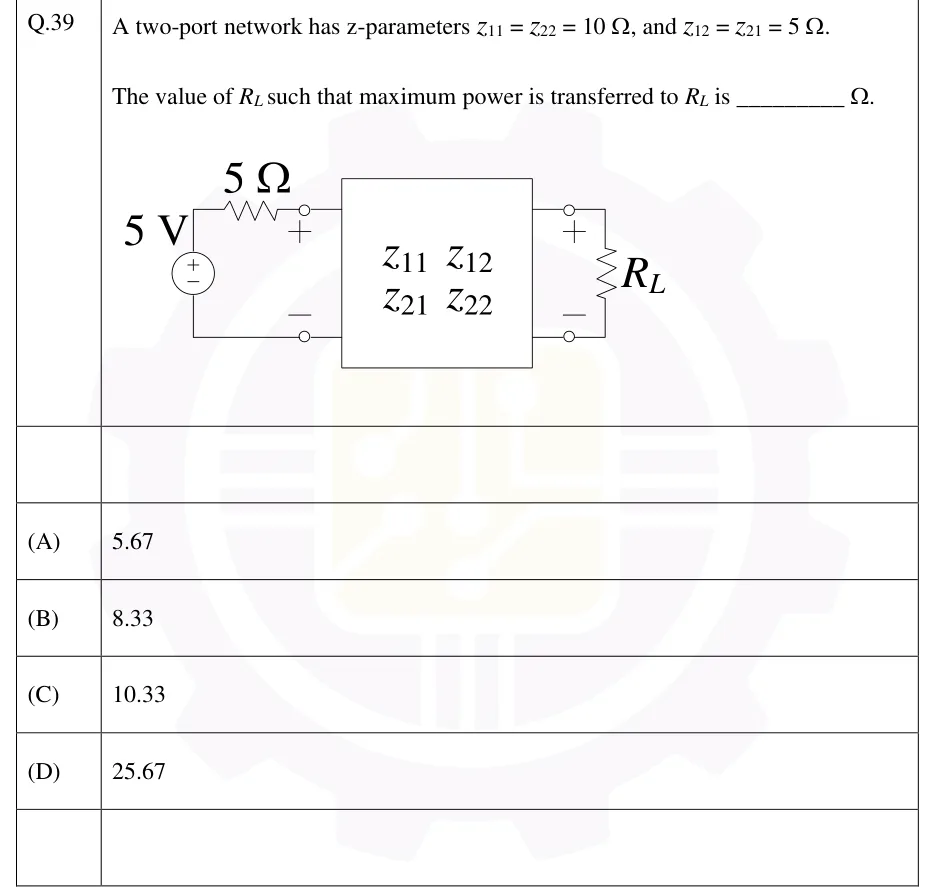
GATE 2026 IN question 39: A two-port network is drawn as a box labelled with the matrix entries z11 z12 (top row) and z21 z22 (bottom row).Tap to open full size
Figure from the GATE 2026 IN paper. It is part of the question.
Figure description

A two-port network is drawn as a box labelled with the matrix entries z11 z12 (top row) and z21 z22 (bottom row). Port 1 on the left: a 5 V independent voltage source (+ at top, - at bottom) in series with a 5 Ω resistor. The resistor connects from the top of the source to the top terminal of port 1 (marked +). The bottom of the source goes to the bottom terminal of port 1 (marked -). Port 2 on the right: its top terminal (+) and bottom terminal (-) connect across a load resistor R_L.

  1. (A)

    5.67

  2. (B)

    8.33

  3. (C)

    10.33

  4. (D)

    25.67

Answer and solution

ANSWER

, option (B).

Official answer: BSource: Official answer key, GATE 2026 IN (IIT Guwahati)

  1. Port equations from the z-parameters, with both port currents taken as flowing into the network: and .

  2. Source constraint at port 1 (KVL around the 5 V source and the resistor): .

  3. To find the Thevenin impedance seen by , kill the 5 V source (replace it with a short) and drive port 2 with a test source that pushes current into the network. Port 1 is now loaded only by the resistor, so .

  4. Substitute into the first port equation: , so and .

  5. Substitute into the second port equation: . Hence

  6. Maximum power transfer theorem: with a purely resistive Thevenin impedance, a resistive load draws maximum power when , which is option (B). The open-circuit voltage, , sets how much power reaches the load but does not change the value of that maximises it.

KEY IDEA

Set equal to the Thevenin impedance at port 2. That impedance is the network's output impedance with the source's own resistance () loading port 1: .

WATCH OUT FOR

Leaving out the source resistance: . Taking , which is the output impedance only when port 1 is open. Adding the correction term instead of subtracting it, which gives . Another mistake is killing the 5 V source by open-circuiting it; a voltage source is killed by shorting it, so the resistor stays connected across port 1.

From the GATE 2026 IN paper. Every question of this paper · Download the full paper · All 11 Two-port questions, with notes

More Two-port questions