IAE Academy

GATE 2025 EE Q.19: solution and answer

GATE 2025 · EEQ.19 · 1 mark · MCQ

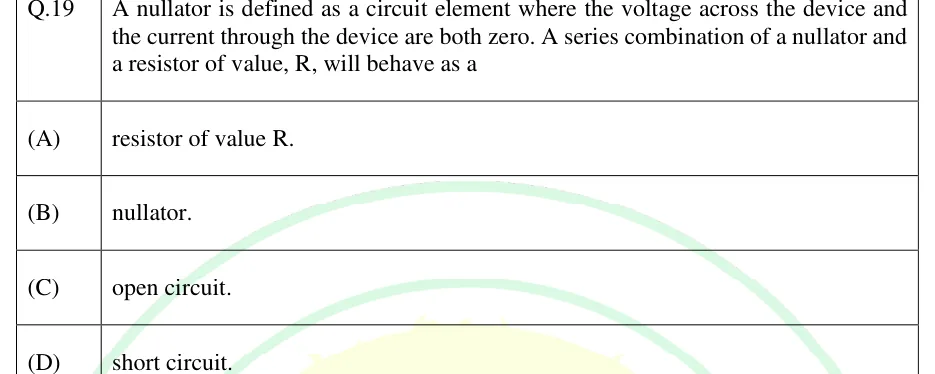
A nullator is defined as a circuit element where the voltage across the device and the current through the device are both zero. A series combination of a nullator and a resistor of value, R, will behave as a

  1. (A)

    resistor of value R.

  2. (B)

    nullator.

  3. (C)

    open circuit.

  4. (D)

    short circuit.

See the question in the paper

Answer and solution

ANSWER

The series combination forces both the terminal current and the terminal voltage to zero, so it behaves as a nullator: option (B).

Official answer: BSource: Official answer key, GATE 2025 EE (IIT Roorkee)

  1. Nullator constraint (from the definition): and at the same time.

  2. Series connection (KCL at the internal node): the same current flows through both elements, so , and therefore .

  3. Ohm's law on the resistor: .

  4. KVL around the series branch: the terminal voltage is .

  5. So the two-terminal combination has and together. That is exactly the definition of a nullator.

  6. It is not an open circuit, which only forces and leaves the voltage free. It is not a short circuit, which only forces and leaves the current free. It is not a resistor of value , because would allow any non-zero pair. Here both and are fixed at zero, so the answer is (B).

KEY IDEA

A nullator fixes BOTH and . In series, its passes to the resistor (KCL), which then has (Ohm's law), so the terminal voltage is also zero (KVL). A nullator in series with any element that has finite impedance is still a nullator.

WATCH OUT FOR

Seeing only the zero current and picking open circuit (C), or seeing only the zero voltage and picking short circuit (D). An open circuit leaves the voltage free and a short circuit leaves the current free. Here both are pinned to zero, which is a nullator, not either of the ideal limits.

From the GATE 2025 EE paper. Every question of this paper · Download the full paper · All 25 Laws & node/mesh questions, with notes

More Laws & node/mesh questions