
IAE Academy

NETWORKS (ELECTRIC CIRCUITS) · AC, POWER & RESONANCE

GATE 2026 IN, question 33: AC, power & resonance — solution and answer

GATE 2026 · INQ.33 · 1 mark · NAT Checked against the official key

In a series circuit shown in the figure, the current through the resistor lags the AC source voltage by . Let and .

The frequency of the source is ____ Hz. (rounded off to the nearest integer)
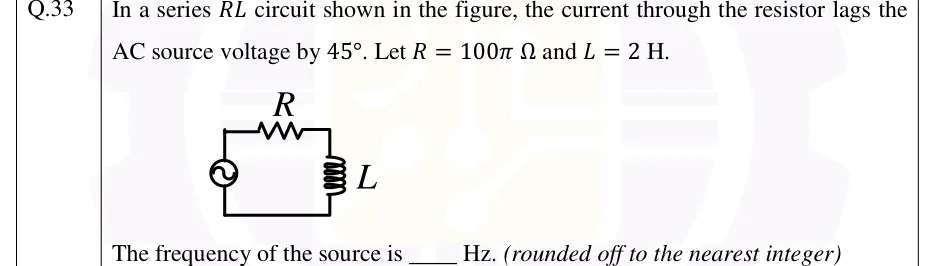
GATE 2026 IN question 33, as printed: A single-loop series circuit.Tap to open full size
As printed in the GATE 2026 IN paper — the figure is part of the question.
Figure description

A single-loop series circuit. An AC voltage source (a circle with a sine symbol) is on the left side of the loop. A resistor labelled R is on the top wire. An inductor (a coil) labelled L is on the right side. A plain wire along the bottom closes the loop back to the source. The figure shows only the symbols R and L. Their values are given in the stem. Source, R and L are all in series, so the same current flows through all three.

Answer and worked solution

ANSWER

The source frequency is 25 Hz, which matches the official key of 25.

Official key: 25 to 25 · Official answer key, GATE 2026 IN (IIT Guwahati)

  1. Series circuit, one current. R and L carry the same current, so the current through the resistor is the circuit current. The impedance is .

  2. Phase angle of a series RL circuit. With the source voltage as reference, , so the current lags the source voltage by the angle of :

  3. Use the 45° condition. gives , so :

  4. Convert angular frequency to hertz.

  5. Check. At , . So and the current lags the voltage by , as the question says. The answer is exactly 25, so no rounding is needed.

KEY IDEA

In a series RL circuit the current lags the source voltage by . A 45° lag means , so . Here the π in cancels the π in .

COMMON MISTAKE

Stopping at and entering that as the answer. That number is the angular frequency in rad/s, not the frequency in Hz. Another slip is to drop the π from and get Hz.

From the GATE 2026 IN paper. Every question of this paper · Download the full paper · All 34 AC, power & resonance questions, with notes

More AC, power & resonance questions