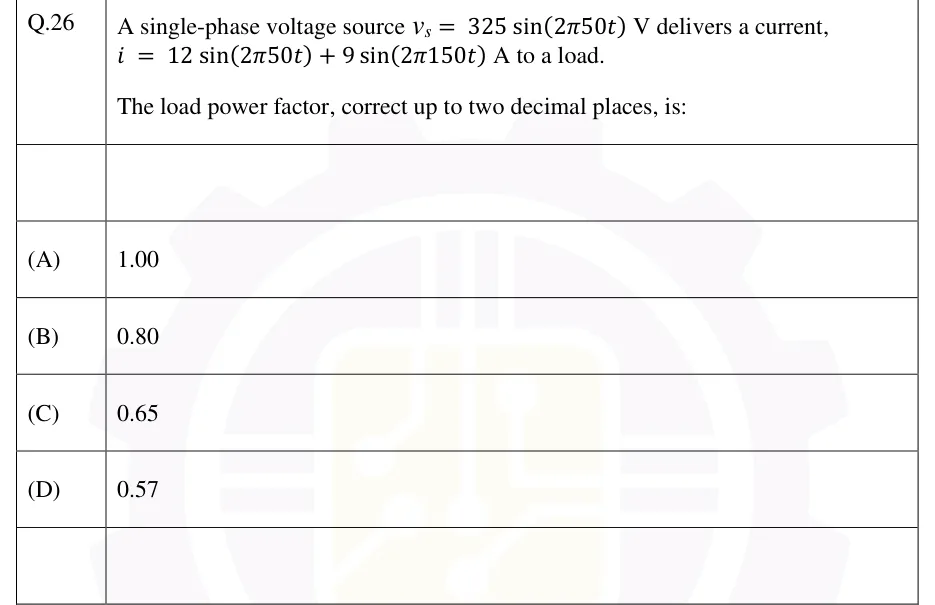
A single-phase voltage source V delivers a current, A to a load.
The load power factor, correct up to two decimal places, is:
- (A)
1.00
- (B)
0.80
- (C)
0.65
- (D)
0.57

A single-phase voltage source V delivers a current, A to a load.
The load power factor, correct up to two decimal places, is:
1.00
0.80
0.65
0.57
ANSWER
The load power factor is 0.80, option (B). The 3rd-harmonic current adds to the rms current, and so to the apparent power, but carries no real power because the voltage is a pure 50 Hz sinusoid. So PF = 1950 W / 2437.5 VA = 0.80.
Official answer: BSource: Official answer key, GATE 2026 EE (IIT Guwahati)
RMS values. The source is a pure 50 Hz sinusoid, so . The current has a 50 Hz fundamental and a 150 Hz (3rd-harmonic) component: and .
Total rms current. Components of different frequency are orthogonal over a period, so their rms values add in quadrature:
Real power. Average power comes only from voltage and current components of the same frequency. The voltage has no 150 Hz component, so the 3rd-harmonic current contributes no real power. The fundamental current, , is in phase with , so :
Apparent power:
Power factor:
Check with the factorised form: PF = (displacement factor) × (distortion factor) . Answer: (B).
KEY IDEA
When the voltage is purely sinusoidal, only the fundamental current carries real power, but every harmonic adds to the rms current. So PF = P/S = cos φ₁ × (I₁/I_rms). Here that is the displacement factor (1) times the distortion factor (12/15), which gives 0.80.
WATCH OUT FOR
One mistake is taking the power factor as cos φ₁ = 1 because the fundamental is in phase, which ignores the harmonic and gives option (A). Another is adding the current amplitudes directly, 12 + 9 = 21, instead of in quadrature, which gives 12/21 ≈ 0.57, option (D). The same 0.57 also comes from wrongly using 1/(1 + THD) with THD = 0.75.
From the GATE 2026 EE paper. Every question of this paper · Download the full paper · All 34 AC, power & resonance questions, with notes