
IAE Academy

GATE 2018 EE Q.55: solution and answer

GATE 2018 · EEQ.55 · 2 marks · NAT

The voltage across the terminals and as shown in the figure, is a sinusoidal voltage having a frequency radian/s. When the inductor current is in phase with the voltage , the magnitude of the impedance (in ) seen between the terminals and is ________ (up to 2 decimal places).
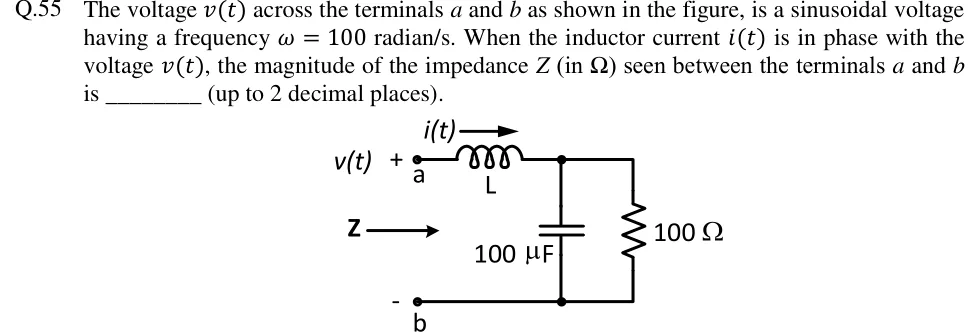
GATE 2018 EE question 55: Terminals a (top, marked +) and b (bottom, marked -), with v(t) applied across them and an arrow labelled Z pointing into…Tap to open full size
Figure from the GATE 2018 EE paper. It is part of the question.
Figure description

Terminals a (top, marked +) and b (bottom, marked -), with v(t) applied across them and an arrow labelled Z pointing into the network from the a-b side. From terminal a, an inductor L is in series along the top wire, carrying current i(t) with its arrow pointing right (away from a). The right end of the inductor meets a top node. Between this top node and the bottom wire (which runs straight back to terminal b) there are two branches in parallel: a 100 µF capacitor and a 100 Ω resistor. So the circuit is L in series with (100 µF parallel with 100 Ω), seen from a-b.

Answer and solution

ANSWER

. The series inductor () cancels the reactance of the RC parallel branch, leaving only its resistive part.

Official answer: 50.0Source: Official answer key, GATE 2018 EE (IIT Guwahati)

  1. Capacitor reactance at : , so the capacitor's impedance is .

  2. Parallel combination of R and C:

  3. Total impedance seen from a-b (L in series with ): .

  4. In-phase condition: the inductor sits in series with the terminals, so the inductor current is the terminal current. in phase with therefore means is purely resistive: .

  5. Magnitude at that condition: , so .

KEY IDEA

Because the inductor carries the terminal current, "i in phase with v" means the whole input impedance is purely resistive. First reduce the parallel R-C branch to its series form, . The inductor's has to cancel the , so the resistive part left over, , is . You don't need to find L to get the answer.

WATCH OUT FOR

A common mistake is to resonate L with the capacitor alone, using , which gives . That ignores the parallel resistor. With you get and , and there the current is not in phase with the voltage. Another mistake is to quote as the answer, which leaves out the inductor.

From the GATE 2018 EE paper. Every question of this paper · Download the full paper · All 34 AC, power & resonance questions, with notes

More AC, power & resonance questions