
IAE Academy

GATE 2018 IN Q.8: solution and answer

GATE 2018 · INQ.8 · 1 mark · NAT

A coil having an impedance of is connected in parallel to a variable capacitor as shown in figure. Keeping the excitation frequency unchanged, the value of the capacitor is changed so that parallel resonance occurs. The impedance across terminals p-q at resonance (in ) is ______.
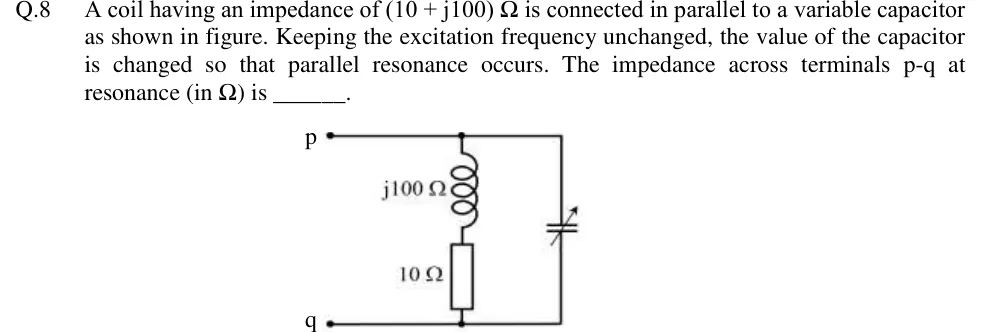
GATE 2018 IN question 8: Two open terminals, p at the top left and q at the bottom left.Tap to open full size
Figure from the GATE 2018 IN paper. It is part of the question.
Figure description

Two open terminals, p at the top left and q at the bottom left. A horizontal wire from p runs right to a top rail; a horizontal wire from q runs right to a bottom rail. Between the rails are two parallel branches. Left branch (the coil): an inductor labelled j100 Ω at the top, in series with a resistor labelled 10 Ω below it, connected from the top rail to the bottom rail. Right branch: a variable capacitor (capacitor symbol with a diagonal arrow through it), connected from the top rail to the bottom rail. So terminals p-q see the series R-L coil (10 + j100) Ω in parallel with the variable capacitor.

Answer and solution

ANSWER

At parallel resonance the impedance across p-q is purely resistive: .

Official answer: 1009 to 1011Source: Official answer key, GATE 2018 IN (IIT Guwahati)

  1. Frequency is fixed, so the coil stays at . Only the capacitor's susceptance changes.

  2. Admittance of the coil:

  3. Parallel resonance means the total admittance is purely real, so the capacitor has to cancel the coil's susceptance: .

  4. At resonance only the coil's conductance is left: .

  5. Impedance across p-q:

  6. Check with the dynamic-resistance form: with , which gives , purely resistive.

KEY IDEA

A lossy coil (R in series with L) in parallel with a capacitor resonates when the capacitor's susceptance cancels the coil's susceptance. This is the unity-power-factor condition: total admittance purely real. Only the coil's conductance is left, so the circuit looks like the dynamic resistance . For a high-Q coil this is roughly .

WATCH OUT FOR

Treating resonance as and then combining with in parallel gives . That is not purely resistive, so it is not resonance. With the coil resistance present, the capacitor has to cancel the coil's susceptance ( S), not its reactance. A second slip is answering , as if the circuit were series resonant: at parallel resonance the impedance is at its largest, not its smallest.

From the GATE 2018 IN paper. Every question of this paper · Download the full paper · All 34 AC, power & resonance questions, with notes

More AC, power & resonance questions