
IAE Academy

GATE 2025 IN Q.56: solution and answer

GATE 2025 · INQ.56 · 2 marks · NAT

Consider an AC bridge shown in the figure with , , , , and a detector D. At the bridge balance condition, the frequency of the excitation source is ________ kHz (rounded off to two decimal places).
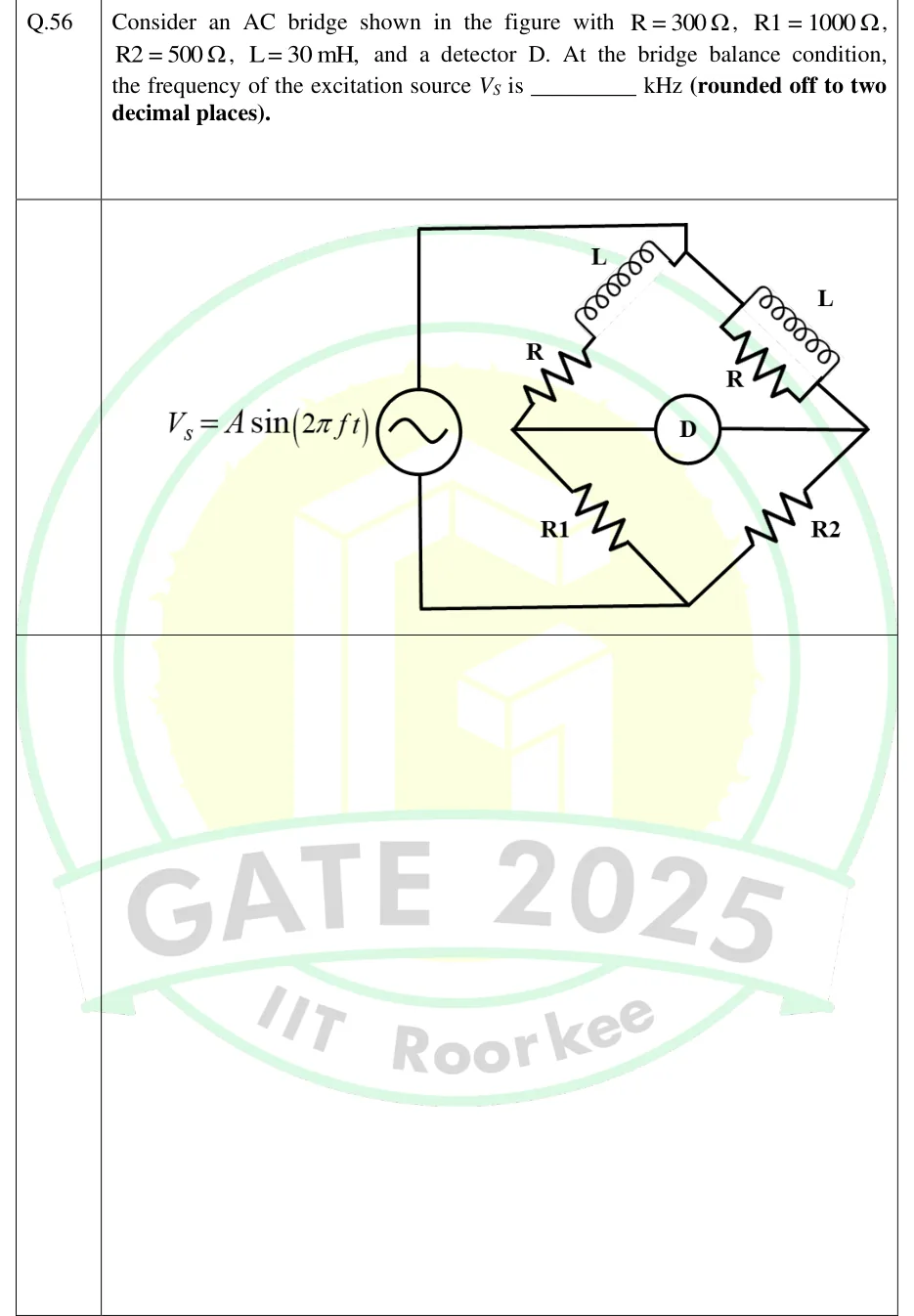
GATE 2025 IN question 56: A four-arm bridge drawn as a diamond with top, left, right and bottom vertices.Tap to open full size
Figure from the GATE 2025 IN paper. It is part of the question.
Figure description

A four-arm bridge drawn as a diamond with top, left, right and bottom vertices. The source V_s = A sin (2 π f t) connects between the top vertex and the bottom vertex. Detector D connects between the left vertex and the right vertex. Top-left arm (left vertex to top vertex): resistor R in series with inductor L. Top-right arm (top vertex to right vertex): resistor R in parallel with inductor L. Bottom-left arm (left vertex to bottom vertex): resistor R1. Bottom-right arm (right vertex to bottom vertex): resistor R2.

Answer and solution

ANSWER

At balance , so and .

Official answer: 1.55 to 1.65Source: Official answer key, GATE 2025 IN (IIT Roorkee)

  1. Name the arms (top, left, right and bottom vertices of the diamond). Top-left arm, series R and L: . Top-right arm, R in parallel with L: . Bottom-left arm: . Bottom-right arm: . The source is across the top and bottom vertices, and D is across the left and right vertices.

  2. Balance condition: D carries no current when the left and right vertices are at the same potential, i.e. , which simplifies to (products of opposite arms equal). Hence .

  3. Form the ratio:

  4. Equate this to . The real part is already , so the resistance-ratio condition holds at every frequency. The imaginary part must vanish: , so (taking the positive root) .

KEY IDEA

With a series RL arm and a parallel RL arm made of the same R and L, always has real part 2. The resistor ratio therefore holds at every frequency, and balance only needs the imaginary part to vanish, which gives . The bridge balances at only one frequency, so it can be used to measure frequency.

WATCH OUT FOR

Reading the top-right arm as a second series RL branch: then , the ratio is 1 rather than 2, and the bridge can never balance. Other slips: pairing adjacent arms (), which gives a ratio of 1/2 that the real part 2 can never match; stopping at without dividing by ; and entering 1591.55 (in Hz) when the question asks for kHz.

From the GATE 2025 IN paper. Every question of this paper · Download the full paper · All 14 Bridges questions, with notes

More Bridges questions