
IAE Academy

GATE 2025 EE Q.59: solution and answer

GATE 2025 · EEQ.59 · 2 marks · NAT

In the Wheatstone bridge shown below, the sensitivity of the bridge in terms of change in balancing voltage for unit change in the resistance , in , is ________ (round off to two decimal places).
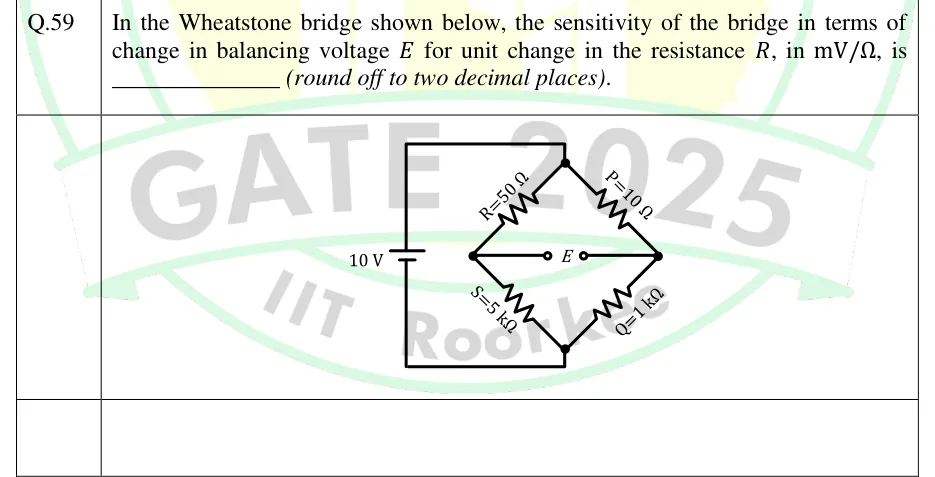
GATE 2025 EE question 59: Diamond-shaped Wheatstone bridge with four nodes: top, left, right and bottom.Tap to open full size
Figure from the GATE 2025 EE paper. It is part of the question.
Figure description

Diamond-shaped Wheatstone bridge with four nodes: top, left, right and bottom. Top-left arm (top node to left node): R = 50 Ω. Top-right arm (top node to right node): P = 10 Ω. Bottom-left arm (left node to bottom node): S = 5 kΩ. Bottom-right arm (right node to bottom node): Q = 1 kΩ. A 10 V DC battery sits on a vertical wire at the far left, with its long (positive) plate on top. The top of that wire connects to the top node and the bottom connects to the bottom node, so the top node is at +10 V relative to the bottom node. The detector output E is taken between the left node (R–S junction) and the right node (P–Q junction), drawn as two open terminals marked E.

Answer and solution

ANSWER

The bridge sensitivity is about 1.96 mV/Ω. The official key accepts 1.94 to 2.00 or -2.00 to -1.94.

Official answer: -2.00 to -1.94, or 1.94 to 2.00Source: Official answer key, GATE 2025 EE (IIT Roorkee)

  1. Check balance with the condition : . The bridge is balanced, so at the operating point.

  2. Take the bottom node as the reference. The battery's positive plate faces the top node, so the top node is at . The battery is connected across both dividers. The left node (R–S junction) is at and the right node is at . does not depend on .

  3. The output is , so only the R–S divider responds to a change in . Differentiating the divider gives

  4. Substitute , and :

  5. The sensitivity is therefore . The minus sign only shows that falls as rises (with measured left node minus right node), which is why the official key accepts either sign.

KEY IDEA

Near balance, only the divider that contains the changed arm moves the detector voltage. With , the sensitivity is . This is the same as the standard small-change result .

WATCH OUT FOR

There are three common slips. The first is using the equal-arm approximation , which gives ; it only holds when all four arms are equal, and here . The second is pairing with the wrong arm, for example using instead of ; and are the two arms in series across the battery, meeting at the left detector terminal. The third is quoting the answer in (0.00196) when the question asks for .

From the GATE 2025 EE paper. Every question of this paper · Download the full paper · All 14 Bridges questions, with notes

More Bridges questions