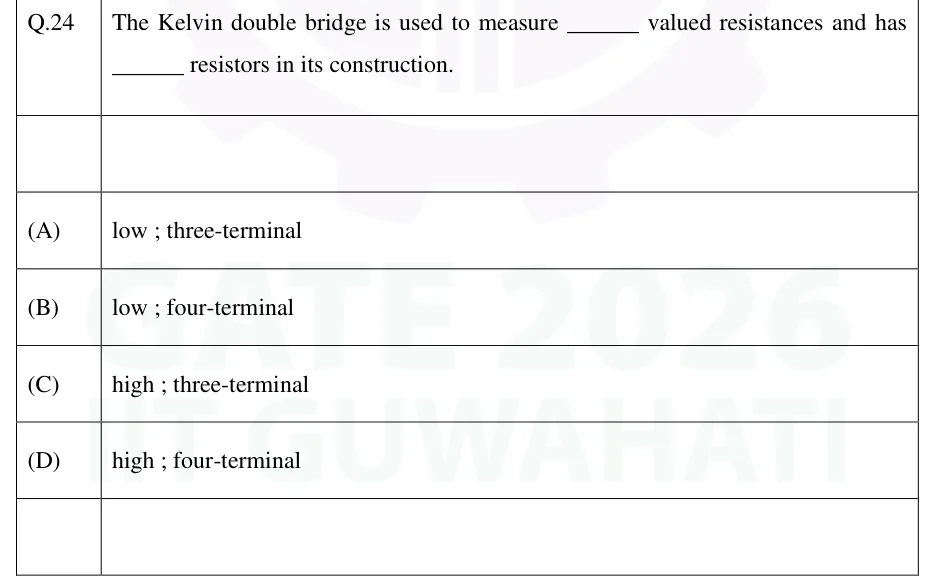
The Kelvin double bridge is used to measure ______ valued resistances and has ______ resistors in its construction.
- (A)
low ; three-terminal
- (B)
low ; four-terminal
- (C)
high ; three-terminal
- (D)
high ; four-terminal

The Kelvin double bridge is used to measure ______ valued resistances and has ______ resistors in its construction.
low ; three-terminal
low ; four-terminal
high ; three-terminal
high ; four-terminal
ANSWER
(B) low ; four-terminal. The Kelvin double bridge measures low resistances (below about 1 ohm) and uses four-terminal resistors, so the current-terminal contact and lead drops fall outside the measured section.
Official answer: BSource: Official answer key, GATE 2026 IN (IIT Guwahati)
Why a Wheatstone bridge fails here. Lead and contact resistances are typically a few milliohms. Against a resistance of hundreds of ohms that is negligible. Against a resistance below it is not. A Wheatstone bridge would then read instead of , and the reading cannot be trusted.
Kelvin's fix: a second pair of ratio arms. The unknown and the standard are joined by a link (the yoke) of resistance . Besides the outer ratio arms , a second pair of ratio arms is connected across the ends of that link. The two sets of ratio arms are why it is called a double bridge.
Balance condition. Let the test current flow through , the link and , and let connect to the -end and the -end of the link. With zero detector current the link is in parallel with , and equating the detector-node potentials gives which rearranges to
Making the link resistance drop out. The ratio arms are ganged so that . The second term then vanishes, leaving , which depends on neither nor the lead resistance. This is the bridge used for resistances below about , down into the range. The first blank is low.
Four-terminal resistors. Both and are built as four-terminal resistors. The two outer current terminals carry the test current. The two inner potential terminals mark out the resistance actually being measured and connect to the ratio arms: to and , to and . The contact and lead drops at the current terminals therefore lie outside the measured section. The second blank is four-terminal.
Ruling out the other options. Three-terminal construction, where the third terminal is a guard that carries surface-leakage current around the detector, is the technique for high resistances such as insulation tests and the megohm bridge. That rules out (C) and (D), which say high, and (A), which pairs low with three-terminal. The answer is (B): low; four-terminal.
KEY IDEA
For a low resistance, lead and contact resistance are comparable to the resistance being measured. The Kelvin double bridge removes them in two ways. The second pair of ratio arms, set so that , cancels the link resistance, leaving . Four-terminal (current + potential) construction of and keeps the contact drops outside the measured section.
WATCH OUT FOR
Mixing up the two terminal techniques. Four-terminal (Kelvin) connection handles LOW resistances by excluding lead and contact drops. Three-terminal (guard) connection handles HIGH resistances by bypassing surface-leakage current. The word "double" may also suggest two measurements or a high range, which pulls students toward (C) or (D).
From the GATE 2026 IN paper. Every question of this paper · Download the full paper · All 14 Bridges questions, with notes