GATE 2025 DA Q.12
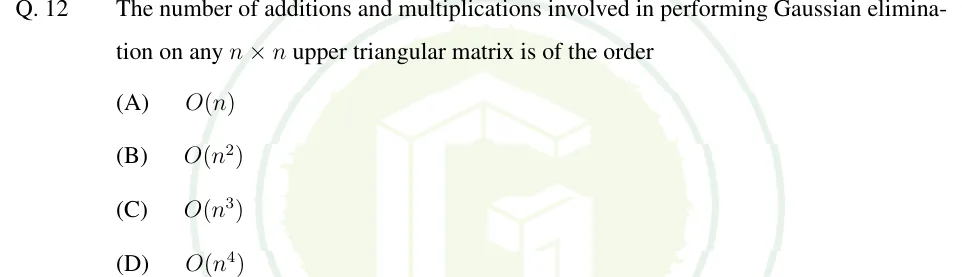
The number of additions and multiplications involved in performing Gaussian elimination on any upper triangular matrix is of the order
- (A)
- (B)
- (C)
- (D)

GATE DA
Systems of linear equations, Gaussian elimination, rank and nullity
A system of linear equations is solved by row-reducing its augmented matrix. The rank of the matrix tells you whether solutions exist and how many there are. Rank and nullity, linked by the rank-nullity theorem, also describe the null space, so the same reduction answers questions on solvability, parametric systems and matrix inverses.
2 previous-year questions · 2 solved · 5 practice questions
Convention: all matrices are real. is an matrix (m equations, n unknowns), and are column vectors in bold, and is the transpose. The system is
, with augmented matrix of size .
The system is consistent if at least one solution exists and inconsistent otherwise. It is homogeneous when ; a homogeneous system is always consistent because is a solution.
The three elementary row operations
Swap two rows.
Multiply a row by a non-zero scalar.
Add a multiple of one row to another row.
Each operation is reversible. Applied to the whole augmented matrix , it does not change the solution set of . It also does not change the row space, the null space or the rank of . It can change the column space of , so never read a column space off the reduced matrix directly; use the pivot positions to pick the original columns of .
Column operations also leave the rank unchanged, so they may be used when only the rank is wanted. Do not use them when solving : they mix the unknowns, and the reduced system no longer has the original variables.
Procedure
Write the augmented matrix .
Working left to right, pick a non-zero entry in the current column (swap rows if needed). This is a pivot. Use it to make every entry below it zero.
Move to the next column and the next row, and repeat until no usable rows or columns are left. The result is a row-echelon form: every zero row is at the bottom, and each pivot lies strictly to the right of the pivot above it.
Read the pivots. A column of with a pivot is a pivot column and its variable is a basic variable. A column of without a pivot gives a free variable.
Back-substitute from the last non-zero row upward, writing each basic variable in terms of the free variables.
Reduced row-echelon form (RREF) goes further: every pivot is 1 and is the only non-zero entry in its column. RREF is unique for a given matrix. A row-echelon form is not unique, but the number and the column positions of its pivots are the same in every echelon form.
RANK AND FREE VARIABLES
Applies to any matrix after row reduction; the rank is the same in every echelon form.
A row of the form with means , so the system is inconsistent. A row carries no information and is dropped.
ROUCHÉ-CAPELLI CONSISTENCY TEST
Equivalent statement: lies in the column space of . Always .
Outcomes for an m by n system, with r = rank(A)
Condition | Number of solutions | Free variables |
|---|---|---|
None (inconsistent) | not applicable | |
Exactly one | 0 | |
Infinitely many |
STRUCTURE OF THE SOLUTION SET
When the system is consistent, is any one particular solution; the general solution adds an arbitrary null-space vector.
Consequences worth remembering: if (full row rank) the system is consistent for every ; if (full column rank) there is at most one solution; for a square matrix with there is exactly one solution for every . A system with fewer equations than unknowns () can never have a unique solution, because .
WORKED EXAMPLE
Solve (a system), and say what happens if the last right-hand side is changed to 14.
Augmented matrix .
gives ; gives .
gives the zero row .
Pivots are in columns 1 and 3, so : consistent with free variable, which is .
Row 2 gives ; row 1 gives .
With 14 instead of 13, gives and then gives , so and there is no solution.
Answer: for any real (infinitely many solutions); with 14 the system is inconsistent.
The null space (kernel) of is , a subspace of . Its dimension is the nullity of . The rank is the dimension of the column space, which equals the dimension of the row space. Equivalently, the rank is the largest for which some submatrix of has a non-zero determinant (a non-zero minor of order ).
RANK-NULLITY THEOREM
is the number of columns of (not rows). Nullity equals the number of free variables in an echelon form of .
RANK BOUNDS
For of size and any product that is defined. For real matrices also .
MORE RANK FACTS
First (Sylvester's inequality): is and is . Second: and have the same size. Third: () and () are invertible. Also, for non-zero and , the matrix has rank 1.
The four fundamental subspaces of an m by n matrix A with rank r
Subspace | Lives in | Dimension |
|---|---|---|
Column space | ||
Row space | ||
Null space | ||
Left null space |
For a real matrix, every vector in is orthogonal to every row of (that is what says), so is the orthogonal complement of the row space in . Likewise is the orthogonal complement of the column space in .
Facts for homogeneous systems $A\mathbf{x}=\mathbf{0}$
A non-trivial solution exists exactly when .
If (fewer equations than unknowns) a non-trivial solution always exists.
For a square matrix: a non-trivial solution exists iff .
The solutions form a subspace with dimension ; a basis is obtained by setting one free variable to 1 and the others to 0, in turn.
WORKED EXAMPLE
Let (). Find the rank, the nullity and a basis of .
gives ; then gives the zero row.
Pivots are in columns 1 and 3, so and, by rank-nullity, .
Free variables are and . Row 2: . Row 1: .
Setting gives ; setting gives .
Check the second vector in row 3 of the original : .
Answer: Rank 2, nullity 2, basis .
INVERSE BY ROW REDUCTION
For a square matrix, with the identity. If the left block cannot be reduced to (a zero row appears in it), is singular and has no inverse.
CRAMER'S RULE
For a square system with . is with its -th column replaced by .
Equivalent conditions for an $n\times n$ matrix $A$
Statement | Meaning |
|---|---|
is invertible | exists |
pivots; RREF is | |
not singular | |
has only | nullity 0 |
has a unique solution for every | |
Columns (and rows) are linearly independent | they span |
is not an eigenvalue of |
The same row reduction that finds also computes the rank: the rank of any matrix is the number of non-zero rows in an echelon form. For a matrix with a parameter, reduce while keeping the parameter symbolic, then examine each special value that makes a pivot vanish. Never divide a row by an expression in the parameter without treating separately the value that makes that expression zero.
EXAM TIP
Parametric square systems: suppose that after reduction every pivot except the last is a non-zero constant, and the last row reads . For every with the solution is unique. At a value with , check : if it is also zero you get infinitely many solutions, and if it is non-zero you get none. If an earlier pivot also depends on , check each of its zeros the same way.
EXAM TIP
Rank-nullity uses the number of columns. For of size with rank 4, , but because has 5 columns.
EXAM TIP
Equal rank does not mean a unique solution. Consistency needs ; uniqueness additionally needs that common rank to equal .
EXAM TIP
Row operations keep the null space and row space, not necessarily the column space. To describe the column space, take the original columns of in the pivot positions.
EXAM TIP
A homogeneous system never has 'no solution'. If a question asks when has non-trivial solutions, the answer is , not an inconsistency condition.
EXAM TIP
Check any particular solution by substituting it back into the original (not reduced) equations; a single arithmetic slip in elimination can lead you to a wrong option.
PREVIOUS-YEAR QUESTIONS
Try each question first, then open the answer. We placed each question under a topic ourselves; the exam paper does not label topics.
See these papers in full: GATE DA 2025 · GATE DA 2024
The number of additions and multiplications involved in performing Gaussian elimination on any upper triangular matrix is of the order
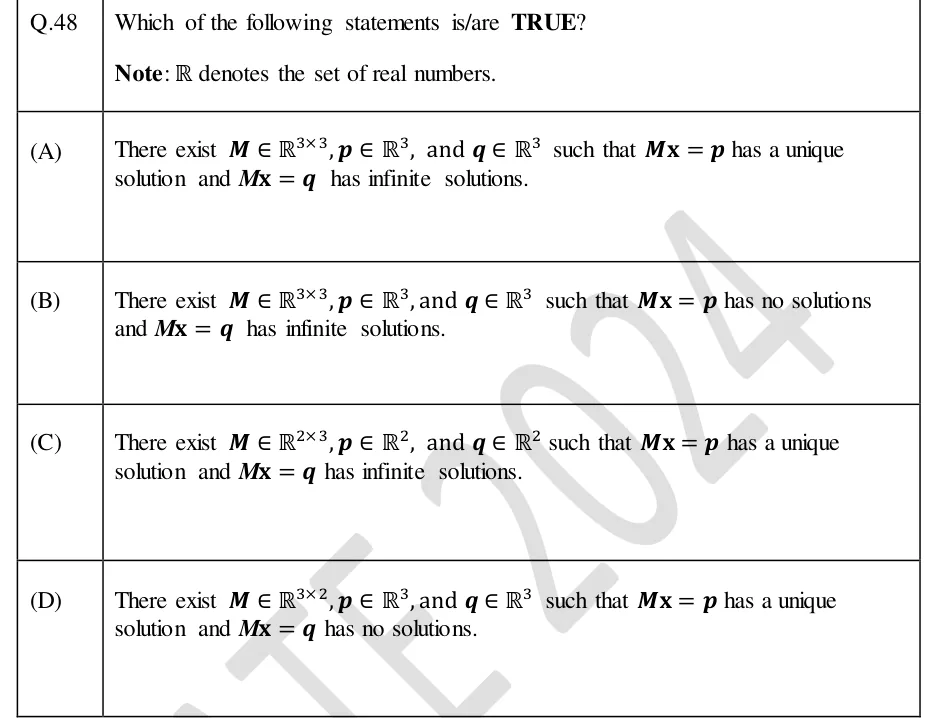
Which of the following statements is/are TRUE?
Note: denotes the set of real numbers.
There exist , , and such that has a unique solution and has infinite solutions.
There exist , , and such that has no solutions and has infinite solutions.
There exist , , and such that has a unique solution and has infinite solutions.
There exist , , and such that has a unique solution and has no solutions.
PRACTICE
For a real number , consider the system . For which value of does the system have infinitely many solutions?
There is no such value of
Answer: (C)
Augmented matrix rows: , , .
: ; : .
: .
The right-hand side of that row is 0, so the system is consistent for every . If the rank is 3 and the solution is unique.
If the last row is zero, the rank is 2 and there is one free variable, so there are infinitely many solutions.
A real matrix has size and rank 4. What is the nullity of (the dimension of the set of with )?
Answer:
.
has size , so it has columns.
By rank-nullity, .
Let be a real matrix with . Which of the following statements must be true?
has only the trivial solution.
For every , the system has at most one solution.
For every , the system is consistent.
The four rows of are linearly independent.
Answer: (A), (B)
Here and , so . Statement A is true.
With a trivial null space, any two solutions of differ by a null-space vector, so they are equal. Statement B is true.
The column space has dimension 3 inside , so it is not all of ; some give an inconsistent system. C is false.
The rows of are four vectors in , and any four vectors in are linearly dependent (equivalently, the row space has dimension 3). D is false.
The real system has a unique solution . What is the value of ?
12
13
14
15
Answer: (C)
The coefficient determinant is , so the solution is unique.
From the first equation .
Substituting in the second: , so and .
Substituting in the third: , so .
Then gives , so , , .
Check in all three equations: , , . Hence .
Let (). Using row reduction on , find the entry in row 1, column 3 of .
Answer:
Write with rows , , . is upper triangular with every pivot equal to 1, so only upward elimination is needed.
Clear column 3 above its pivot: gives . Row 1 already has 0 in column 3.
Clear column 2 above its pivot: gives .
So . Check: row 1 of times column 3 of is , and row 3 of times column 3 is , as required for .
The entry in row 1, column 3 is .
OFFICIAL GATE 2027 SYLLABUS WORDING
Copied from the GATE 2027 syllabus; see all 2027 syllabi.
GATE DA
systems of linear equations and solutions; Gaussian elimination … rank, nullity
Preparing in Kolkata? IAE Academy's course for GATE DA.