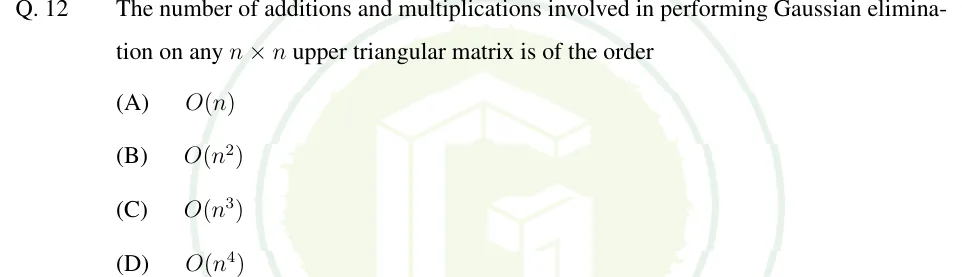
The number of additions and multiplications involved in performing Gaussian elimination on any upper triangular matrix is of the order
- (A)
- (B)
- (C)
- (D)

The number of additions and multiplications involved in performing Gaussian elimination on any upper triangular matrix is of the order
ANSWER
The operation count is of order , option (B).
Official answer: BSource: Official answer key, GATE 2025 DA (IIT Roorkee)
Gaussian elimination reduces a matrix to upper triangular form by subtracting multiples of the pivot row from the rows below it. In an upper triangular matrix every entry below the diagonal is already , so every row multiplier is and the elimination phase needs no row operations.
The arithmetic that remains is the solution of by back substitution, computing in turn. Row uses the already-known unknowns: multiplications, subtractions, and one division by .
Total multiplications: . The number of additions/subtractions is the same, so multiplications plus additions come to (plus divisions).
grows like , so the work is . Every one of the nonzero entries is used, so the work cannot be , and it is not of order or .
Hence the order is , option (B). The cost belongs to a full (dense) matrix, where each of about pivots updates an block.
KEY IDEA
An upper triangular matrix needs no elimination. The only work left is back substitution, which costs about multiplications and as many additions, so .
WATCH OUT FOR
Quoting the dense-matrix cost for Gaussian elimination without noticing that this matrix is already triangular and the elimination cost vanishes.
From the GATE 2025 DA paper. Every question of this paper · Download the full paper · All 2 Linear systems questions, with notes