GATE 2026 DA Q.21
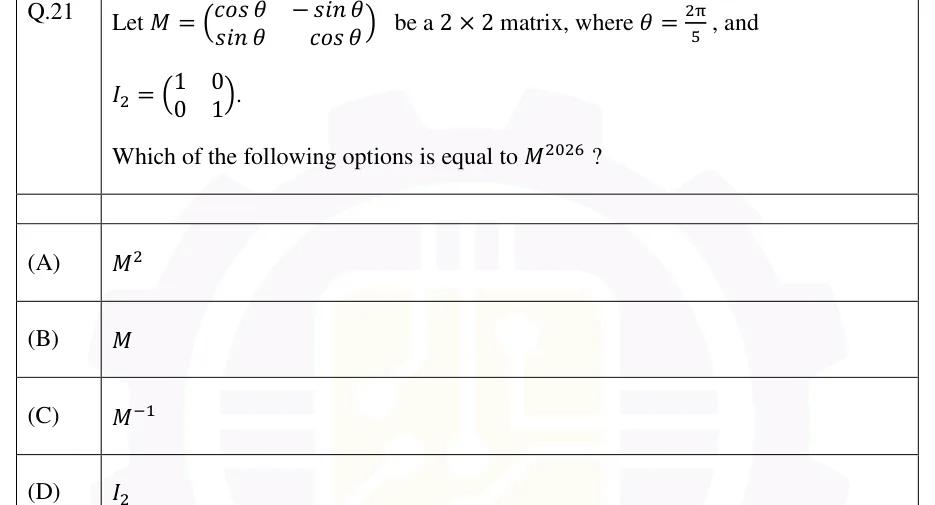
Let be a matrix, where , and . Which of the following options is equal to ?
- (A)
- (B)
- (C)
- (D)

GATE DA
Projection, orthogonal, idempotent and partitioned matrices, and quadratic forms
Orthogonal, idempotent and projection matrices, partitioned (block) matrices, and quadratic forms with their definiteness tests. The key facts are the eigenvalues of each special type, rank = trace for idempotent matrices, the block determinant, transpose and inverse rules, and the eigenvalue and minor tests for definiteness. With these, many long computations become one-line checks.
7 previous-year questions · 7 solved · 6 practice questions
Throughout, matrices are real, vectors are column vectors written in bold (), is the transpose, is the identity of the size that makes the product defined, denotes an eigenvalue and is the Euclidean norm. is unless a size is stated.
Type | Defining condition | Eigenvalues | Determinant |
|---|---|---|---|
Symmetric | all real; eigenvectors for distinct eigenvalues are orthogonal | no restriction | |
Skew-symmetric | or purely imaginary, in pairs | if is odd; if is even | |
Orthogonal | ( square) | modulus | or |
Idempotent | only or | if , otherwise | |
Orthogonal projection | and | only or | if , otherwise |
Triangular or diagonal | all entries below the diagonal are zero (upper triangular) or all above are zero (lower triangular); both for diagonal | the diagonal entries | product of the diagonal entries |
SYMMETRIC PLUS SKEW DECOMPOSITION
Holds for every square real matrix, and the split is unique.
SKEW-SYMMETRIC FORM VANISHES
is and is any real vector in . Because is a scalar, it equals its own transpose, which is .
A square matrix is orthogonal when its columns are orthonormal, that is . For a square matrix this forces and hence also , so the rows are orthonormal too. Geometrically keeps lengths and angles: it is a rotation when , and involves a reflection when .
ORTHOGONAL MATRIX
Square real . Columns (and rows) form an orthonormal set.
LENGTH AND ANGLE PRESERVATION
Holds for every when is orthogonal.
DETERMINANT AND EIGENVALUES OF AN ORTHOGONAL MATRIX
A real eigenvalue can only be or . Complex eigenvalues come in conjugate pairs of modulus 1.
EVERY 2×2 ORTHOGONAL MATRIX
Every real orthogonal matrix is one of these two forms. is a rotation by : , eigenvalues . is a reflection: symmetric, , eigenvalues and .
If is orthogonal, so are , every power and . The product of two orthogonal matrices of the same size is orthogonal.
A symmetric orthogonal matrix satisfies , so its eigenvalues are only.
If then is an eigenvalue of , for any . If is odd and then is an eigenvalue. For the eigenvector for is the rotation axis.
Permutation matrices are orthogonal.
EXAM TIP
is necessary, not sufficient. has determinant and is not orthogonal. To test orthogonality, check that the columns have unit length and are mutually perpendicular.
A square matrix is idempotent when . If with , then , so and . An idempotent matrix is always diagonalisable (its minimal polynomial divides , which has distinct roots), so the number of eigenvalues equal to is the rank. If is idempotent, so is .
IDEMPOTENT: EIGENVALUES AND RANK
Square matrix with . The converse is false: has rank trace and is not idempotent. For a general matrix, rank and trace are unrelated.
COMPLEMENT OF AN IDEMPOTENT
If () is idempotent, then so is , and .
POWERS AND A QUICK INVERSE
For idempotent . Check the inverse by multiplying out: .
EXAM TIP
An idempotent matrix need not be symmetric. squares to itself, has eigenvalues and is not symmetric. It projects onto the -axis along the direction , which is not perpendicular to that axis. Only symmetric idempotents are orthogonal projections. Also, the only invertible idempotent is .
Let be an matrix with linearly independent columns. The orthogonal projection of onto the column space of is the point closest to . The residual is perpendicular to every column of , which gives the normal equations .
PROJECTION MATRIX ONTO THE COLUMN SPACE OF A
Needs the columns of linearly independent, so that the matrix is invertible. is the point of the column space nearest to .
SPECIAL CASES OF THE PROJECTION MATRIX
First: projection onto the line through . Second: is with , and need not be square.
PROPERTIES OF AN ORTHOGONAL PROJECTION
For with of size and rank . has eigenvalue on the column space (multiplicity ) and on its orthogonal complement (multiplicity ). depends only on the column space, not on which basis forms the columns of .
PYTHAGORAS FOR A PROJECTION
projects onto the orthogonal complement of the column space. Use it to find the distance from to the subspace.
REFLECTION MATRIX
in , and is . , with the projection onto the line through . reflects across the hyperplane perpendicular to . Its eigenvalues are once (along ) and with multiplicity . More generally, is symmetric and orthogonal for every orthogonal projection .
Check that the columns of are independent. If they are not, replace by a matrix whose columns are a basis of its column space.
Form () and .
Solve .
The projection is , and the distance is .
Verify that .
WORKED EXAMPLE
Let () and . Find the projection of onto the column space of , and .
, with determinant , so .
, so .
.
Check: the residual is perpendicular to both columns (both dot products are ).
.
Answer: and .
A partitioned matrix is a matrix cut by horizontal and vertical lines into sub-matrices (blocks). Blocks add and multiply by the same rules as numbers, provided the block sizes are compatible and the order of every product is kept, because matrix products do not commute.
BLOCK MULTIPLICATION
The column partition of the left factor must match the row partition of the right factor, so that every product such as and is defined.
TRANSPOSE OF A PARTITIONED MATRIX
Transpose each block and also swap the two off-diagonal blocks.
DETERMINANT OF A BLOCK TRIANGULAR MATRIX
and square. The same holds for block lower triangular and block diagonal matrices. The eigenvalues of the whole matrix are those of together with those of , with multiplicities.
INVERSES OF BLOCK DIAGONAL AND BLOCK TRIANGULAR MATRICES
and square. The matrix is invertible exactly when and are both invertible.
SCHUR COMPLEMENT DETERMINANT
Requires square and invertible, and square. is the Schur complement of . If instead is invertible, .
RANK AND POWERS OF A BLOCK DIAGONAL MATRIX
The rank statement allows diagonal blocks of any size. The power statement needs square blocks.
EXAM TIP
Do not copy the rule: in general . The formula is valid only when all four blocks are square, of equal size, and and commute. Otherwise use the Schur complement or a block triangular form.
A quadratic form in is for an matrix . The skew part of contributes nothing, so only matters. We therefore always work with the unique symmetric matrix : its diagonal entries are the coefficients of , and each off-diagonal pair is half the coefficient of .
QUADRATIC FORM AND ITS SYMMETRIC MATRIX
is real symmetric. Example: has .
PRINCIPAL AXES (ORTHOGONAL DIAGONALISATION)
A real symmetric always has real eigenvalues and an orthogonal matrix whose columns are eigenvectors. . The signs of the decide the definiteness.
Class | Condition on | Eigenvalue test | Minor test |
|---|---|---|---|
Positive definite | for all | all | all leading principal minors |
Positive semi-definite | for all | all | all principal minors (every one, not only the leading ones) |
Negative definite | for all | all | leading minors alternate in sign, starting negative: (that is, ) |
Negative semi-definite | for all | all | every principal minor of order is for odd and for even (that is, is positive semi-definite) |
Indefinite | takes both positive and negative values | at least one positive and one negative eigenvalue | none of the four patterns above; for example, any principal minor of even order is negative, or two diagonal entries have opposite signs |
LEADING PRINCIPAL MINOR TEST
real symmetric. is the determinant of the top-left block. For : is positive definite exactly when and .
EXTREME VALUES OF A QUADRATIC FORM ON THE UNIT SPHERE
real symmetric. Equality holds when is an eigenvector for (or for ). It follows from with .
CHANGE OF VARIABLES AND THE LAW OF INERTIA
is an invertible matrix. is symmetric and has the same numbers of positive, negative and zero eigenvalues as , although the eigenvalues themselves may differ. So the definiteness class, the rank, and the number of positive terms in any diagonal form of do not change.
For every real matrix , the matrix is positive semi-definite. It is positive definite exactly when the columns of are independent.
A positive definite matrix has positive diagonal entries and a positive determinant. It is invertible, and is positive definite (eigenvalues ).
The sum of a positive definite and a positive semi-definite matrix of the same size is positive definite.
and (eigenvalues counted with multiplicity). Use them to read off signs quickly.
An orthogonal projection matrix is positive semi-definite, because .
WORKED EXAMPLE
Classify .
Each cross-term coefficient gives . There is no term, so . Hence .
.
.
.
All leading minors are positive, so is positive definite. Its eigenvalues are and , all positive: check and .
Answer: Positive definite.
EXAM TIP
The leading-minor test with minors does NOT prove semi-definiteness. has leading minors , yet it is negative semi-definite. For semi-definiteness you need all principal minors, or simply the eigenvalues. Also, always symmetrise first: the matrix of is (indefinite, ), not .
PREVIOUS-YEAR QUESTIONS
Try each question first, then open the answer. We placed each question under a topic ourselves; the exam paper does not label topics.
See these papers in full: GATE DA 2026 · GATE DA 2025 · GATE DA 2024
Let be a matrix, where , and . Which of the following options is equal to ?
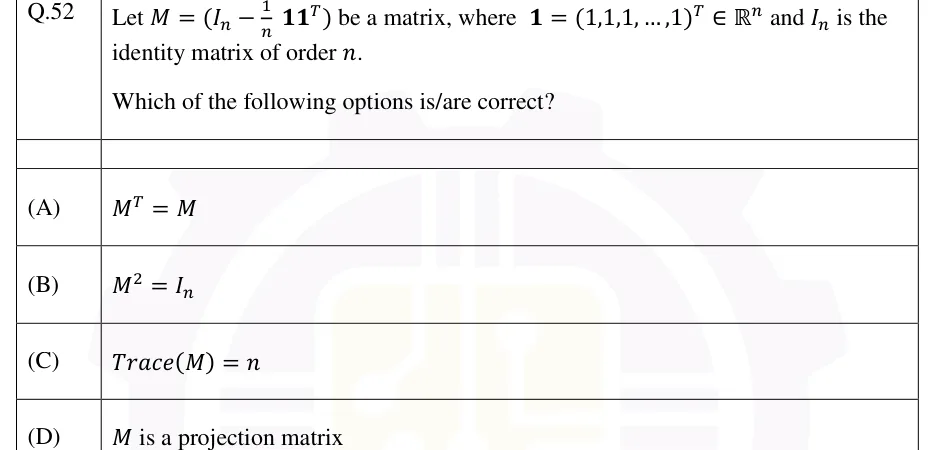
Let be a matrix, where and is the identity matrix of order .
Which of the following options is/are correct?
is a projection matrix
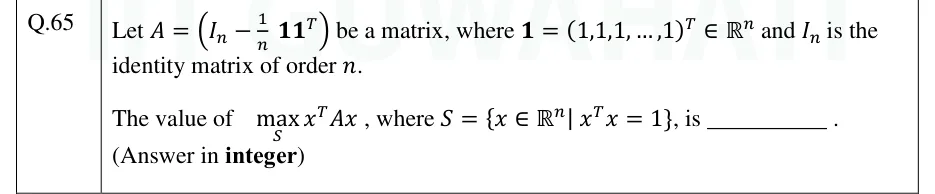
Let be a matrix, where and is the identity matrix of order .
The value of , where , is ________. (Answer in integer)
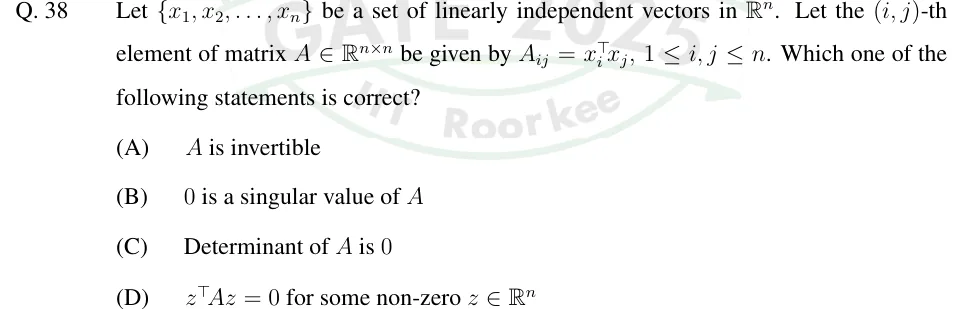
Let be a set of linearly independent vectors in . Let the -th element of matrix be given by , . Which one of the following statements is correct?
is invertible
is a singular value of
Determinant of is
for some non-zero
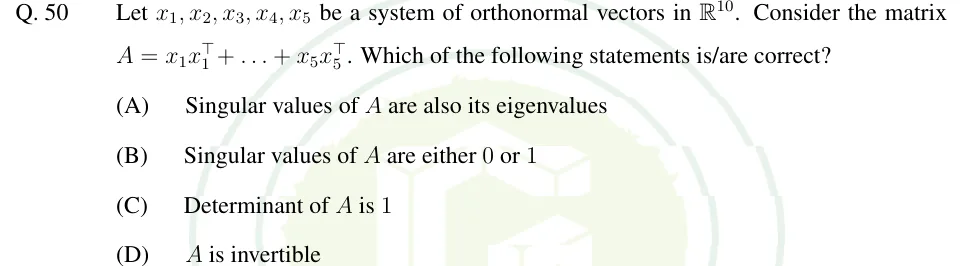
Let be a system of orthonormal vectors in . Consider the matrix . Which of the following statements is/are correct?
Singular values of are also its eigenvalues
Singular values of are either 0 or 1
Determinant of is 1
is invertible
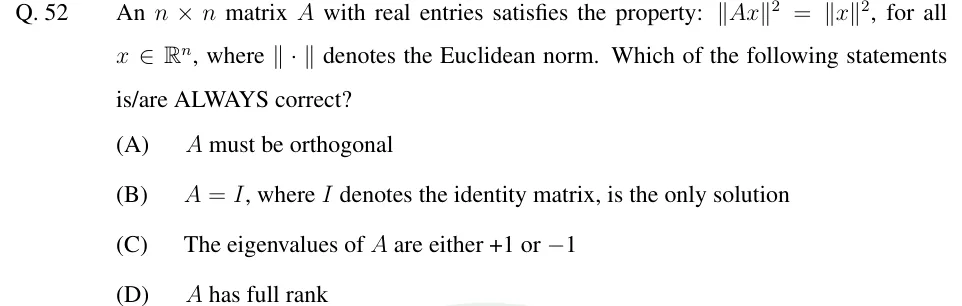
An matrix with real entries satisfies the property: , for all , where denotes the Euclidean norm. Which of the following statements is/are ALWAYS correct?
must be orthogonal
, where denotes the identity matrix, is the only solution
The eigenvalues of are either or
has full rank
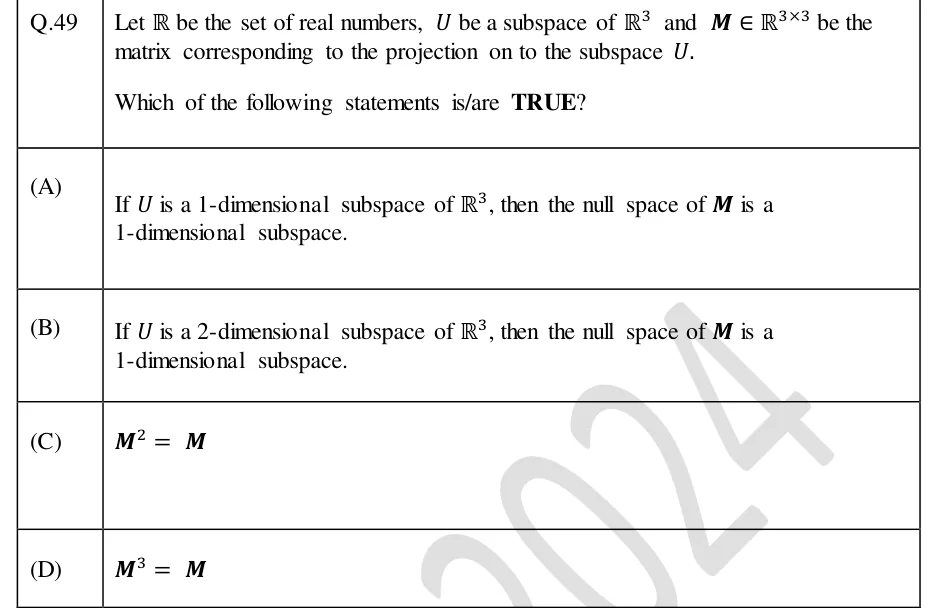
Let be the set of real numbers, be a subspace of and be the matrix corresponding to the projection on to the subspace .
Which of the following statements is/are TRUE?
If is a 1-dimensional subspace of , then the null space of is a 1-dimensional subspace.
If is a 2-dimensional subspace of , then the null space of is a 1-dimensional subspace.
PRACTICE
A real matrix satisfies and . Find , where is the identity.
Answer:
An idempotent matrix is diagonalisable with eigenvalues in , and .
So the eigenvalues are .
The eigenvalues of are .
.
Let and . Let be the orthogonal projection matrix onto the line spanned by . Find the squared Euclidean distance from to that line.
Answer:
, with .
, so and .
and are perpendicular, so .
Direct check: , whose squared length is .
Let . Which of the following statements are true?
Answer: (A), (C), (D)
Each row has squared length . The pairwise dot products are , and (all divided by ). So is orthogonal, and (A) is true.
is also symmetric, so , and (C) is true.
The trace is , so (D) is true.
From the eigenvalues are , and they sum to , so they are and . Directly: , and . Hence (B) is false.
The quadratic form is positive definite for which values of the real constant ?
Answer: (A)
The symmetric matrix is .
Leading minors: always, and .
Positive definiteness needs , that is .
Let be a matrix, where , and is an arbitrary real matrix. Find .
Answer:
is block upper triangular, so , whatever is.
and , so .
For a matrix, .
Find the maximum value of subject to .
Answer:
The symmetric matrix is .
Its eigenvalues are , that is and (trace , determinant ).
On the unit circle the maximum of is .
Check: at , .
OFFICIAL GATE 2027 SYLLABUS WORDING
Copied from the GATE 2027 syllabus; see all 2027 syllabi.
GATE DA
matrices, projection matrix, orthogonal matrix, idempotent matrix, partition matrix and their properties, quadratic forms
Preparing in Kolkata? IAE Academy's course for GATE DA.