GATE 2024 DA Q.61
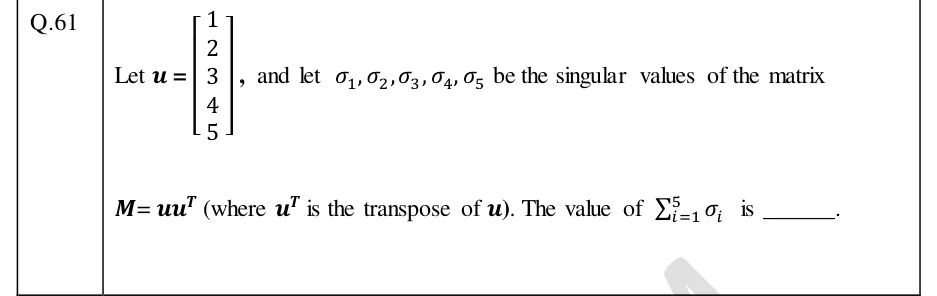
Let , and let be the singular values of the matrix (where is the transpose of ). The value of is ______.

GATE DA
Projections, LU decomposition and singular value decomposition
Projections, LU decomposition and the SVD each break a matrix problem into easy pieces. A projection gives the closest point in a subspace, which is where least squares comes from. LU turns Ax = b into two triangular solves. The SVD shows rank, 2-norm and the best low-rank approximation. Typical calculations here are a projection or least-squares solution, a pivot or determinant from an LU factorisation, or a rank, norm or approximation error from singular values. Each is short once the formulas are known.
1 previous-year question · 1 solved · 5 practice questions
Convention. All matrices and vectors are real. Vectors are column vectors, written in bold; is the transpose, is the Euclidean norm, and . Eigenvalues are written and singular values .
The orthogonal projection of onto a subspace is the unique vector such that the error is orthogonal to every vector in . It is also the point of closest to in the Euclidean norm, so the distance from to is .
PROJECTION ONTO A LINE
Line through the origin along ; and are in , is of rank , and .
PROJECTION ONTO A COLUMN SPACE
is with linearly independent columns (so is invertible); is and projects onto the column space of .
PROJECTION WITH AN ORTHONORMAL BASIS
The columns of the matrix are orthonormal (); is and no inverse is needed.
Property of an orthogonal projection matrix () onto | Statement |
|---|---|
Idempotent | (projecting twice changes nothing) |
Symmetric | |
Eigenvalues | each eigenvalue is (eigenvectors: non-zero vectors in ) or (eigenvectors: non-zero vectors orthogonal to ) |
Rank and trace | |
Complement | is the orthogonal projection onto the orthogonal complement of |
Reflection | is symmetric and orthogonal, , eigenvalues ; with , , it reflects across the hyperplane orthogonal to |
EXAM TIP
Check any projection by testing that the error is orthogonal to , that is , or to every column of , that is . A non-zero result means an arithmetic slip.
When has no solution ( is not in the column space of the matrix ), a least-squares solution minimises . Then is exactly the projection of onto the column space, which gives the normal equations.
NORMAL EQUATIONS
The normal equations always have a solution; it is unique (and given by the inverse form) only when the columns of are linearly independent.
RESIDUAL IS ORTHOGONAL TO THE COLUMNS
Pythagoras applies because the projection and the residual are perpendicular.
WORKED EXAMPLE
Find the least-squares line through the points , and the minimum sum of squared errors.
Write (), , unknown .
and .
Solve , . Subtracting gives , so . From the first equation .
Fitted values , residual .
The residual is orthogonal to both columns ( and ). Squared error .
Answer: , minimum squared error .
Gram-Schmidt turns linearly independent vectors into orthogonal ones by subtracting, from each new vector, its projections onto the earlier ones. Dividing by lengths gives an orthonormal set.
GRAM-SCHMIDT STEP
For an matrix with linearly independent columns this gives : is with orthonormal columns and is upper triangular with entries () and positive diagonal. The span of the first vectors is preserved at every step.
EXAM TIP
Use the projection onto the already orthogonalised , not onto the original ; mixing them is a frequent slip. If some , the vectors were linearly dependent.
For a square matrix , LU decomposition records Gaussian elimination as a product . is the upper triangular matrix reached at the end of forward elimination. is unit lower triangular (ones on the diagonal), and its entry () is the multiplier used to clear position : , with row row row .
LU FACTORISATION
Shown for . Elimination without row exchanges succeeds exactly when the first pivots are non-zero, equivalently when the leading principal minors are non-zero; the factorisation with unit lower is then unique. ( may be , which happens exactly when is singular.)
PIVOTS FROM LEADING PRINCIPAL MINORS
is the determinant of the top-left block of ; valid when no row exchanges are needed ().
PIVOTED FORM
When a zero pivot appears, rows are exchanged; is an permutation matrix. A factorisation exists for every square , and , where is the number of row exchanges.
DETERMINANT FROM LU
Valid when no row exchanges were used; because is unit triangular.
SYMMETRIC MATRICES: LDLᵀ AND CHOLESKY
is symmetric with ; then . is positive definite exactly when every pivot (equivalently every ), and then the Cholesky factor is lower triangular with positive diagonal.
Factorise once: by elimination, saving each multiplier in .
Forward substitution: solve from the top row down.
Back substitution: solve from the bottom row up.
Then . The same serve every new right-hand side.
WORKED EXAMPLE
Factorise as , find , and solve .
Pivot . Multipliers , . Row 2 becomes and row 3 becomes .
Pivot . Multiplier . Row 3 becomes .
So , , and . (Check: , , give pivots .)
Forward: ; ; .
Back: ; ; . Check row 3: .
Answer: and .
EXAM TIP
Multipliers go into with their sign as computed (row minus times row ). Putting in is a frequent error; a quick check is to multiply by and recover .
Every real matrix (square or not, invertible or not) has an SVD. Acting on , applies (a rotation or reflection), then (a stretch along the coordinate axes, possibly changing the dimension), then (another rotation or reflection).
SINGULAR VALUE DECOMPOSITION
is orthogonal (left singular vectors ), is orthogonal (right singular vectors ), is with the singular values on its diagonal and zeros elsewhere; . Equivalently .
SINGULAR VALUES FROM EIGENVALUES
() and () are symmetric positive semidefinite and have the same non-zero eigenvalues; all their other eigenvalues are . The columns of are orthonormal eigenvectors of and the columns of are orthonormal eigenvectors of .
LEFT VECTORS FROM RIGHT VECTORS
Fixes so that its sign agrees with ; choosing independently from can give a wrong sign.
RANK-ONE MATRIX
and are non-zero, so is of rank ; this follows from .
Form (an symmetric matrix) and find its eigenvalues . If it is quicker to use the matrix , which has the same non-zero eigenvalues.
Set in decreasing order; the number of non-zero ones is .
Find orthonormal eigenvectors of to form .
Compute for each non-zero ; complete to an orthonormal basis of if .
WORKED EXAMPLE
For find the singular values, , and check them against .
, with eigenvalues , that is and .
Singular values: and .
The 2-norm is the largest singular value, .
Checks: and .
Answer: ; .
Matrix | Singular values |
|---|---|
orthogonal () | all equal to |
symmetric | , the absolute values of its eigenvalues |
symmetric positive semidefinite | (the SVD is the eigendecomposition) |
the same non-zero singular values as |
EXAM TIP
Singular values are square roots of eigenvalues of , not eigenvalues of . For a square they equal the exactly when is normal (), symmetric matrices being the usual case. For a general square the product of the equals , but their sum need not equal .
RANK AND NORMS FROM SINGULAR VALUES
is the spectral norm; is the Frobenius norm (square root of the sum of squared entries).
SQUARE MATRICES
is ; is invertible exactly when , and is the 2-norm condition number.
RANK-$K$ TRUNCATION
Keeps the largest singular values, ; has rank .
BEST LOW-RANK APPROXIMATION (ECKART-YOUNG)
ranges over matrices; the minimum is attained by in both norms; take if .
LEAST SQUARES THROUGH THE SVD
() is the pseudo-inverse, where () has in place of each non-zero ; this gives the least-squares solution of smallest norm, and it equals when the columns of are independent.
Decomposition | Form | Exists for | Main use |
|---|---|---|---|
LU | (or ) | square with ; with row exchanges, every square | solving , determinant |
QR (Gram-Schmidt) | with independent columns | projections, least squares | |
SVD | every real matrix | rank, 2-norm, low-rank approximation |
EXAM TIP
In the Eckart-Young error, the 2-norm error is a single singular value , while the Frobenius error is the square root of the sum of squares of all the discarded ones. Read the question to see which norm is asked.
PREVIOUS-YEAR QUESTIONS
Try each question first, then open the answer. We placed each question under a topic ourselves; the exam paper does not label topics.
See these papers in full: GATE DA 2024
Let , and let be the singular values of the matrix (where is the transpose of ). The value of is ______.
PRACTICE
In (column vectors, Euclidean norm), let and . What is the length of the orthogonal projection of onto the line spanned by ?
Answer: (accepted range )
and .
Projection .
Length (equivalently ).
Let . Gaussian elimination without row exchanges gives with unit lower triangular and upper triangular (). What is the product of the pivots ?
Answer: (accepted range )
Pivot . Multipliers , .
Row 2 . Row 3 .
Pivot , multiplier . Row 3 , so .
Product . Cross-check by cofactors along row 1: .
A real matrix has singular values , and . Which of the following statements are true?
The eigenvalues of are , and
is singular
Answer: (A), (B), (D)
Rank equals the number of non-zero singular values, which is 2, so (A) is true.
The 2-norm is the largest singular value, , so (B) is true.
The eigenvalues of are the squares of the singular values: , , . So (C) is false.
, so is singular and (D) is true.
A real matrix has singular values , and . Over all real matrices of rank at most , what is the minimum possible value of (Frobenius norm)? Give your answer correct to two decimal places.
Answer: (accepted range )
By the Eckart-Young result, the best rank-1 approximation keeps and discards the rest.
Minimum error .
, so the answer is .
Let (a matrix) and . What is the minimum value of over real scalars ?
1
3
5
10
Answer: (C)
Normal equation: , i.e. , so .
and the residual is .
Minimum . The residual is orthogonal to : . (Check: .)
OFFICIAL GATE 2027 SYLLABUS WORDING
Copied from the GATE 2027 syllabus; see all 2027 syllabi.
GATE DA
projections, LU decomposition, singular value decomposition
Preparing in Kolkata? IAE Academy's course for GATE DA.