IAE Academy

GATE 2023 EE Q.25: solution and answer

GATE 2023 · EEQ.25 · 1 mark · MCQ

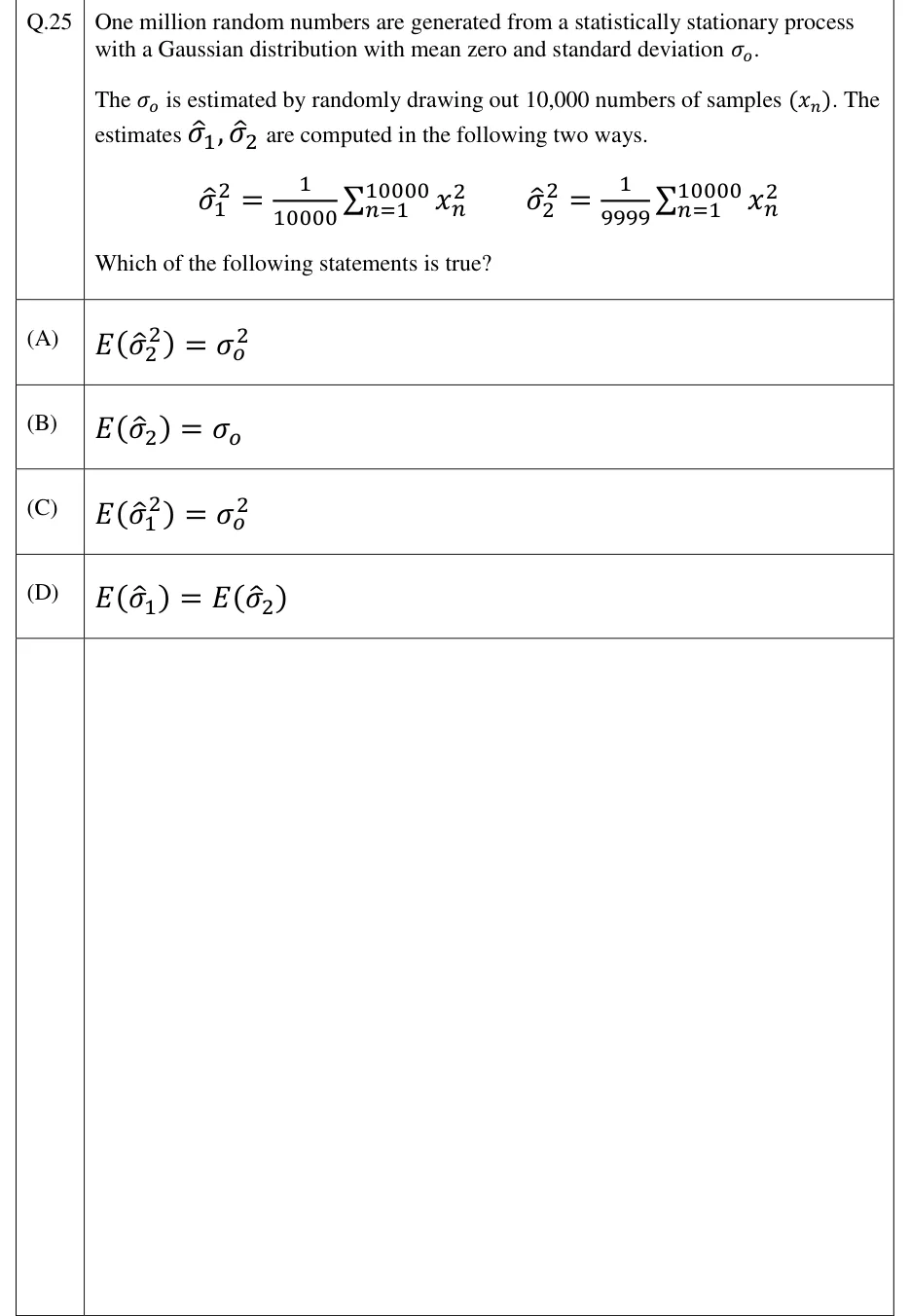
One million random numbers are generated from a statistically stationary process with a Gaussian distribution with mean zero and standard deviation .

The is estimated by randomly drawing out 10,000 numbers of samples . The estimates are computed in the following two ways.

Which of the following statements is true?

  1. (A)

  2. (B)

  3. (C)

  4. (D)

See the question in the paper

Answer and solution

ANSWER

(C) . With the mean known to be zero, averaging over samples gives an unbiased estimate of the variance.

Official answer: CSource: Official answer key, GATE 2023 EE (IIT Kanpur)

  1. Every value drawn comes from the Gaussian with mean and variance . So for each sample

  2. (C). By linearity of expectation (this needs no independence between the draws): So (C) is true, and is an unbiased estimator of .

  3. (A). The same step for gives so (A) is false. Dividing by (Bessel's correction) removes the bias only when the sample mean is subtracted, as in . Here the mean is known to be zero and nothing is subtracted, so dividing by adds bias.

  4. (D). For every set of samples, . So . Since and is not always zero, , and so . (D) is false.

  5. (B), exam shortcut. Exactly one option is correct, and (C) has been proved true exactly, so (B) must be false. Linearity cannot settle (B) by itself, because the square root is not linear: in general. Jensen's inequality gives , but the factor pushes the other way. The next two steps settle it exactly for completeness.

  6. (B), exact. Treat the draws as independent. Then is chi-square with degrees of freedom, with density for . Its mean square root is and , so .

  7. Using with : Let be the sum of the first of the same standardised squares; it is chi-square with degrees of freedom and adds one more square, which is positive with probability 1. So and . Hence , so and . Numerically (and ). (B) is false.

  8. Only (C) holds. Answer: (C).

KEY IDEA

When the mean is known (here zero), is exactly unbiased for , because and expectation passes through a sum. Bessel's only compensates for subtracting the sample mean . Expectation does not pass through a square root, so an unbiased variance estimate does not give an unbiased standard-deviation estimate.

WATCH OUT FOR

Picking (A) out of habit, because "dividing by gives the unbiased variance". That rule is for , where the sample mean is subtracted. Here nothing is subtracted, so dividing by overestimates . A second trap is assuming that an unbiased makes unbiased, as in (B).

From the GATE 2023 EE paper. Every question of this paper · Download the full paper · All 33 Probability & statistics questions, with notes

More Probability & statistics questions