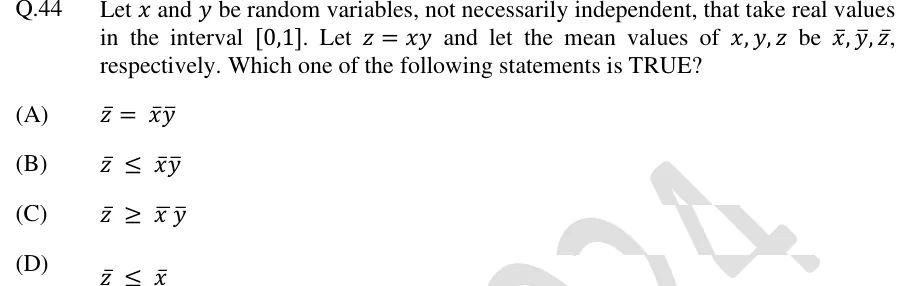
Let and be random variables, not necessarily independent, that take real values in the interval . Let and let the mean values of be , respectively. Which one of the following statements is TRUE?
- (A)
- (B)
- (C)
- (D)

Let and be random variables, not necessarily independent, that take real values in the interval . Let and let the mean values of be , respectively. Which one of the following statements is TRUE?
ANSWER
The true statement is (D): .
Official answer: DSource: Official answer key, GATE 2024 CS2 (IISc Bengaluru)
Since and , we have for every outcome.
Expectation preserves inequalities that hold for every outcome, so , that is . This does not use independence, so (D) is always true.
Test (A) and (B) with dependent variables. Take , equal to or with probability each. Then and . So , which makes (A) and (B) false.
Test (C). Take as above and . Then , so , while . So , which makes (C) false.
Only (D) holds for every pair of random variables on .
KEY IDEA
Because and , for every outcome, and expectation keeps that inequality whether or not and are independent. Relations between and depend on the covariance, so they can go either way.
WATCH OUT FOR
Assuming , which holds only for uncorrelated variables. The question says the variables need not be independent, so (A), (B) and (C) each fail for some dependent pair.
From the GATE 2024 CS2 paper. Every question of this paper · Download the full paper · All 60 Probability & statistics questions, with notes