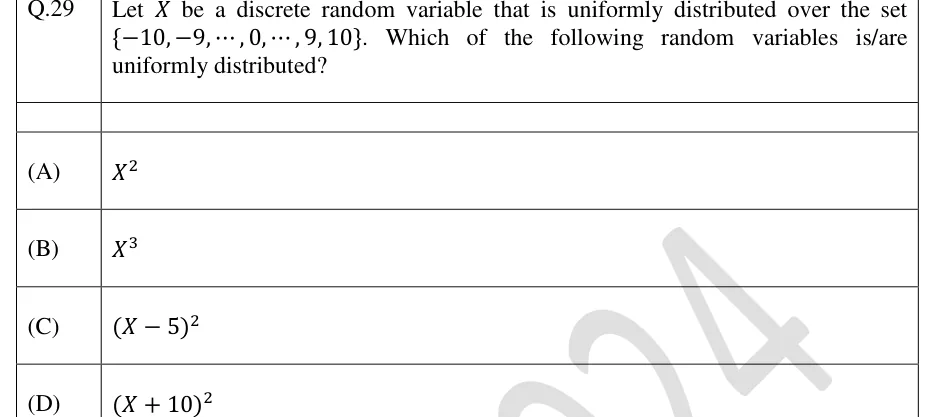
Let be a discrete random variable that is uniformly distributed over the set . Which of the following random variables is/are uniformly distributed?
- (A)
- (B)
- (C)
- (D)

Let be a discrete random variable that is uniformly distributed over the set . Which of the following random variables is/are uniformly distributed?
ANSWER
(B) and (D) are uniformly distributed. and are not.
Official answer: B, DSource: Official answer key, GATE 2024 EE (IISc Bengaluru)
takes 21 equally likely values, so for .
For a function of a discrete random variable, . Every support point carries , so , where is the number of support points with . So is uniform on its range exactly when every value in the range has the same count . In particular, if is one-to-one on the support then every and is uniform. If some values have and others have , it is not uniform.
(A) : the value comes only from , so . But and give the same , so for . Not uniform.
(B) : the cube is strictly increasing, so it is one-to-one. takes the 21 distinct values , each with probability . Uniform.
(C) : runs over . For , both and lie in this range, so . The value comes only from , and for only is possible, so and each have probability . (Count check: support points.) For example, . Not uniform.
(D) : runs over , and all of these are non-negative. Squaring is strictly increasing on non-negative numbers, so it is one-to-one there. therefore takes the 21 distinct values , each with probability . Uniform.
Correct options: (B) and (D).
KEY IDEA
When is uniform on points, equals (the number of support points that sends to ) divided by . So is uniform exactly when every value in its range has the same number of preimages. Any one-to-one map keeps the distribution uniform: a strictly monotone function such as , or squaring on a set whose values all have the same sign, as with . A square of a set that contains both and for some , next to values that have no partner, is not uniform.
WATCH OUT FOR
(1) Rejecting (D) because "a square is never one-to-one". Squaring is one-to-one on because every value is non-negative. (2) Thinking the shift in (C) removes the pairing. Since still runs from up to , the values still pair up. (3) Treating "uniform" as meaning evenly spaced values and rejecting (B) or (D) because or are unequally spaced. Uniformity is about equal probabilities, not about spacing.
From the GATE 2024 EE paper. Every question of this paper · Download the full paper · All 33 Probability & statistics questions, with notes