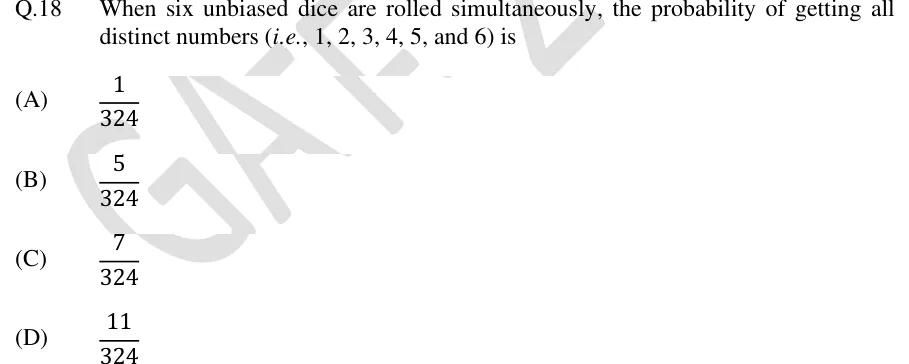
When six unbiased dice are rolled simultaneously, the probability of getting all distinct numbers (i.e., 1, 2, 3, 4, 5, and 6) is
- (A)
- (B)
- (C)
- (D)

When six unbiased dice are rolled simultaneously, the probability of getting all distinct numbers (i.e., 1, 2, 3, 4, 5, and 6) is
ANSWER
The probability is , option (B).
Official answer: BSource: Official answer key, GATE 2024 CS2 (IISc Bengaluru)
Each die has 6 faces, so rolling six dice gives equally likely ordered outcomes (multiplication rule).
Favourable outcomes: the six dice show all of , each exactly once. Each such outcome is an arrangement of the six numbers over the six dice, so the count is .
Factorise: and . Cancelling gives
This is option (B).
KEY IDEA
Count favourable outcomes as ordered arrangements: all six faces distinct means the dice show a permutation of 1 to 6, giving out of equally likely outcomes.
WATCH OUT FOR
Using or instead of , or forgetting to treat the dice as distinguishable. Both the numerator and the denominator must count ordered outcomes.
From the GATE 2024 CS2 paper. Every question of this paper · Download the full paper · All 60 Probability & statistics questions, with notes