
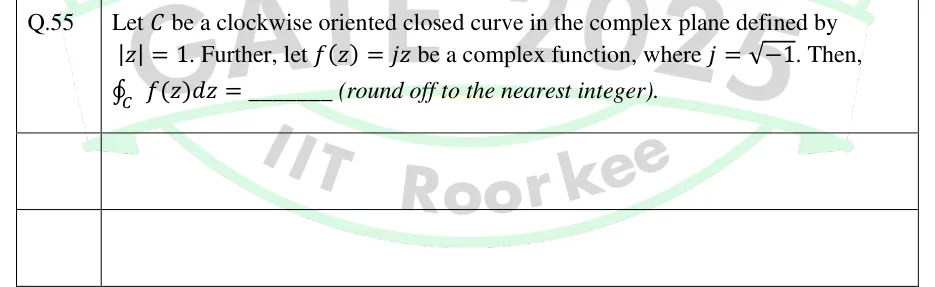
Let be a clockwise oriented closed curve in the complex plane defined by . Further, let be a complex function, where . Then, ________ (round off to the nearest integer).
GATE 2025 EE Q.55: solution and answer
Answer and solution
ANSWER
. The integrand is entire, so Cauchy's theorem gives zero whichever way the contour is traversed.
Official answer: 0Source: Official answer key, GATE 2025 EE (IIT Roorkee)
Start with the integrand. is a polynomial in , so it is analytic at every point of the finite plane (an entire function). It has no singularity inside or on .
Apply Cauchy's integral theorem: if is analytic on and inside a simple closed contour , then . Traversing the contour clockwise instead of anticlockwise only changes the sign of the integral, and .
Check directly by parametrisation. The clockwise unit circle is , , so .
(using and ).
A third check: has the antiderivative , which is single-valued in the whole plane, so its integral around any closed path is .
Therefore .
KEY IDEA
Before you compute anything, look for singularities inside the contour. is entire, so Cauchy's integral theorem gives . The orientation (clockwise) and the constant only multiply that zero.
WATCH OUT FOR
Mixing up with and writing (or after multiplying by ). Only a pole inside the contour gives a nonzero result, and has none. A second slip is to think that the clockwise orientation must make the answer nonzero and negative. Reversing direction only flips the sign, and zero stays zero.
From the GATE 2025 EE paper. Every question of this paper · Download the full paper · All 24 Complex analysis questions, with notes
More Complex analysis questions
- GATE 2025 IN Q.49 · MSQ · 2 marksChoose the correct statement(s) from the following options, regarding Cauchy's theorem on complex…
- GATE 2024 EC Q.43 · MCQ · 2 marksLet z be a complex variable. If f(z)=(sin (π z))/(z^2(z-2)) and C is the circle in the complex plane with…
- GATE 2024 EE Q.30 · MSQ · 1 markWhich of the following complex functions is/are analytic on the complex plane?
- GATE 2024 EE Q.31 · NAT · 1 markConsider the complex function f(z) = cos z + e^z^2. The coefficient of z^5 in the Taylor series expansion of…