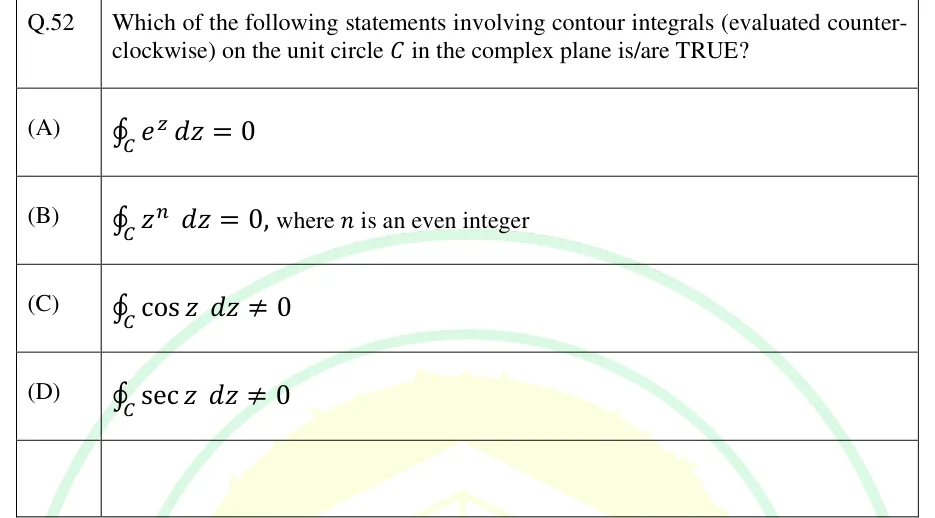
Which of the following statements involving contour integrals (evaluated counter-clockwise) on the unit circle in the complex plane is/are TRUE?
- (A)
- (B)
, where is an even integer
- (C)
- (D)

Which of the following statements involving contour integrals (evaluated counter-clockwise) on the unit circle in the complex plane is/are TRUE?
, where is an even integer
ANSWER
(A) and (B) are true. is entire, so its integral round the unit circle is , and is nonzero only for , which is odd. is entire and every pole of lies at , so both of those integrals are and statements (C) and (D) are false.
Official answer: A, BSource: Official answer key, GATE 2025 EC (IIT Roorkee)
Tool: Cauchy's integral theorem. If is analytic on and inside the closed contour (here ), then . So for each option we look for singularities inside .
(A) is entire (it has no singularity anywhere), so by Cauchy's theorem . TRUE.
(B) Cauchy's theorem does not settle negative , because then has a pole at . So evaluate directly. Parametrise , , : For the antiderivative takes the same value at and , so the integral is .
The only nonzero case is , which is odd. So for every even the integral is . That includes and negative even values such as , where has a double pole at with residue . TRUE.
(C) is entire, so . The statement "" is FALSE.
(D) is singular only where . Write : Setting the real part to zero gives (since ). Then , and setting the imaginary part to zero gives , so . So every zero of is real:
The poles nearest the origin have , so every pole lies outside . That makes analytic on and inside , and Cauchy's theorem gives . The statement "" is FALSE.
Correct options: (A) and (B).
KEY IDEA
By Cauchy's theorem, a contour integral is zero whenever the integrand is analytic on and inside the contour. So first find where the singularities are. For powers of , use the standard result if and for every other integer . A pole inside the contour does not by itself make the integral nonzero; only the residue counts.
WATCH OUT FOR
Two traps. First, treating (B) as false because a negative even power such as has a pole inside : that pole's residue is , so the integral is still . Second, marking (D) true because has poles at all: they sit at (all real, since has no non-real zeros), which is outside the unit circle. Also watch the sign in (C) and (D): both integrals are , so those statements are false.
From the GATE 2025 EC paper. Every question of this paper · Download the full paper · All 24 Complex analysis questions, with notes