
IAE Academy

GATE 2025 IN Q.57: solution and answer

GATE 2025 · INQ.57 · 2 marks · NAT

An air filled parallel plate electrostatic actuator is shown in the figure. The area of each capacitor plate is . The distance between the plates when both the capacitor charge and spring restoring force are zero as shown in Figure (a). A linear spring of constant is connected to the movable plate. When charge is supplied to the capacitor using a current source, the top plate moves as shown in Figure (b). The magnitude of minimum charge (Q) required to momentarily close the gap between the plates is ______ (rounded off to two decimal places).

Note: Assume a full range of motion is possible for the top plate and there is no fringe capacitance. The permittivity of free space is and relative permittivity of air is 1.
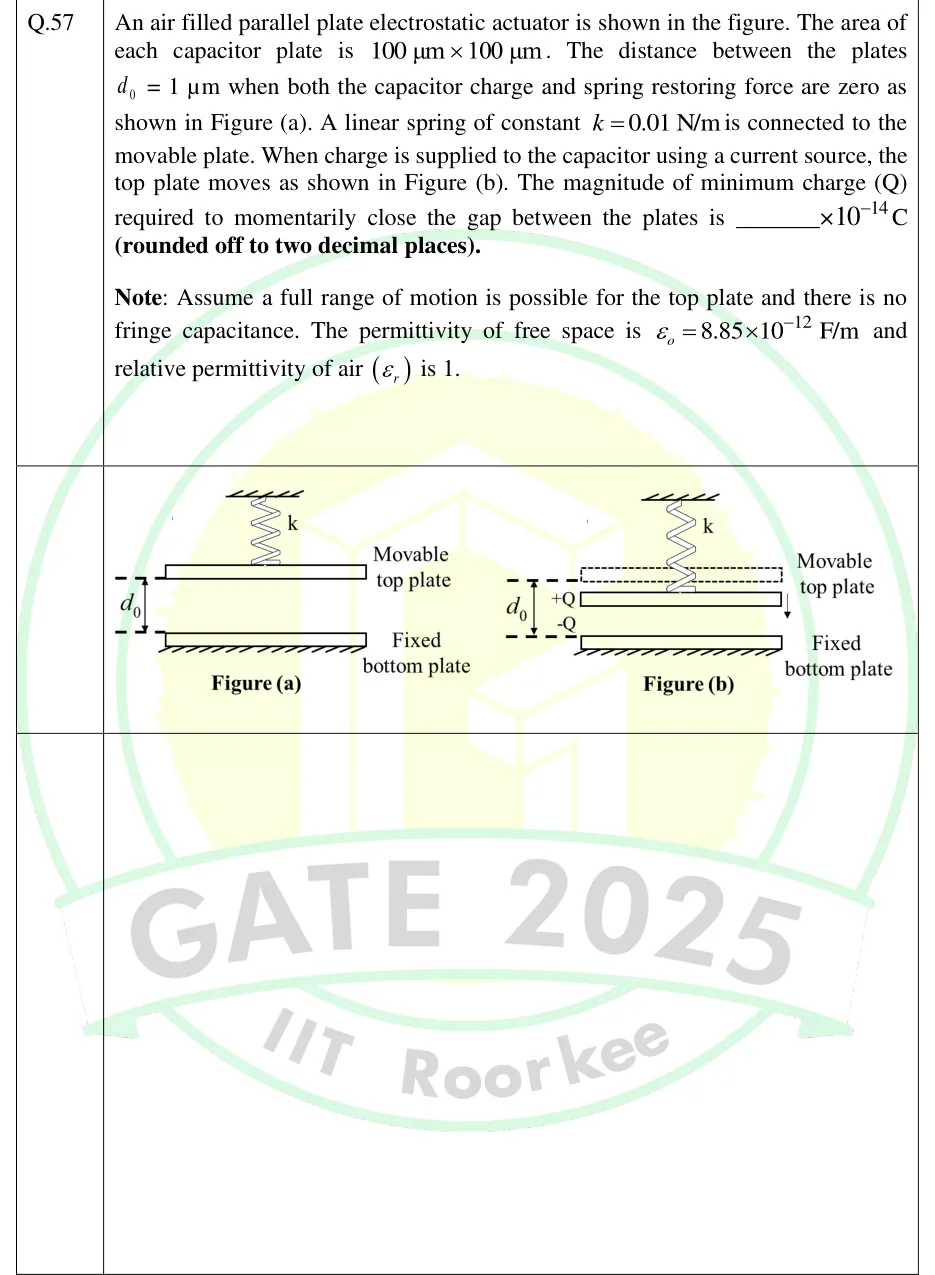
GATE 2025 IN question 57: Two side-by-side sketches.Tap to open full size
Figure from the GATE 2025 IN paper. It is part of the question.
Figure description

Two side-by-side sketches. Figure (a): a fixed bottom plate resting on a hatched ground, and a movable top plate above it, separated by a vertical gap marked d_0 with dashed extension lines. The top plate hangs from a spring labelled k, whose upper end is attached to a hatched fixed support. No charge is shown. Figure (b): the same arrangement. The original position of the top plate is drawn dashed, and the top plate is now drawn lower with a downward arrow beside it. The top plate is labelled +Q and the bottom plate -Q. The original gap d_0 is still marked between the dashed lines. Labels read 'Movable top plate' and 'Fixed bottom plate' in both sketches.

Answer and solution

ANSWER

The minimum charge is , so the blank is 4.21.

Official answer: 4.00 to 4.40Source: Official answer key, GATE 2025 IN (IIT Roorkee)

  1. Plate area and the product we need: . With and , .

  2. A current source sets the charge on the plates, not the voltage, so this is charge control. At fixed the stored energy is , using with no fringing, where is the gap.

  3. Force from virtual work at constant charge: . The minus sign means it acts to shrink the gap (attraction), and its size does not depend on the gap. Check: the top plate sits in the field of the bottom plate alone, with , so .

  4. Spring: once the top plate has moved down by , the spring pulls it back with (Hooke's law), and this grows as the gap closes. The current source adds charge gradually, so the plate moves slowly through equilibrium positions with at every instant. Because does not depend on the gap, there is no pull-in instability: the plate reaches the bottom plate () only when the electrostatic force equals the largest spring force, .

  5. Condition for the gap to just close: .

  6. Substitute and (so ):

  7. To two decimal places, , so the blank is .

KEY IDEA

A current source fixes the charge, not the voltage. With charge fixed, the pull between the plates is whatever the gap. The spring's pull-back grows as the gap closes and is largest at contact, . So the gap closes when .

WATCH OUT FOR

Using the voltage-drive result. At fixed voltage the force grows as the gap shrinks, which gives the familiar pull-in at one third of the gap. Setting the balance at gives , which is wrong here: at fixed charge the force is constant and there is no pull-in. A second trap is treating the charge as switched on suddenly. A constant force applied in one step makes the plate overshoot to twice its equilibrium displacement, which gives . A current source builds the charge up gradually, so there is no overshoot.

From the GATE 2025 IN paper. Every question of this paper · Download the full paper · All 23 Electrostatics questions, with notes

More Electrostatics questions