IAE Academy

GATE 2025 IN Q.19: solution and answer

GATE 2025 · INQ.19 · 1 mark · MCQ

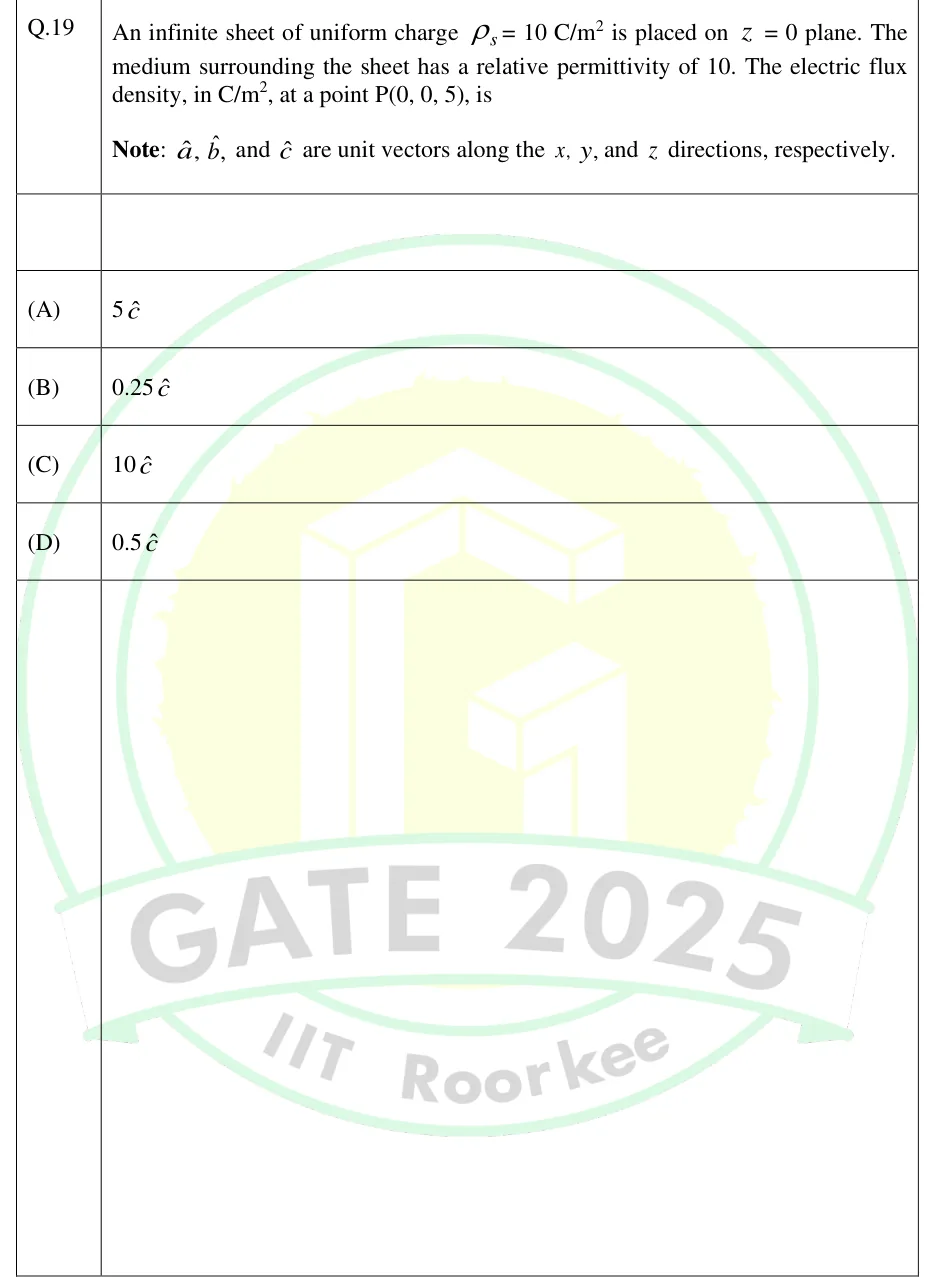
An infinite sheet of uniform charge is placed on plane. The medium surrounding the sheet has a relative permittivity of 10. The electric flux density, in , at a point , is

Note: , , and are unit vectors along the , , and directions, respectively.

  1. (A)

  2. (B)

  3. (C)

  4. (D)

See the question in the paper

Answer and solution

ANSWER

Option (A): . An infinite sheet gives , directed along at , and this does not depend on the relative permittivity.

Official answer: ASource: Official answer key, GATE 2025 IN (IIT Roorkee)

  1. Gauss's law over a pillbox. Take a cylindrical pillbox of face area that straddles the sheet. By symmetry is normal to the sheet and, because the sheet is positively charged, points away from it on both sides. runs parallel to the curved wall, so that wall carries no flux and only the two flat faces count:

  2. Field of an infinite sheet. So . It is the same at every distance from the sheet, so the height of the point does not change the magnitude.

  3. The permittivity does not appear. Gauss's law written for uses only the free charge, so does not depend on . Only depends on the medium: , where . Multiplying back, , and the cancels.

  4. Magnitude. .

  5. Direction. is on the side of the sheet, and the sheet is positively charged, so at points away from the sheet, along , which is . Therefore This is option (A).

KEY IDEA

Gauss's law for uses only the free charge enclosed. For an infinite sheet, whatever the medium and whatever the distance from the sheet. The permittivity changes only .

WATCH OUT FOR

Dividing by to get (option D), or by again to get (option B). Both mix up with , and only depends on the medium. A third mistake is to forget that the flux leaves through both faces of the pillbox and write (option C). is the result for a conductor surface, where the field on the inside is zero.

From the GATE 2025 IN paper. Every question of this paper · Download the full paper · All 23 Electrostatics questions, with notes

More Electrostatics questions