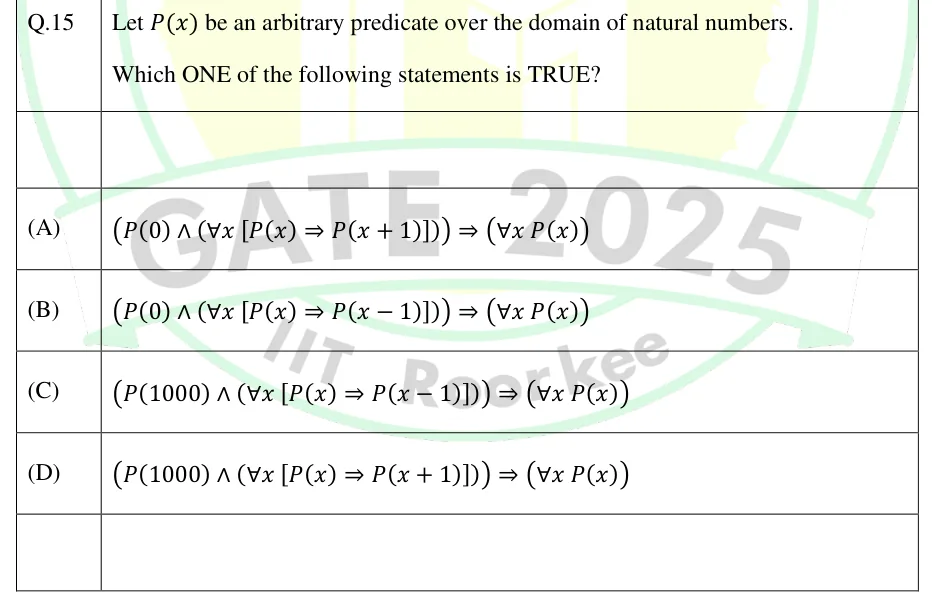
Let be an arbitrary predicate over the domain of natural numbers.
Which ONE of the following statements is TRUE?
- (A)
- (B)
- (C)
- (D)

Let be an arbitrary predicate over the domain of natural numbers.
Which ONE of the following statements is TRUE?
ANSWER
The true statement is (A), the principle of mathematical induction.
Official answer: ASource: Official answer key, GATE 2025 CS2 (IIT Roorkee)
Mathematical induction over the natural numbers says: if holds and holds, then holds.
Option (A) is exactly this principle, with base case and an upward step . It is true for every predicate over the naturals.
Option (B): the step goes downward. Take true only for . Then holds. For , is false, so is true. For , has a true premise, but is not a natural number, so the step is only a claim over the naturals. Reading the step as ranging over (the only values for which is a natural number), the hypothesis holds while is false. So (B) is not true for every predicate.
Option (C): take . Then holds. For , holds, since implies . The hypothesis therefore holds, but is false, so fails.
Option (D): take . Then holds, and holds for every . But is false, so fails.
Only (A) holds for every predicate .
KEY IDEA
A statement about an arbitrary predicate is TRUE only if it holds for every predicate. Induction needs a base case at the start of the naturals (0) and a step that goes upward.
WATCH OUT FOR
Choosing (D) or (C) because a base case and a step are present. A base case at 1000 reaches only the values above 1000 with an upward step, and only the values below it with a downward step. A downward step from 0 reaches nothing new.
From the GATE 2025 CS2 paper. Every question of this paper · Download the full paper · All 7 Mathematical logic questions, with notes