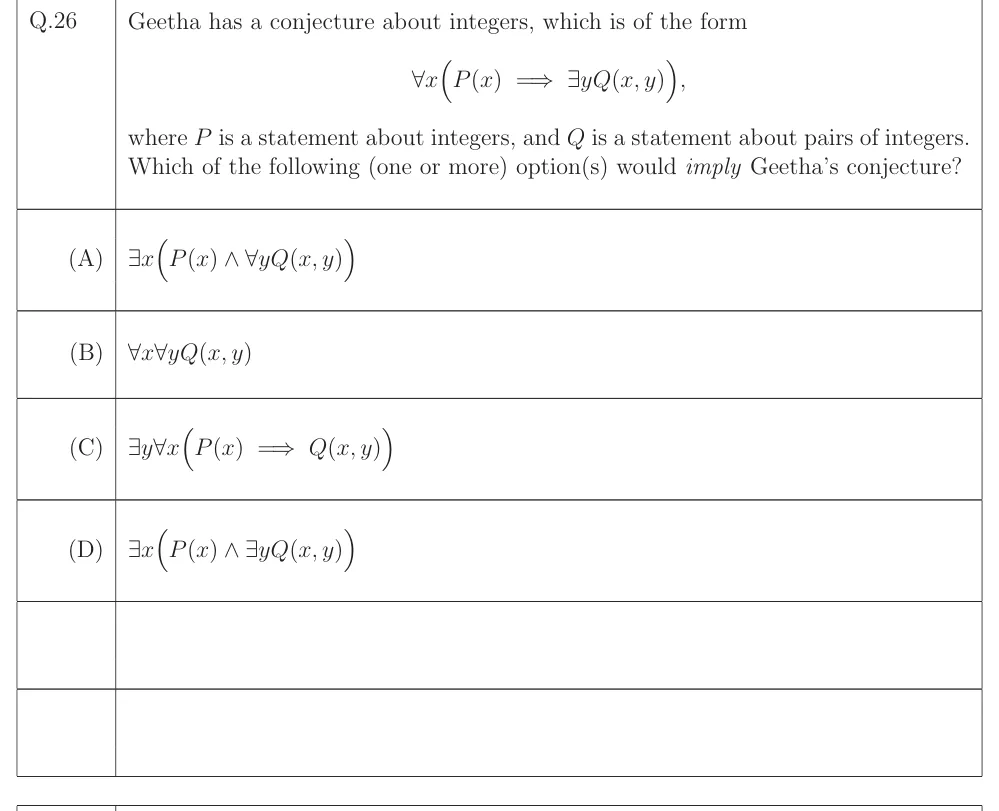
Geetha has a conjecture about integers, which is of the form
where is a statement about integers, and is a statement about pairs of integers. Which of the following (one or more) option(s) would imply Geetha's conjecture?
- (A)
- (B)
- (C)
- (D)

Geetha has a conjecture about integers, which is of the form
where is a statement about integers, and is a statement about pairs of integers. Which of the following (one or more) option(s) would imply Geetha's conjecture?
ANSWER
The options that imply the conjecture are (B) and (C).
Official answer: B, CSource: Official answer key, GATE 2023 CS (IIT Kanpur)
The conjecture is . A statement implies it only if, whenever it is true, every with has some with .
(A) talks about one only. Counter-model: take integers, true for all , and true exactly when . Then (A) holds with , but for there is no with , so the conjecture fails. (A) does not imply it.
(B) : fix any . Since the integers are non-empty, take . Then holds, so holds for every . Hence is true for every . (B) implies the conjecture.
(C) : fix a witness with for all . Take any with . Then holds, so . Hence . This is the valid rule that implies . (C) implies the conjecture.
(D) again names only one . Counter-model: true for all , true exactly when . (D) holds with , but has no with , so the conjecture fails. (D) does not imply it.
Correct options: (B) and (C).
KEY IDEA
To imply a statement of the form , a premise must give a witness for every with . and both do. A premise about only one (an statement) cannot.
WATCH OUT FOR
Choosing (A) or (D) because they look like the conjecture, when an premise says nothing about the other . Also doubting (C) because its quantifier order differs: is stronger than , so it implies it.
From the GATE 2023 CS paper. Every question of this paper · Download the full paper · All 7 Mathematical logic questions, with notes