IAE Academy

GATE 2024 CS2 Q.12: solution and answer

GATE 2024 · CS2Q.12 · 1 mark · MCQ

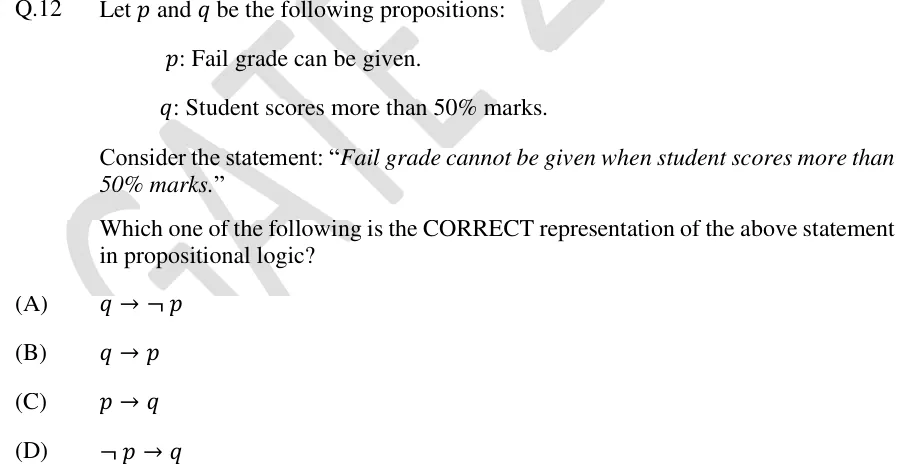
Let and be the following propositions:

: Fail grade can be given.

: Student scores more than 50% marks.

Consider the statement: "Fail grade cannot be given when student scores more than 50% marks."

Which one of the following is the CORRECT representation of the above statement in propositional logic?

  1. (A)

  2. (B)

  3. (C)

  4. (D)

See the question in the paper

Answer and solution

ANSWER

The statement is represented by , which is option (A).

Official answer: ASource: Official answer key, GATE 2024 CS2 (IISc Bengaluru)

  1. Read "X when Y" as "if Y, then X", so the clause after "when" is the hypothesis: .

  2. The hypothesis is "student scores more than 50% marks", which is .

  3. The conclusion is "fail grade cannot be given". This is the negation of ("fail grade can be given"), so it is .

  4. Combine them: , which is option (A).

  5. Check the other options. (B) says a student scoring above 50% does get a fail grade, which is the opposite of the statement. (C) says a fail grade implies a score above 50%, which reverses the direction and drops the negation. (D) says no fail grade implies a score above 50%, which is also not the statement. A counter-model for (C) and (D): take true and false, meaning a fail grade is given to a student at or below 50%. The original statement holds ( is false, so is true), but is false. Take false and false: the original statement holds, but is false.

  6. Equivalent forms of (A): . A fail grade and a score above 50% never occur together.

KEY IDEA

"X when Y" means : the clause after "when" is the hypothesis. "Cannot be given" negates the proposition and puts in the conclusion.

WATCH OUT FOR

Reading "fail grade cannot be given when student scores more than 50%" in the order the words appear, as or . Another slip is forgetting that "cannot" requires , which gives .

From the GATE 2024 CS2 paper. Every question of this paper · Download the full paper · All 7 Mathematical logic questions, with notes

More Mathematical logic questions