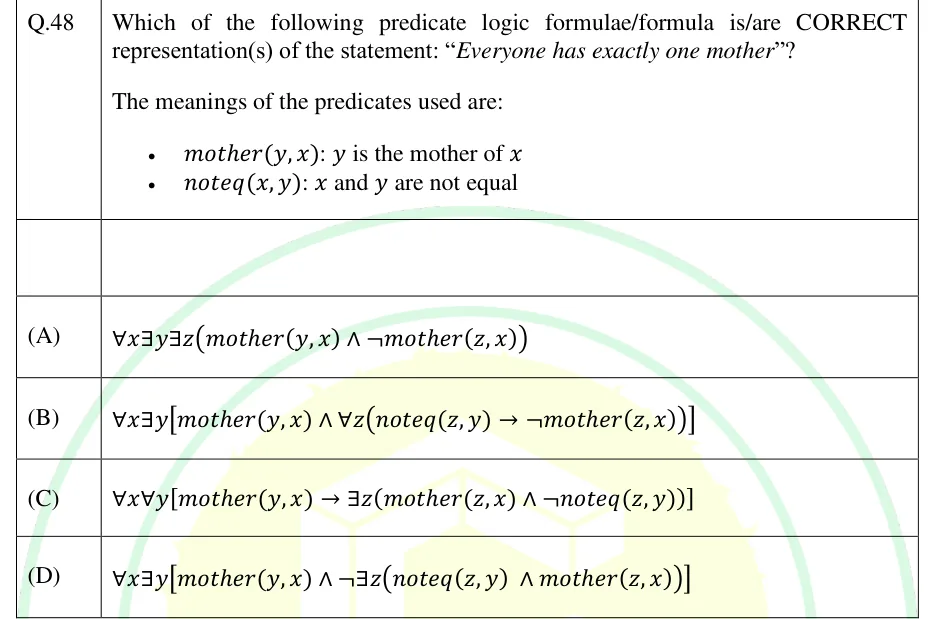
Which of the following predicate logic formulae/formula is/are CORRECT representation(s) of the statement: "Everyone has exactly one mother"?
The meanings of the predicates used are:
- : is the mother of
- : and are not equal
- (A)
- (B)
- (C)
- (D)

Which of the following predicate logic formulae/formula is/are CORRECT representation(s) of the statement: "Everyone has exactly one mother"?
The meanings of the predicates used are:
- : is the mother of
- : and are not equal
ANSWER
The correct options are B and D.
Official answer: B, DSource: Official answer key, GATE 2025 CS1 (IIT Roorkee)
"Exactly one mother" for every means two things: existence (some is a mother of ) and uniqueness (nobody other than is a mother of ). Target form: .
(A) says only that has some mother and that some is not a mother of . The second part is true in any world with at least two people, even if has ten mothers (take as one mother and as a non-mother). Uniqueness is not captured, so (A) is incorrect.
(B) is exactly the target form: is a mother of , and every different from is not a mother of . Correct.
(C) . Here means , so the consequent is , which is . The formula reduces to , a tautology. A person with no mother satisfies it vacuously, and so does a person with two mothers. It does not express "exactly one", so (C) is incorrect.
(D) . Use , then . This gives , which is the same as the inner part of (B). So (D) is equivalent to (B). Correct.
Hence the correct options are B and D.
KEY IDEA
"Exactly one" means existence plus uniqueness: some is the mother, and every different from is not. Writing uniqueness as or as gives equivalent formulas.
WATCH OUT FOR
Choosing (A) because it looks like "one mother and others are not mothers". Its only says some is not a mother, which does not limit the number of mothers. Another slip is reading in (C) as a real restriction, when it just means and makes the formula a tautology.
From the GATE 2025 CS1 paper. Every question of this paper · Download the full paper · All 7 Mathematical logic questions, with notes