
IAE Academy

GATE 2023 IN Q.16: solution and answer

GATE 2023 · INQ.16 · 1 mark · MCQ

The table shows the present state Q(t), next state Q(t+1), and the control input in a flip-flop. Identify the flip-flop.

| Q (t) | Q (t+1) | Input |
|---|---|---|
| 0 | 0 | 0 |
| 0 | 1 | 1 |
| 1 | 0 | 1 |
| 1 | 1 | 0 |
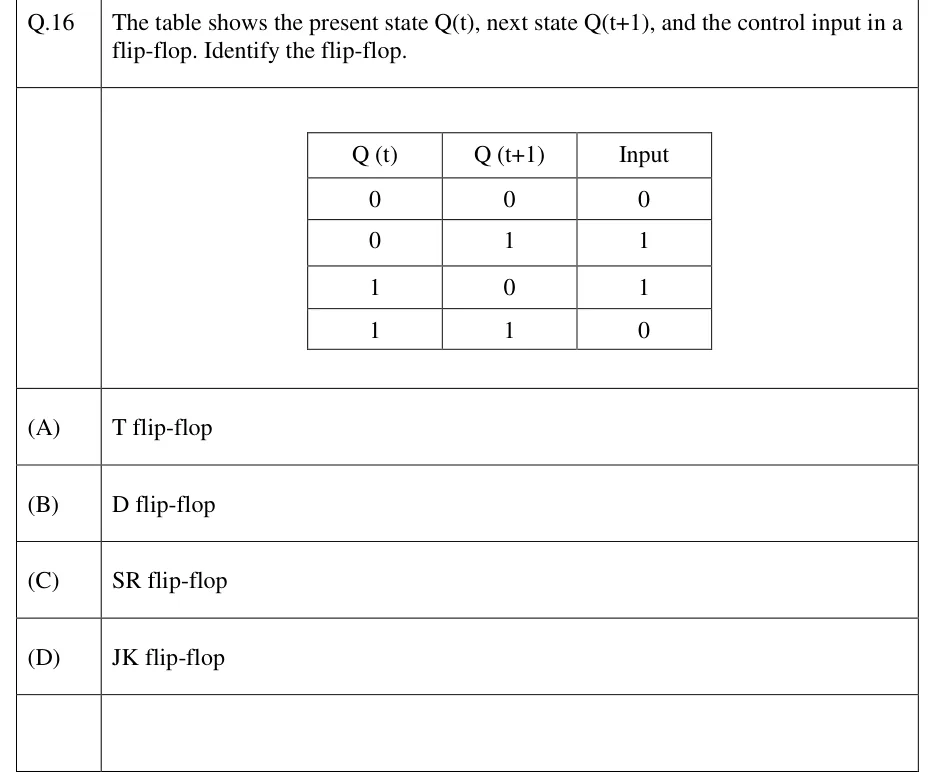
GATE 2023 IN question 16: A table with three columns headed Q (t), Q (t+1) and Input, and four rows: (Q(t), Q(t+1), Input) = (0, 0, 0), (0, 1, 1)…Tap to open full size
Figure from the GATE 2023 IN paper. It is part of the question.
Figure description

A table with three columns headed Q (t), Q (t+1) and Input, and four rows: (Q(t), Q(t+1), Input) = (0, 0, 0), (0, 1, 1), (1, 0, 1), (1, 1, 0).

  1. (A)

    T flip-flop

  2. (B)

    D flip-flop

  3. (C)

    SR flip-flop

  4. (D)

    JK flip-flop

Answer and solution

ANSWER

The table matches : the state holds when the input is 0 and toggles when it is 1. That is a T flip-flop, option (A).

Official answer: ASource: Official answer key, GATE 2023 IN (IIT Kanpur)

  1. The table has only one control-input column, so the device is a single-input flip-flop: T or D. SR and JK flip-flops each have two control inputs ( or ), so a one-column table cannot describe them. This rules out (C) and (D).

  2. Read the rows where the input is : the state holds, and .

  3. Read the rows where the input is : the state flips, and .

  4. Holding on and toggling on is the defining behaviour of the T flip-flop. Its characteristic equation is .

  5. Check every row against : row 1, ; row 2, ; row 3, ; row 4, . All four rows match.

  6. Rule out D, whose characteristic equation is . In row 3 the input is but , and in row 4 the input is but . So the next state does not simply copy the input, and the device cannot be a D flip-flop.

  7. The flip-flop is a T flip-flop, option (A).

KEY IDEA

Look for the pattern that links the input to the change of state. A T flip-flop holds when and toggles when , so . A D flip-flop copies its input, so .

WATCH OUT FOR

Picking D because the input equals in the first two rows. Rows 3 and 4 break that pattern. The input actually equals , which means it tells the flip-flop whether to change state. That is the T flip-flop's excitation rule.

From the GATE 2023 IN paper. Every question of this paper · Download the full paper · All 30 Sequential questions, with notes

More Sequential questions