
IAE Academy

GATE 2024 IN Q.45: solution and answer

GATE 2024 · INQ.45 · 2 marks · MCQ

The transfer function of a system is

Choose the range of and (in rad/s) from the following options such that the poles lie on the shaded region of the -plane as shown in the figure.
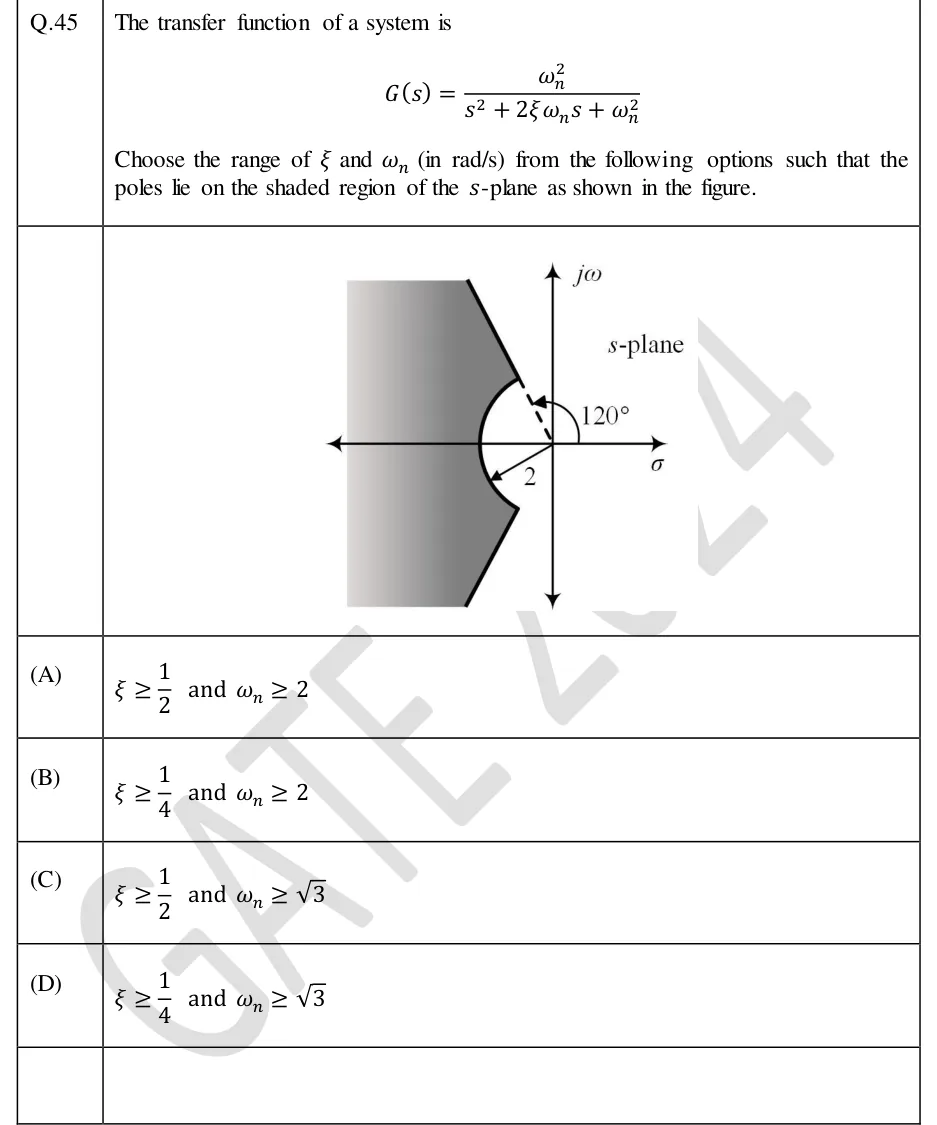
GATE 2024 IN question 45: An s-plane with a vertical jω axis and a horizontal σ axis, both drawn with arrows, and the label 's-plane' in the first…Tap to open full size
Figure from the GATE 2024 IN paper. It is part of the question.
Figure description

An s-plane with a vertical jω axis and a horizontal σ axis, both drawn with arrows, and the label 's-plane' in the first quadrant. A dashed line runs from the origin into the second quadrant at 120° from the positive σ axis, and an arc marked 120° runs from the positive σ axis to it. The dashed line ends where it meets a solid circular arc of radius 2 centred at the origin. From there a solid ray continues outward along the same 120° direction. The arc runs through the left half-plane, crosses the negative real axis at −2, and ends at the mirror-image point in the third quadrant (at 240°, i.e. −120°; this angle is not labelled). From that point a second solid ray runs outward along the 240° direction. The lower ray is not drawn inside the arc. An arrow labelled 2 goes from the origin to the arc a little below the negative real axis, marking the radius. The shaded region lies outside the arc and between the two solid rays, so it contains the negative real axis beyond −2. It extends to the left edge of the figure, and the shading gets lighter towards the left. The region inside the arc near the origin is unshaded, and so is everything to the right of the rays.

  1. (A)

    and

  2. (B)

    and

  3. (C)

    and

  4. (D)

    and

Answer and solution

ANSWER

Option (A): and .

Official answer: ASource: Official answer key, GATE 2024 IN (IISc Bengaluru)

  1. Pole geometry. For the poles of are Their distance from the origin is If is the angle each pole makes with the negative real axis, then . So on the -plane sets the radius and sets the angle. At both poles sit at with , which fits the same picture. The figure's rays and arc are drawn in exactly these radius and angle terms.

  2. Read the boundary rays. The rays are at from the positive axis. Measured from the negative real axis, that is , above and below the axis.

  3. Damping condition. The shaded region lies between the two rays and contains the negative real axis, so every pole in it has . Since decreases on ,

  4. Natural-frequency condition. The shaded region lies outside the arc of radius 2, so . Because , this gives .

  5. Combine the conditions and check the other options. Together the conditions are and , which is option (A). Option (B) allows , which gives , so the poles would fall outside the wedge. Options (C) and (D) allow values such as , between and , which puts the poles inside the arc, in the unshaded region.

  6. Where comes from. The corner where the upper ray meets the arc is . The number is that point's height above the real axis, not its distance from the origin. The distance, which is what measures, is .

KEY IDEA

For a complex pole pair of the standard second-order system, , so circles centred at the origin are lines of constant . The angle from the negative real axis is , so rays from the origin are lines of constant . A wedge of half-angle around the negative real axis therefore means , and the region outside a circle of radius means .

WATCH OUT FOR

One mistake is to use the marked directly, which gives . The damping angle has to be measured from the NEGATIVE real axis, which makes it and gives . The other mistake is to take the corner point's imaginary part , from , as the bound on (options C and D). The bound is the radius, 2, not the height. The value in option B matches no boundary in the figure: , which lies outside the wedge.

From the GATE 2024 IN paper. Every question of this paper · Download the full paper · All 22 Time response questions, with notes

More Time response questions