IAE Academy

GATE 2022 IN Q.41: solution and answer

GATE 2022 · INQ.41 · 2 marks · MCQ

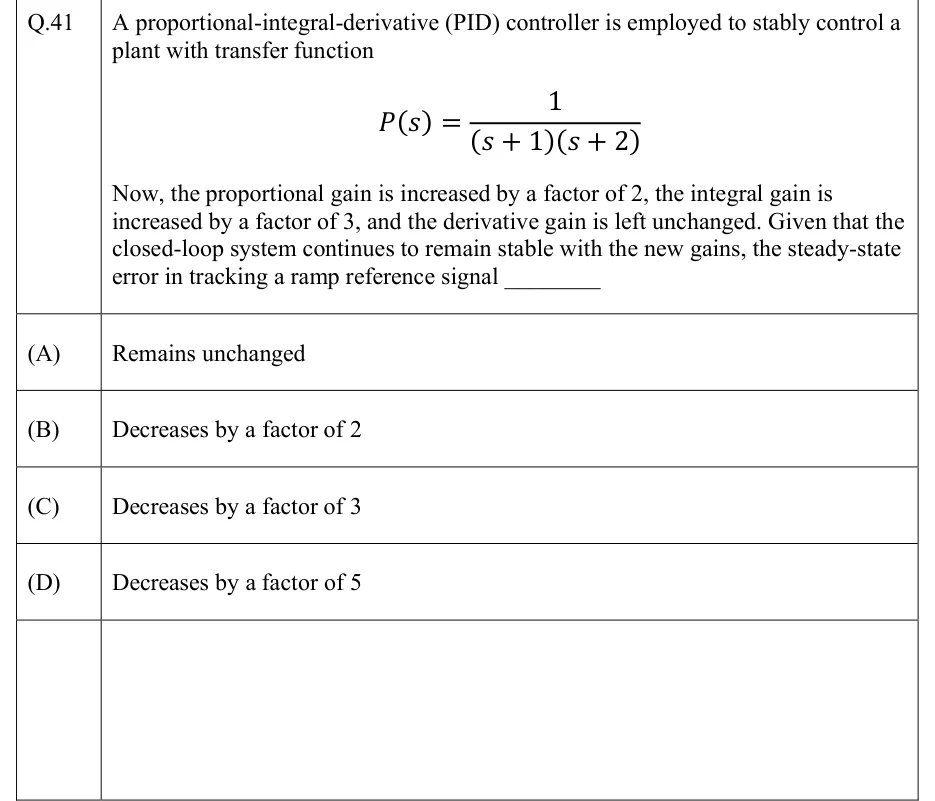
A proportional-integral-derivative (PID) controller is employed to stably control a plant with transfer function

Now, the proportional gain is increased by a factor of 2, the integral gain is increased by a factor of 3, and the derivative gain is left unchanged. Given that the closed-loop system continues to remain stable with the new gains, the steady-state error in tracking a ramp reference signal ________

  1. (A)

    Remains unchanged

  2. (B)

    Decreases by a factor of 2

  3. (C)

    Decreases by a factor of 3

  4. (D)

    Decreases by a factor of 5

See the question in the paper

Answer and solution

ANSWER

(C) Decreases by a factor of 3. The ramp error is , which depends only on the integral gain, and that gain is tripled.

Official answer: CSource: Official answer key, GATE 2022 IN (IIT Kharagpur)

  1. Take the standard unity-feedback loop with the PID controller in series with the plant. The controller is .

  2. Open-loop transfer function: The integral term puts one pole at the origin, so the loop is type 1, provided (and must be nonzero here because the question multiplies it by 3).

  3. A stable type-1 loop follows a ramp with a finite steady-state error , where is the velocity error constant.

  4. Compute : The and terms vanish as , so only is left.

  5. So . The ramp error depends only on the integral gain, not on or .

  6. With the new gains , , : Doubling changes the transient response, not the ramp error. The question says the loop stays stable, so the final value theorem still applies and the error really does settle to this value.

  7. The steady-state error in tracking a ramp decreases by a factor of 3, which is option (C).

KEY IDEA

With a PID controller the loop is type 1, and its velocity error constant is . At the proportional and derivative terms drop out, so the steady-state ramp error is inversely proportional to alone.

WATCH OUT FOR

Thinking every gain increase reduces the error. Some students multiply the factors (2 x 3 = 6, not an option) or add them (2 + 3 = 5, which gives option D). Others take as the gain that sets the ramp error and pick option (B). In a PID loop, and vanish from , so only the factor of 3 on matters.

From the GATE 2022 IN paper. Every question of this paper · Download the full paper · All 22 Time response questions, with notes

More Time response questions