IAE Academy

CONTROL SYSTEMS · TIME RESPONSE

GATE 2020 EE, question 34: Time response — solution and answer

GATE 2020 · EEQ.34 · 2 marks · MCQ Checked against the official key

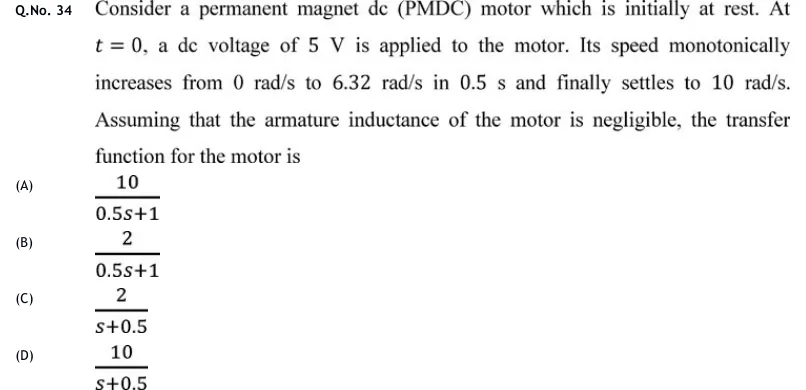
Consider a permanent magnet dc (PMDC) motor which is initially at rest. At , a dc voltage of is applied to the motor. Its speed monotonically increases from to in and finally settles to . Assuming that the armature inductance of the motor is negligible, the transfer function for the motor is

  1. (A)

  2. (B)

  3. (C)

  4. (D)

See it as printed in the paper

Answer and worked solution

ANSWER

The motor transfer function is , which is option (B).

Official key: B · Official answer key printed with the GATE 2020 EE paper (IIT Delhi)

  1. With armature inductance neglected, the electrical time constant drops out and the PMDC motor's speed-to-voltage transfer function is first order: . A monotonic rise with no overshoot is what a first-order response looks like.

  2. For a step input of , , and the first-order step response is .

  3. Steady state, using the final value theorem: . Setting this equal to gives .

  4. Time constant: . So , which means is exactly one time constant: .

  5. Therefore which is option (B).

  6. Checking the other options: (C) has DC gain and . (D) has DC gain and . (A) has the right time constant, but its DC gain is , so a step would settle at , not .

KEY IDEA

If armature inductance is negligible, a PMDC motor behaves as a first-order system . Its DC gain is the final speed divided by the step voltage (). Its time constant is the time taken to reach of the final value ().

COMMON MISTAKE

Using the final speed () as the gain and forgetting to divide by the input, which gives option (A). Another mistake is reading the pole form as if were the time constant. In fact and the DC gain is , so has and DC gain .

From the GATE 2020 EE paper. Every question of this paper · Download the full paper · All 22 Time response questions, with notes

More Time response questions