
IAE Academy

GATE 2018 EE Q.46: solution and answer

GATE 2018 · EEQ.46 · 2 marks · NAT

The unit step response of a unity feedback system with open loop transfer function is shown in the figure. The value of is _______ (up to 2 decimal places).
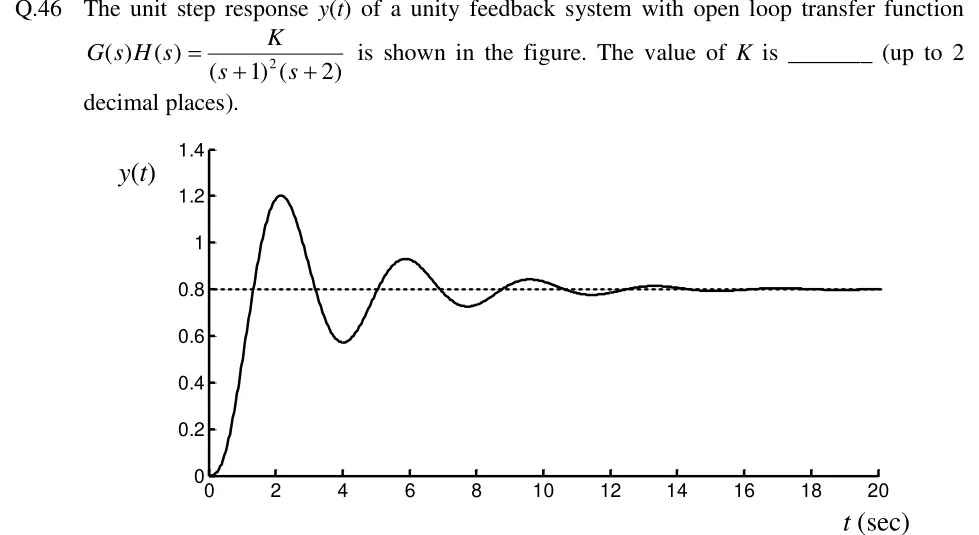
GATE 2018 EE question 46: Plot of y(t) (vertical axis, 0 to 1.4 in steps of 0.2) against t (sec) (horizontal axis, 0 to 20 in steps of 2).Tap to open full size
Figure from the GATE 2018 EE paper. It is part of the question.
Figure description

Plot of y(t) (vertical axis, 0 to 1.4 in steps of 0.2) against t (sec) (horizontal axis, 0 to 20 in steps of 2). The response starts at 0 and rises to a first peak of about 1.2 at t ≈ 2.2 s, falls to a minimum of about 0.57 at t ≈ 4 s, peaks again near 0.93 at t ≈ 5.9 s, dips to about 0.72 near t ≈ 7.7 s, peaks near 0.84 at t ≈ 9.6 s, and so on: a decaying oscillation that settles by t ≈ 16–20 s. A horizontal dashed line at y = 0.8 marks the steady-state value.

Answer and solution

ANSWER

. The step response settles at , and for this type-0 unity-feedback loop , so gives . That value is inside the stable range .

Official answer: 8.0Source: Official answer key, GATE 2018 EE (IIT Guwahati)

  1. Read the steady-state value off the graph. The dashed line the response settles onto is at , not 1, so the closed loop has a steady-state error to a unit step.

  2. The open loop has no pole at , so the system is type 0. Its position error constant is

  3. With unity feedback and a unit step input, . The final value theorem gives the same thing directly: the closed loop is , so

  4. Set this equal to the value read from the graph:

  5. Check stability, because the final value theorem only holds for a stable closed loop. Expanding , the characteristic equation is . For a cubic the Routh condition is with all coefficients positive, so , which gives . lies inside this range, so the loop is stable and the final value theorem applies.

  6. Check against the shape of the curve. With the characteristic equation factors approximately as . The complex pair is , so and the oscillation period is . That matches the spacing of the peaks at about 2.2, 5.9 and 9.6 s. The slow decay, set by the real part , fits the ringing lasting until about 16 s.

  7. Answer: .

KEY IDEA

Only one number on the graph matters: the steady-state value. For a stable unity-feedback loop, for a unit step. Here , so fixes . The overshoot and ringing are there to distract you, or at most to confirm the answer afterwards.

WATCH OUT FOR

1) Reading the 1.2 peak and trying to extract from percent overshoot with second-order formulas. The system is third order, and the overshoot has to be measured from 0.8, not from 1. 2) Taking instead of , forgetting the factor , which gives . 3) Assuming the response settles at 1, the usual unit-step reflex. A type-0 loop always leaves a steady-state error. 4) Skipping the stability check. The final value theorem is only valid if is in the stable range, here .

From the GATE 2018 EE paper. Every question of this paper · Download the full paper · All 22 Time response questions, with notes

More Time response questions