
IAE Academy

GATE 2020 EE Q.13: solution and answer

GATE 2020 · EEQ.13 · 1 mark · MCQ

Which of the options is an equivalent representation of the signal flow graph shown here?
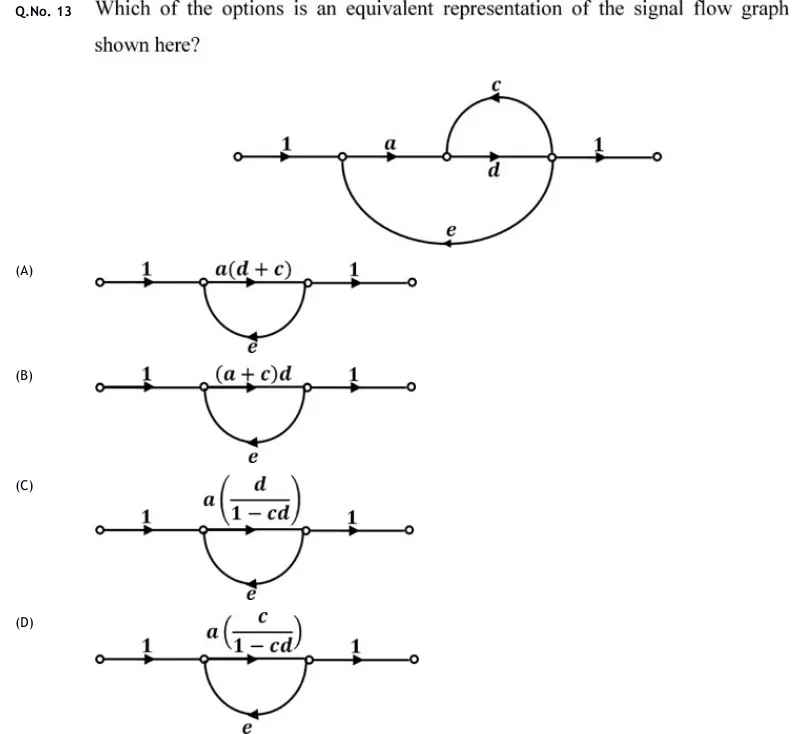
GATE 2020 EE question 13: Signal flow graph with five nodes on a horizontal line: input node x_0, then x_1, x_2, x_3, output node x_4.Tap to open full size
Figure from the GATE 2020 EE paper. It is part of the question.
Figure description

Signal flow graph with five nodes on a horizontal line: input node x_0, then x_1, x_2, x_3, output node x_4. Forward branches: x_0 → x_1 gain 1; x_1 → x_2 gain a; x_2 → x_3 gain d (straight branch); x_3 → x_4 gain 1. Branch c: an arc drawn above the line from x_3 back to x_2 (arrowhead at the top points left, so it is a feedback branch x_3 → x_2). Branch e: a large arc drawn below the line from x_3 back to x_1 (arrowhead at the bottom points left, so it is a feedback branch x_3 → x_1). Each option is a four-node graph: input 1 node P G node Q 1 output, with a branch e drawn below from Q back to P; the options differ only in the forward gain G.

  1. (A)

    Figure — input P Q output, feedback branch from Q to P

  2. (B)

    Figure — input P Q output, feedback branch from Q to P

  3. (C)

    Figure — input P Q output, feedback branch from Q to P

  4. (D)

    Figure — input P Q output, feedback branch from Q to P

Answer and solution

ANSWER

Option (C) is correct. The – pair is a forward branch with positive feedback around it, so it collapses to . In series with this gives from to , and branch is left as feedback around . Both graphs give .

Official answer: CSource: Official answer key, GATE 2020 EE (IIT Delhi)

  1. Read the arrowheads. Enlarged, the figure shows the arrowhead on arc at its top pointing left, so runs from back to . The arrowhead on arc at its bottom also points left, so runs from back to . Both are feedback branches, which means is not in parallel with .

  2. Remove node using its node equations. Signals entering come from and , and its only outgoing branch is : Substituting gives , so Seen as a rule, this is a forward branch with feedback branch around it. Their loop gain is positive (signal-flow-graph gains never change sign), so the pair reduces to one branch in series with .

  3. Series rule. The single branch from to therefore has gain

  4. What is left. Nodes and both survive, and their equations are unchanged: and . So branch still runs from back to and wraps around . That is exactly the graph drawn in option (C).

  5. Check with Mason's gain formula on the original graph. There is one forward path, . There are two loops: (through ) and (through ). They share nodes and , so there is no non-touching pair. That gives . The forward path touches both loops, so .

  6. Option (C): This matches. The other options do not: (A) gives , (B) gives , and (D) gives . None of these equals . The answer is (C).

KEY IDEA

In a signal flow graph, a forward branch with a feedback branch around it forms a loop of gain . Branch gains simply multiply, with no minus sign, so the pair reduces to and not . Removing a node such as never touches the branches between the nodes that remain, so from to survives unchanged.

WATCH OUT FOR

Not checking which way arrow points. If you read as a second forward branch alongside , you add them and get , which is option (A). There are two smaller slips. One is using the block-diagram negative-feedback form . The other is putting in the numerator instead of , which gives option (D). In a signal flow graph the numerator must be the forward branch, and the loop gain always goes in as .

From the GATE 2020 EE paper. Every question of this paper · Download the full paper · All 10 Block diagrams & SFG questions, with notes

More Block diagrams & SFG questions