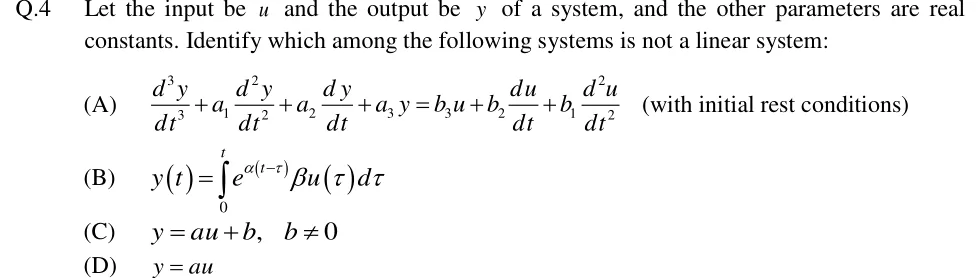
Let the input be and the output be of a system, and the other parameters are real constants. Identify which among the following systems is not a linear system:
- (A)
(with initial rest conditions)
- (B)
- (C)
- (D)

Let the input be and the output be of a system, and the other parameters are real constants. Identify which among the following systems is not a linear system:
(with initial rest conditions)
ANSWER
(C) with is not linear. It gives when , so superposition fails. (A), (B) and (D) all satisfy superposition.
Official answer: CSource: Official answer key, GATE 2018 EC (IIT Guwahati)
The test is superposition. A system is linear only if it is additive and homogeneous: an input must give the output . Setting gives a quick necessary check: zero input must give zero output.
(A) This is a linear ODE with constant coefficients. Every term is first-degree in , or one of their derivatives, and no term multiplies two of them together. Initial rest means all initial conditions are zero, so there is no stored-energy (zero-input) term, and the output depends linearly on the input. So (A) is linear.
(B) This is a convolution integral, , with kernel . The kernel does not depend on . Integration is linear, so the input gives . So (B) is linear.
(D) is a pure gain: . So (D) is linear.
(C), zero-input test. Put . Then . A linear system must give for zero input, so (C) fails.
(C), additivity check. Input gives and input gives . Input gives Superposition fails. The graph of against is a straight line, but it does not pass through the origin, so the map is affine, not linear.
(C) is the only system that is not linear. Answer: (C).
KEY IDEA
A linear system must obey superposition (additivity plus homogeneity). A necessary consequence is that zero input gives zero output. A constant offset breaks this, so is affine, not linear. A constant-coefficient ODE at initial rest and a convolution integral are both linear.
WATCH OUT FOR
Calling linear because its graph is a straight line. A straight line through the origin is linear; any other straight line is affine. A second trap is doubting (A) because it contains derivatives of . Derivatives are linear operators, and initial rest removes any zero-input response, so (A) is linear.
From the GATE 2018 EC paper. Every question of this paper · Download the full paper · All 10 Block diagrams & SFG questions, with notes