
IAE Academy

GATE 2022 EE Q.17: solution and answer

GATE 2022 · EEQ.17 · 1 mark · MCQ

The Bode magnitude plot of a first order stable system is constant with frequency. The asymptotic value of the high frequency phase, for the system, is . This system has
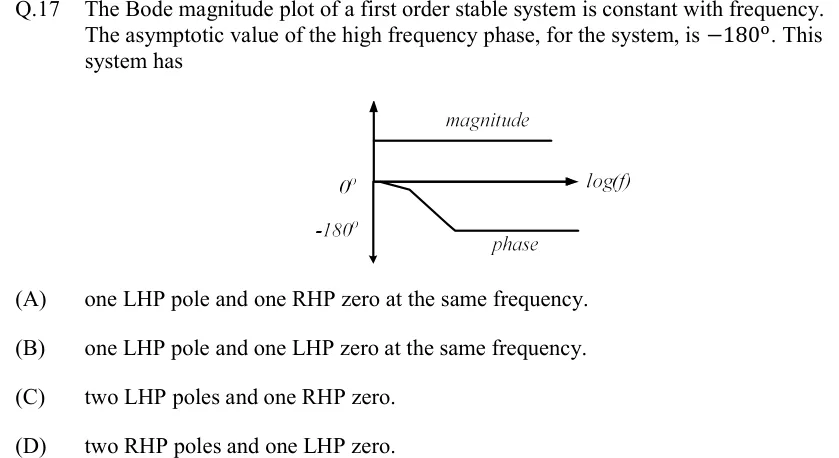
GATE 2022 EE question 17: Sketch of a Bode plot.Tap to open full size
Figure from the GATE 2022 EE paper. It is part of the question.
Figure description

Sketch of a Bode plot. A vertical axis with arrowheads at both ends carries two labels on its left, 0° (level with the horizontal axis) and -180° (below it). The horizontal axis is labelled log (f). A curve labelled 'magnitude' is a flat horizontal line drawn above the horizontal axis, constant at every frequency. A curve labelled 'phase' starts at 0° on the vertical axis, falls gently for a short stretch, then falls more steeply in a straight line, and then levels off as a flat asymptote at -180° at high frequency.

  1. (A)

    one LHP pole and one RHP zero at the same frequency.

  2. (B)

    one LHP pole and one LHP zero at the same frequency.

  3. (C)

    two LHP poles and one RHP zero.

  4. (D)

    two RHP poles and one LHP zero.

Answer and solution

ANSWER

(A) one LHP pole and one RHP zero at the same frequency. This is the first-order all-pass : its magnitude is at every frequency and its phase goes from to .

Official answer: ASource: Official answer key, GATE 2022 EE (IIT Kharagpur)

  1. First order and stable. A first-order system has exactly one pole, and because the system is stable that pole is in the LHP. Options (C) and (D) both have two poles, so neither is first order, and (D) is unstable as well. That leaves one LHP pole at () and one zero.

  2. Flat magnitude. Let the zero be at with . Then At this is , and as it tends to . It is constant at every frequency only when , so the zero sits at the same corner frequency as the pole. What remains to decide is which half-plane the zero is in.

  3. Case (B), LHP zero: . The pole and zero cancel, so the phase is at every frequency. That contradicts the plot, where the phase falls to .

  4. Case (A), RHP zero (all-pass): with , so

  5. Phase of the all-pass. The numerator has angle . The denominator has angle , and dividing by it subtracts that angle. So

  6. Check the limits. As the phase is . At it is . As it tends to . The magnitude is flat and the phase goes from to , exactly as in the plot. The system therefore has one LHP pole and one RHP zero at the same frequency, which is option (A).

KEY IDEA

A pole and a zero at mirror-image points, and , have equal distances to every point , so the magnitude stays flat. Their angles do not cancel, though. Each one contributes , which gives the first-order all-pass a phase that runs from to . A flat magnitude with a moving phase is the signature of a non-minimum-phase (RHP) zero.

WATCH OUT FOR

Picking (B) because a pole and a zero at the same frequency give a flat magnitude. With both in the LHP they cancel completely, so the phase is also constant at and can never reach . A second error is to assume an RHP zero behaves like an LHP zero in phase. At high frequency an LHP zero adds , but an RHP zero adds .

From the GATE 2022 EE paper. Every question of this paper · Download the full paper · All 27 Bode & margins questions, with notes

More Bode & margins questions