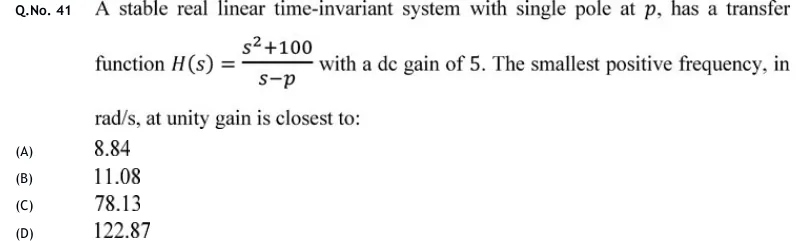
A stable real linear time-invariant system with single pole at , has a transfer function with a dc gain of 5. The smallest positive frequency, in rad/s, at unity gain is closest to:
- (A)
8.84
- (B)
11.08
- (C)
78.13
- (D)
122.87

A stable real linear time-invariant system with single pole at , has a transfer function with a dc gain of 5. The smallest positive frequency, in rad/s, at unity gain is closest to:
8.84
11.08
78.13
122.87
ANSWER
The dc gain gives . Setting gives , so or . The smallest positive unity-gain frequency is , option (A).
Official answer: ASource: Official answer key, GATE 2020 EE (IIT Delhi)
DC gain fixes the pole. Put : . The pole is in the left half-plane, which agrees with the system being stable. So .
Magnitude on the axis. With , the numerator is (real) and the denominator is , so
Unity-gain condition . Square both sides:
Substitute : .
Quadratic formula: which gives or .
Take square roots, since these are values of : or . Check at : and , so the gain is indeed 1.
Pick the smaller root. The gain starts at 5 at , falls to zero at the notch (the zeros ), then rises without bound. It therefore crosses unity once below the notch and once above it. The smallest positive unity-gain frequency is , option (A).
KEY IDEA
Use the dc gain to find the unknown pole. Then set , which is a quadratic in . The zeros at make a notch at , so the gain falls from 5 to 0 and then rises again, and it crosses unity once on each side of the notch. The smaller crossing is the answer.
WATCH OUT FOR
Picking 78.13 (option C) or 122.87 (option D). Those are the roots for , not , and the options are set up to catch anyone who forgets the square root. Another trap is a sign slip in that gives . That pole is unstable and contradicts the problem statement, though it gives the same magnitude, so check the sign against stability.
From the GATE 2020 EE paper. Every question of this paper · Download the full paper · All 27 Bode & margins questions, with notes